

Relative Entropy and Modular Horizon Laws
Relative entropy converts otherwise divergent horizon entropies into finite comparisons and supplies monotonicity without requiring a tensor-product factorization. Its power is conditional: both states must live on the same algebra, and a local geometric modular Hamiltonian exists only in special state–region pairs.
Required background. Fine, coarse, and algebraic entropy fixes the entropy object; relative entropy in QFT supplies the algebraic definition; and Rindler modular flow supplies the geometric case. Helpful background. The supporting toolkit includes positivity and monotonicity, the entanglement first law, modular domains, Tomita–Takesaki flow, relative modular operators, commutants, ball flow, modular spectra, modular intersections, nonlocal generators, the flow convention atlas, and the relative-entropy Bekenstein bound.
Relative entropy on nested horizon algebras
Section titled “Relative entropy on nested horizon algebras”For faithful density matrices, with reference state and ,
Araki’s relative modular operator extends this definition to von Neumann algebras. The two crucial results are positivity and monotonicity: if , then
This is a theorem about a fixed pair of states restricted to nested algebras; it is not an energy condition. At first order around , stationarity of relative entropy gives
while the leading nonzero relative entropy is quadratic and positive Araki 1976, Thms. 3.1–3.2, pp. 815–820.
The order of the states matters: is not symmetric, and it may be infinite if the support or modular-domain conditions fail. Monotonicity compares the same ordered pair after restriction by a normal completely positive map or algebra inclusion. It does not compare unrelated states assigned independently on successive horizon cuts. This prevents a common misuse in which monotonicity is invoked after changing both the state preparation and the accessible algebra.
For a one-parameter family , the vanishing first variation and positive second variation define the quantum Fisher information associated with the reference state. Thus first-law equality is the tangent statement, while relative entropy at quadratic order measures distinguishability and supplies the inequality. Keeping these orders separate is essential in physical-process arguments.
First application: a perturbed Rindler horizon
Section titled “First application: a perturbed Rindler horizon”For the Minkowski vacuum on the right wedge, the modular generator is the boost charge,
This local boost generator is the special wedge-vacuum conclusion of Bisognano and Wichmann 1976, Thm. 3 and Eqs. (4.5)–(4.8).
Take a smooth finite-energy perturbation with . The first law yields . Restricting from an earlier to a later horizon algebra and applying monotonicity controls how distinguishability is lost as degrees of freedom cross the causal horizon.
When the semiclassical Einstein equation and linearized Raychaudhuri equation apply, the same weighted null-energy integral is related to a horizon-area variation. With boundary conditions that remove the late-time homogeneous expansion mode, one obtains a relation of the form
for the appropriate first-order stationary comparison. This is a first-law identity. Monotonic generalized entropy requires the additional nested-algebra argument and its hypotheses Wall 2012, §§2–4.
The structure map shows where the modular theorem enters: finite algebraic comparison precedes any conversion of modular energy into geometry.

Monotonicity is algebraic; its interpretation as a horizon law additionally uses a known modular generator and semiclassical gravitational dynamics. Schematic; not to scale.
Domain and failure conditions
Section titled “Domain and failure conditions”The chapter’s canonical domain table separates modular first laws from the GSL. The decisive data here are the ordered pair of states, one specified algebra or inclusion, modular-domain control, and—only for a geometric interpretation—a known local .
Adversarial test. For a generic curved region or excited reference state, replace by the Rindler boost integral. The substitution has no theorem behind it: the true modular generator is generally nonlocal. Positivity of relative entropy survives, but the proposed local energy bound and horizon-flux interpretation do not.
Even in a wedge, the normalization and orientation of boosts must match the chosen algebra and state. Reversing the wedge or using the commutant reverses geometric flow conventions; checking that generates the correct future-directed modular action is a useful sign test before converting it into a stress integral.
The failure map emphasizes this downgrade from a geometric equation to an abstract operator-algebra inequality.
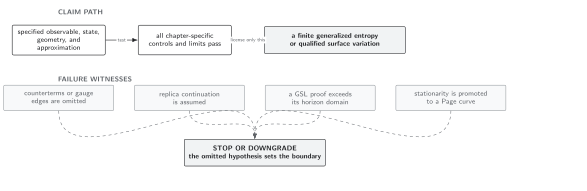
Relative entropy remains defined when geometric modular flow is absent, but the local boost-energy formula must then be withdrawn. Schematic; not to scale.
References
Section titled “References”- Araki, H., “Relative Entropy of States of von Neumann Algebras,” Publications of the Research Institute for Mathematical Sciences 11, 809–833 (1976), doi:10.2977/prims/1195191148.
- Bisognano, J. J., and E. H. Wichmann, “On the Duality Condition for a Hermitian Scalar Field,” Journal of Mathematical Physics 17, 303–321 (1976), doi:10.1063/1.522898.
- Wall, A. C., “A Proof of the Generalized Second Law for Rapidly Changing Fields and Arbitrary Horizon Slices,” Physical Review D 85, 104049 (2012), doi:10.1103/PhysRevD.85.104049.
Original QFT.org content:CC BY 4.0, unless an item supplies different terms. Third-party material retains its own terms.