

Large-N, Species, and Cutoff Hierarchies
Large can improve semiclassical control while simultaneously lowering the scale at which gravity resolves many species. These statements refer to different limits. A valid comparison must say whether bare or renormalized gravitational parameters, the number and masses of active species, and the physical background are held fixed.
Required background. Cross-expansion hierarchies supplies the multi-parameter ordering; heavy thresholds and the species cutoff supplies matching; large-N limits and normalizations supplies limit definitions; and large-N, loop, and ℏ hierarchies supplies semiclassical scaling.
Helpful background. Vacuum energy and the cosmological constant supplies threshold conventions, while species, gauge edges, and contact terms supplies entropy renormalization.
Two different large-N statements
Section titled “Two different large-N statements”For identical weakly coupled matter fields,
when the fields are independent and identically prepared. If the gravitational coupling is scaled as while and the background are fixed, the mean source is and the induced metric covariance scales as . Its rms amplitude is therefore . This is a controlled semiclassical large-N limit for specified linear observables; it does not suppress every collective or critical fluctuation.
At the same time, active species renormalize gravitational couplings and contribute to high-energy amplitudes. Parametrically one often writes
This estimates where species-enhanced gravitational loops or black-hole arguments signal new gravitational behavior. Its order-one coefficient and even the relevant depend on masses, regulator-independent matching data, background, and the observable. Dvali and Redi discuss the parametric bound and its assumptions in Dvali and Redi 2008, §§2–4, Eqs. (3)–(16).
The fluctuation suppression assumes weakly correlated species and an observable normalized against the mean geometry. Common interactions or a collective critical mode can make cross-covariances scale as , defeating the central-limit estimate. Likewise, a rare species with a very low threshold can determine the cutoff of one channel even when it hardly changes an inclusive field count. The covariance and threshold spectrum, not alone, decide the hierarchy.
Thresholds and renormalized parameters
Section titled “Thresholds and renormalized parameters”A massive species contributes only according to its threshold relative to the process. Local power-sensitive pieces are absorbed into the renormalized , cosmological constant, and higher-curvature coefficients; a bare quadratic cutoff term is not itself an observable running law. Entanglement-entropy species divergences are likewise tied to renormalization of gravitational and surface terms, so an unrenormalized entropy proportional to cannot be compared directly with a fixed Newton constant.
The first application compares identical massive fields in two limits. In limit A, scale to keep the mean geometry fixed; semiclassical fluctuations shrink. In limit B, hold measured low-energy fixed and add active species; loop enhancements and the inferred gravity cutoff change, so background parameters and Wilson coefficients must be rematched. These are different theories, not contradictory estimates.
For entropy, the comparison must use a generalized entropy with the same renormalized Newton and surface couplings as the effective action. Changing while holding only the area term fixed double-counts the species dependence that has already shifted those couplings.
The structure map separates mean-field control, induced fluctuations, threshold matching, entropy renormalization, and the species scale.

Large-N semiclassical suppression and species-cutoff arguments coexist only after the held-fixed parameters, active thresholds, and renormalized gravitational couplings are declared. Schematic; not to scale.
Fixed-bare versus fixed-renormalized test
Section titled “Fixed-bare versus fixed-renormalized test”Repeat the calculation once at fixed bare coefficients and once at fixed measured low-energy coefficients. Counterterm shifts that grow with change the relation between these limits. Any claimed cutoff, entropy, or fluctuation scaling that does not specify which limit is being taken is rejected.
Also vary a species mass through the physical energy. A correct decouples heavy fields from low-energy nonlocal observables while retaining their matched local threshold effects. See the chapter’s domain and failure conditions.
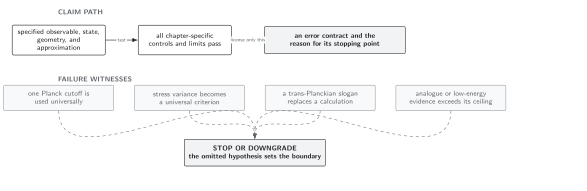
Species and large-N conclusions require threshold-aware matching and an explicit order of limits; raw field counts or bare cutoff terms are insufficient. Schematic; not to scale.
References
Section titled “References”- Dvali, G., and M. Redi, “Black Hole Bound on the Number of Species and Quantum Gravity at LHC,” Physical Review D 77, 045027 (2008), doi:10.1103/PhysRevD.77.045027.
Original QFT.org content:CC BY 4.0, unless an item supplies different terms. Third-party material retains its own terms.