

Mean Semiclassical Backreaction
Mean semiclassical backreaction is a coupled problem: a renormalized quantum state supplies a c-number stress expectation, that source changes the classical metric, and the state must then be propagated on the changed geometry. A calculation is self-consistent only when this loop is causal, constraint preserving, correctly ordered in its approximation parameters, stable within its cutoff, and numerically resolved. A fixed-background stress tensor or mass-loss law is an input to this problem, not already its solution.
Helpful background. Conservation and the backreaction source fixes the renormalized stress tensor; variation and response consistency relates one- and two-point metric variations; and in-out versus in-in expectation values distinguishes transition amplitudes from causal evolution.
Enter the coupled mean-field problem
Section titled “Enter the coupled mean-field problem”The site uses signature and
For a scalar,
so the four-dimensional conformal value is . With ,
On every page the stress convention is
where is the renormalized matter functional appropriate to the declared state and contour. The mean equation is written
with
This definition fixes all curvature-counterterm signs; the finite coefficients and translate when the stress prescription is shifted by a conserved local curvature tensor. The equation is for a classical mean metric and a quantum matter expectation. It is neither an operator Einstein equation nor a statement that stress fluctuations vanish. The standard framework and this division of roles are reviewed by Hu and Verdaguer 2020, Chapters 3–5.
Read the construction map from left to right. Initial state–geometry data determine the renormalized source; the response must be in-in and retarded; constraints and the Bianchi identity are checked before higher-derivative branches are controlled; only then is a jointly solved mean geometry obtained.

Controlled construction of mean semiclassical backreaction. The diagram is schematic and not to scale; its checkpoints require causal response, propagated constraints, a declared higher-derivative prescription, and recognition that mean response does not include all fluctuations.
The failure map supplies the stopping rule. An in-out kernel, drifting constraint, retained runaway, or independently chosen state and geometry changes the conclusion before a small field-equation residual can rescue it.
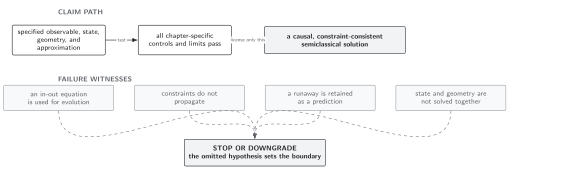
Failure conditions for a mean-field claim. This schematic, not-to-scale map makes the first omitted causal, constraint, EFT, or self-consistency hypothesis the boundary of the result.
Route by the missing control
Section titled “Route by the missing control”| Order | Use this page when the missing ingredient is… |
|---|---|
| 1 | The semiclassical Einstein equation: the renormalized source, finite gravitational couplings, and mean-field interpretation. |
| 2 | Coupled state–geometry initial data: admissible Cauchy data, Hadamard ultraviolet structure, and initial constraints. |
| 3 | In-in effective actions: a real retarded equation and state-dependent memory kernel. |
| 4 | Constraints, conservation, and Bianchi: Ward identities and propagation of Hamiltonian and momentum constraints. |
| 5 | Large-N, loop, and ℏ hierarchies: which mean, connected, matter-loop, and metric-loop terms have actually been retained. |
| 6 | Self-consistent state–geometry solutions: a fixed point or evolution satisfying the sourced equation on its own geometry. |
| 7 | Quantum-state evolution: transport of a Hadamard state while the mean geometry changes. |
| 8 | Higher-derivative initial-value problems: additional branches and initial data introduced by curvature-squared terms. |
| 9 | Order reduction: perturbative removal of above-cutoff branches and its data restriction. |
| 10 | Linear-response stability: physical retarded poles after gauge, constraints, and EFT runaways are removed. |
| 11 | Gauge-invariant response kernels: transverse bi-tensors, contact terms, and invariant perturbation variables. |
| 12 | Cosmological benchmarks: homogeneous adiabatic states, subtraction translation, and expansion backreaction. |
| 13 | Black-hole evaporation: Unruh-state flux, slow mass loss, and the endpoint of adiabatic control. |
| 14 | Numerical self-consistency: independent residuals, convergence directions, and combined uncertainty. |
Domain and failure conditions
Section titled “Domain and failure conditions”This is the canonical comparison table for the chapter. Each leaf links here and states its narrower conditions.
| Strategy or task | Source and state–geometry data | Causality and constraints | Loop, large-N, and higher-derivative treatment | Stability and observable | Numerical uncertainty | Licensed result and breakdown signal |
|---|---|---|---|---|---|---|
| Fixed-background stress calculation | Hadamard state on prescribed ; finite declared | Conservation checked on that background; no metric evolution | Matter loops at stated order; no claim of solved feedback | Local or flux | Mode, subtraction, and discretization errors | A source candidate only. It becomes backreaction only after the sourced geometry and state are solved together. |
| Local semiclassical equation | Compatible Cauchy data for and state | In-in expectation and Bianchi-compatible source | Order in and curvature expansion stated | Mean metric and local stress | Equation and constraint residuals | Mean evolution while curvature, state regularity, and truncation ratios remain controlled. |
| Nonlocal closed-time-path response | Initial density matrix and doubled metric histories | Retarded support plus initial-state terms; Ward identities on both branches | Matter-loop kernel at declared order | Mean memory and dissipation response | Kernel quadrature and memory-tail error | Causal expectation-value equation. A Feynman in-out kernel downgrades it to a transition-amplitude equation. |
| Large-N matter saddle | species and scaling of fixed | Same causal and constraint tests as finite | fixed; connected stress and metric corrections ordered in | Mean saddle and response | Sampling or mode errors separate from error | Controlled where connected correlators remain uniformly subleading; secular or critical growth ends the counting. |
| Unreduced curvature-squared equation | Extra initial derivatives specified | Constraints derived for the full higher-order system | Exact treatment retains high-frequency branches | Mathematical solutions of the truncated differential equation | Stiff-solver and branch-resolution error | Not automatically an EFT prediction; excitation near the cutoff requires a completion or a different prescription. |
| Order-reduced EFT equation | Only lower-order initial data admitted | Reduction performed covariantly so constraints remain consistent | Higher derivatives replaced with lower-order equations through fixed order | Low-frequency physical branch | Truncation error plus numerical error | Predicts the perturbative branch; it excludes, rather than approximates, data dominated by a discarded runaway. |
| Retarded linear response | Perturbations of both state and geometry specified | Transverse retarded kernel; pure gauge and constraints projected out | Above-cutoff poles removed according to declared EFT prescription | Growth of gauge-invariant smeared observables | Pole-location, time-window, and discretization errors | Linear stability only within amplitude, frequency, and duration bounds; it does not determine nonlinear endpoints or noise. |
| Homogeneous cosmology | Adiabatic/Hadamard initial state and FLRW data | Continuity equation propagates the Friedmann constraint | Adiabatic order and finite curvature couplings matched | , , and pressure | Momentum cutoff, initial-time, subtraction, and ODE errors | Mean expansion history over a scale-separated interval; state dependence and infrared secular growth require separate control. |
| Slowly evaporating black hole | Collapse/Unruh-like state and spherical boundary data | Outgoing luminosity matched to ingoing negative energy and local conservation | Fixed-background greybody input iterated only within adiabatic order | and renormalized flux | Partial waves, state approximation, and evolution error | Quasistatic mass loss while and curvature is subcutoff; no endpoint claim after failure. |
| Numerical self-consistent solution | Same state, couplings, boundary conditions, and geometry at every iterate | Independent field, constraint, conservation, and response residuals | Analytic truncation kept separate from discretization | Declared local or asymptotic observable | Spectral, mesh, iteration, subtraction, state, and EFT components | Resolved result only when every relevant error converges and the total uncertainty is smaller than the claimed effect. |
What a complete result reports
Section titled “What a complete result reports”A reproducible calculation states the action and metric-variation sign, curvature convention, matter field and state, renormalization scale and finite gravitational couplings, initial and boundary data, in-in contour, approximation order in , loops, , derivatives and amplitudes, treatment of extra branches, constraint and conservation residuals, stability observable, regulator and discretization sequence, and the interval over which every control remains small.
The chapter stops at the mean metric. Stress fluctuations, noise kernels, and induced metric variance require the next chapter; graviton loops require the gravitational EFT treatment. A small mean correction does not by itself show that fluctuations are small.
References
Section titled “References”- Hu, Bei-Lok, and Enric Verdaguer. Semiclassical and Stochastic Gravity: Quantum Field Effects on Curved Spacetime. Cambridge: Cambridge University Press, 2020. doi:10.1017/9780511667497.
- Parker, Leonard, and Jonathan Z. Simon. “Einstein Equation with Quantum Corrections Reduced to Second Order.” Physical Review D 47 (1993): 1339–1355. doi:10.1103/PhysRevD.47.1339.
- Wald, Robert M. “The Back Reaction Effect in Particle Creation in Curved Spacetime.” Communications in Mathematical Physics 54 (1977): 1–19. doi:10.1007/BF01609833.
Original QFT.org content:CC BY 4.0, unless an item supplies different terms. Third-party material retains its own terms.