

Singularities, Initial Conditions, and Predictive Limits
A singularity theorem establishes geodesic incompleteness under stated hypotheses; it does not specify a microscopic endpoint, a boundary condition for quantum fields, or a unique continuation. Semiclassical predictivity ends observable by observable when curvature, state, response, or initial-condition uncertainty exceeds its contract—often at different times for local stress and finite-resolution detectors.
Required background. Observable-specific validity contracts fixes tolerances; semiclassical breakdown diagnostics supplies mean, response, and fluctuation tests; Cauchy horizons and global hyperbolicity supplies extension dependence; and quantum trapped surfaces and semiclassical singularity theorems supplies the theorem boundary.
Helpful background. The quantum focusing conjecture supplies a conjectural focusing extension, while metastability and eternal-inflation claim limits supplies initial-condition sensitivity.
Stopping surfaces, not universal endpoints
Section titled “Stopping surfaces, not universal endpoints”Choose a foliation only as computational apparatus and define invariant stopping conditions. Useful examples are
where is an apparatus-frame curvature scale, the EFT cutoff, a finite smearing, and the last expression denotes the largest response-weighted induced metric covariance in a declared norm. These surfaces need not coincide.
In a contracting or big-bang FLRW example, local curvature grows as the singular time is approached. State-dependent particle production and anomaly terms can become important before reaches unity. A detector with switching width samples a finite region and can remain calculable until its bandwidth or support intersects the uncontrolled domain. Its response therefore has a different stopping surface from the pointwise renormalized stress.
Homogeneity is itself an approximation. Anisotropic shear, spatial gradients, or a growing inhomogeneous mode can cross its error threshold before the scalar curvature becomes large. The contract should therefore monitor the largest relevant tidal eigenvalue and the ratio of neglected gradient or shear terms to the retained background terms. A minisuperspace continuation cannot establish a generic spacetime endpoint unless these departures remain controlled.
Classical singularity theorems themselves conclude incomplete causal geodesics, not infinite curvature in every extension Hawking and Penrose 1970, Theorem and §§4–6, pp. 529–548. Semiclassical refinements similarly depend on averaged energy, generalized entropy, or quantum inequality hypotheses; failure of a hypothesis is not proof of singularity resolution.
Initial state and extension uncertainty
Section titled “Initial state and extension uncertainty”The initial state must be specified in a region where its Hadamard or adiabatic properties can be checked. Two admissible states that agree on coarse low-energy data can differ in high-frequency excitations or long correlations, producing distinct stress tensors as curvature grows. Boundary proposals at a singular surface add new information rather than deriving it from the earlier Cauchy data.
Numerical convergence toward a singular coordinate time is not evidence of physical convergence if the continuum resolution scale approaches the curvature or state bandwidth. Refine the grid, shrink the detector support independently, and compare invariant quantities on common proper-time slices.
For the first application, evolve a renormalized stress expectation and a compactly switched detector response toward a cosmological singular limit. Vary adiabatic order, smearing width, and initial state within a declared class. Report the last surface on which each observable’s truncation, state, and numerical errors remain below tolerance. Do not extrapolate either answer through the uncontrolled interval.
The structure map separates theorem conclusions, observable evolution, and genuinely new initial or boundary data.

Predictivity ends at observable-specific stopping surfaces; geodesic incompleteness, high curvature, state sensitivity, and missing boundary data are related but distinct conclusions. Schematic; not to scale.
Initial-state and smearing adversarial test
Section titled “Initial-state and smearing adversarial test”Before entering high curvature, vary the allowed state and detector smearing. If the inferred “endpoint behavior” shifts parametrically, only the earlier common interval is robust. A universal bounce, divergence, or avoidance claim cannot be inferred from one extension or one preferred state.
If all admissible low-energy states share a bound up to a stopping surface, preserve that bound in the transfer. The unknown region does not erase controlled precursor data. See the chapter’s domain and failure conditions.
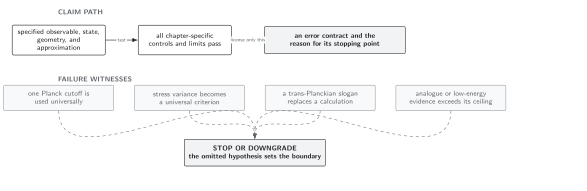
Singular-limit claims are downgraded when their state, smearing, extension, or derivative hierarchy changes the result before the proposed endpoint is reached. Schematic; not to scale.
References
Section titled “References”- Hawking, S. W., and R. Penrose, “The Singularities of Gravitational Collapse and Cosmology,” Proceedings of the Royal Society A 314, 529–548 (1970), doi:10.1098/rspa.1970.0021.
Original QFT.org content:CC BY 4.0, unless an item supplies different terms. Third-party material retains its own terms.