

The Semiclassical Einstein Equation
The semiclassical Einstein equation equates a classical mean geometry to the renormalized expectation value of quantum matter in a specified state. Its content is meaningful only together with finite gravitational couplings, a causal state prescription, conservation, and an approximation hierarchy. It does not replace the metric by an operator or assert that stress fluctuations are negligible.
Required background. Conservation and the backreaction source supplies the admissible renormalized stress tensor, and renormalization of gravitational couplings supplies the curvature counterterms.
Helpful background. Stress tensors and charge algebras fixes the Ward identity, and controlled EFT expansions fixes the meaning of a truncated mean equation.
The renormalized mean equation
Section titled “The renormalized mean equation”Use the matter action
which gives and . Define
The gravitational Einstein–Hilbert action has the sign
so stationary variation of gives
and are defined by the metric variations of and with the same positive convention. In four dimensions a Riemann-squared term is reducible up to the Euler density and a boundary term on a boundary-free spacetime. Boundaries require their own surface action and invalidate that shortcut unless treated explicitly.
The right-hand side contains state-dependent nonlocal information and state-independent local subtraction terms. The left-hand couplings absorb the latter. Wald’s axiomatic analysis shows why local conserved curvature ambiguities accompany stress renormalization rather than representing different measurable sources by themselves (Wald 1977, §§ 2–4).
The structure map places this equation between initial data and causal response. Evaluating the source once on an unrelated background fills only its second box.

Role of the semiclassical Einstein equation in the coupled construction. The diagram is schematic and not to scale; the equation becomes a predictive evolution law only with compatible data, a retarded prescription, constraints, and controlled higher derivatives.
The failure map rejects a common shortcut: inserting a convenient while leaving the geometry and state unrelated does not produce a self-consistent pair.
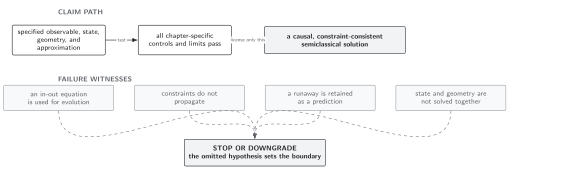
Self-consistency test for the mean equation. This schematic, not-to-scale map also stops at a nonconserved source, an in-out evolution kernel, or an uncontrolled higher-derivative branch.
Application: a scalar source in homogeneous spacetime
Section titled “Application: a scalar source in homogeneous spacetime”For
choose a homogeneous isotropic Hadamard state . Write its renormalized energy density as
The first term contains the state-dependent mode integral after local subtraction; the remaining terms display every bulk finite ambiguity for a free scalar at this derivative order. The equation becomes
The spatial equation supplies the pressure relation, and
is an independent conservation check. A reproducible calculation specifies the mode functions and Wronskian, the initial state, subtraction scale , finite , the derivative order, and the residuals of both Friedmann and continuity equations. It also requires the dimensionless ratios , , and for occupied modes to remain small.
Adversarial test: move a curvature tensor across the equation
Section titled “Adversarial test: move a curvature tensor across the equation”Let a second stress prescription be
Substitution shows that the same physical equation is recovered by
with all other quantities unchanged. Comparing the two stresses at fixed would manufacture a scheme dependence. Comparing the paired data and gives the same mean geometry.
The strongest claim is therefore scheme-translated: a solution is attached to renormalized couplings and a state, not to an isolated numerical value of the subtracted stress tensor. If conservation fails, no coupling translation repairs the source. If the equation is varied from an in-out functional for real-time evolution, it need not be causal or real.
Domain and failure conditions
Section titled “Domain and failure conditions”See the chapter domain and failure-conditions table. This page treats quantum matter on a classical mean metric, including local curvature counterterms through the declared order. It licenses a mean equation only for Hadamard states, conserved renormalized sources, matched finite couplings, and subcutoff curvatures. It excludes stress variance, graviton loops, and ultraviolet completion.
Exercise
Section titled “Exercise”Show that adding to the renormalized stress can be absorbed into Newton’s constant.
Solution
Since , substitution in the unprimed equation gives
Dividing by defines
with the cosmological and higher-curvature coefficients translated consistently. The conclusion holds perturbatively where the denominator is nonzero.
Handoff
Section titled “Handoff”Coupled state–geometry initial data specifies the geometric and quantum data on which this equation can begin a causal evolution.
References
Section titled “References”- Birrell, N. D., and P. C. W. Davies. Quantum Fields in Curved Space. Cambridge: Cambridge University Press, 1982. doi:10.1017/CBO9780511622632.
- Hu, Bei-Lok, and Enric Verdaguer. Semiclassical and Stochastic Gravity: Quantum Field Effects on Curved Spacetime. Cambridge: Cambridge University Press, 2020. doi:10.1017/9780511667497.
- Wald, Robert M. “The Back Reaction Effect in Particle Creation in Curved Spacetime.” Communications in Mathematical Physics 54 (1977): 1–19. doi:10.1007/BF01609833.
Original QFT.org content:CC BY 4.0, unless an item supplies different terms. Third-party material retains its own terms.