

Secular Growth, Resummation, and Dynamical RG
Secular growth means that a fixed-order approximation becomes nonuniform in elapsed time, not necessarily that the underlying state or spacetime is unstable. Resummation is controlled only after identifying the observable, the large dimensionless parameter, the class of terms being summed, and a residual error that stays small.
Required background. Cosmological loops and renormalization separates UV and time logarithms; in-in correlators supplies causal evolution; power spectra and freeze-out supplies the late-time object; and large logarithms and RG improvement supplies the renormalization-group method.
Helpful background. Adiabatic limits and infrared obstructions distinguishes switching and volume limits, while nonuniform large-N limits supplies a second controlled resummation example.
Finding the actual large parameter
Section titled “Finding the actual large parameter”Suppose an equal-time quantity has a perturbative series
Fixed order fails when even if . The exponent and coefficients depend on the interaction, mass, state, and observable. A retarded response, an equal-time variance, and a gauge-invariant curvature observable need not share the same leading logarithms.
A dynamical renormalization group introduces an arbitrary intermediate time , absorbs the large dependence between and into running data, and demands independence of . In a simple multiplicative case this gives
whose solution exponentiates the leading series. More general cosmological problems produce coupled flow equations, memory kernels, or Fokker–Planck evolution rather than one anomalous dimension. Burgess and collaborators formulate this real-time resummation and its relation to inflationary logarithms in Burgess et al. 2010, §§2–4, Eqs. (2.1)–(4.18).
Spectator example and matching
Section titled “Spectator example and matching”For a light spectator scalar with weak self-interaction, long modes accumulate and fixed-order in-in terms grow with . A stochastic or diagrammatic leading-log treatment can resum a declared subset, generating a late-time distribution or dynamical mass scale. To compare methods, match the same renormalized field, state, coarse-graining prescription, and equal- or unequal-time observable. Agreement for does not prove equality of all gradients, commutators, or response functions.
The first application is to calculate the first two leading secular terms of a spectator correlator, infer the combination , and solve the corresponding DRG or stochastic evolution. Re-expanding the resummed answer must reproduce those fixed-order coefficients. Varying the matching time must change the result only beyond the retained logarithmic order.
Different resummations make different controlled omissions. A leading-log stochastic equation neglects gradients and some memory; a 2PI truncation retains selected self-energies but not every vertex; a large-N expansion orders diagrams by index topology; a DRG flow follows the identified time dependence. Agreement is strongest when the same object agrees in an overlap regime and each method’s neglected terms are independently small. A visually similar late-time saturation value is not enough if unequal-time response or normalization differs.
The structure map places resummation after ultraviolet renormalization and before an observable-specific late-time claim.

Resummation begins with a renormalized fixed-order series, extracts its observable-specific secular parameter, and is accepted only if it re-expands correctly and retains a smaller remainder. Schematic; not to scale.
Observable and gauge adversarial test
Section titled “Observable and gauge adversarial test”Repeat the calculation for a second object—for example, a local derivative correlator instead of the unsmeared field variance—or in a relationally completed gauge. If the leading logarithm disappears, changes power, or becomes a coordinate redefinition, the first resummation cannot be advertised as universal dynamics. Similarly, changing the system window in a stochastic split requires matching its coefficients; raw window dependence is not physical late-time running.
No resummation justifies extrapolation beyond its positivity, scale-separation, or gradient regime. See the chapter’s domain and failure conditions. The validity map distinguishes fixed-order nonuniformity from a failed or overextended resummation.
One should also quote a resummed uncertainty. Vary the matching time, include the first subleading logarithm or gradient term, and compare with direct fixed-order evolution before its breakdown. These variations convert “late-time improvement” into an error estimate.
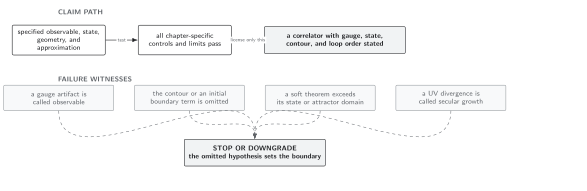
A secular approximation controls only the observable and logarithmic class it matches; re-expansion, matching-scale independence, and a small remainder are decisive tests. Schematic; not to scale.
References
Section titled “References”- Burgess, C. P., R. Holman, L. Leblond, and S. Shandera, “Breakdown of Semiclassical Methods in de Sitter Space,” Journal of Cosmology and Astroparticle Physics 10, 017 (2010), doi:10.1088/1475-7516/2010/10/017.
- Burgess, C. P., R. Holman, L. Leblond, and S. Shandera, “Dynamical RG and Inflationary Perturbations,” Journal of Cosmology and Astroparticle Physics 03, 033 (2010), doi:10.1088/1475-7516/2010/03/033.
Original QFT.org content:CC BY 4.0, unless an item supplies different terms. Third-party material retains its own terms.