

Conservation, Local Covariance, and the Backreaction Source
A finite stress tensor is not yet a gravitational source. It must transform locally and covariantly, obey the background Ward identity with every external force and boundary flux included, and use the same finite gravitational couplings as the field equation. Conservation is a coupled tensor test, not a component-by-component subtraction rule.
Required background. Renormalized Stress Tensor: Axioms and Curvature Ambiguities supplies the admissible tensor; Local Covariance, Isometries, and Background Embeddings supplies functorial comparison; Coupling to Background Gauge Fields and Bundles supplies source Ward identities.
Helpful background. What Is an Anomaly? separates genuine obstructions; Contact Terms and Renormalized Operator Products controls coincident insertions.
Diffeomorphism Ward identity
Section titled “Diffeomorphism Ward identity”We define the matter stress by
For a background gauge potential, define
For an infinitesimal active diffeomorphism generated by ,
After integrating by parts, gauge-current conservation removes the second term in . Diffeomorphism invariance therefore gives, in an anomaly-free bulk and with the charged-field equations imposed,
The right side is work done by the external gauge field. With a spacetime boundary, its integral acquires the normal stress flux and boundary Ward terms. With a diffeomorphism anomaly, an additional local anomalous term remains. A trace anomaly instead changes and does not by itself violate this divergence equation.
First application: divergence of the point-split scalar tensor
Section titled “First application: divergence of the point-split scalar tensor”Start with
Apply before taking coincidence, use in each argument, and use the Hadamard recursion for . Because the parametrix solves the field equation only modulo a smooth local remainder, the divergence can reduce to a state-independent gradient,
Adding in the present convention restores conservation. The exact depends on the parametrix normalization and which equation-of-motion Wick polynomial is imposed; it may not be guessed by renormalizing each tensor component independently. Wald’s analysis explains why conservation and local curvature freedom must be imposed together Wald 1977, pp. 6–15.
For interacting local covariant fields, conservation also constrains time-ordered products and their contact terms; the corresponding Ward construction is given in Hollands and Wald 2005, §§4–5, pp. 270–296.
Three independent checks follow:
- in Minkowski vacuum, the chosen normalization gives the declared zero;
- on FLRW, and obey when there is no external source;
- under a coordinate change, the complete result transforms as a tensor rather than as separately subtracted components.
Export to semiclassical gravity
Section titled “Export to semiclassical gravity”The matter source can appear in a schematic equation
only after the finite coefficients on both sides are in the same prescription. The Bianchi identity makes conservation a compatibility condition. This page does not choose the causal in-in state evolution or solve the backreaction equation; Chapter 9 owns that step.
Adversarial component subtraction
Section titled “Adversarial component subtraction”Renormalize and using unrelated coordinate cutoffs, then transform to another chart. Finite remnants need not assemble into a tensor, and a numerical divergence can appear even though each component is finite. Adding an arbitrary nonconserved local tensor to cancel one component moves the error rather than curing it.
The strongest surviving claim is a coordinate-dependent regularized diagnostic. A valid stress source requires a covariant prescription or an explicit demonstration that the noncovariant regulator’s counterterms restore the complete Ward identity.
Source and failure maps
Section titled “Source and failure maps”The structure map’s conservation checkpoint is the gateway from a local expectation value to a possible backreaction source.

Covariant conservation links all tensor components and the renormalized gravitational couplings; the map is schematic and not to scale.
The failure map separates three different possibilities: a subtraction error, a physical external force, and a genuine anomalous Ward identity.
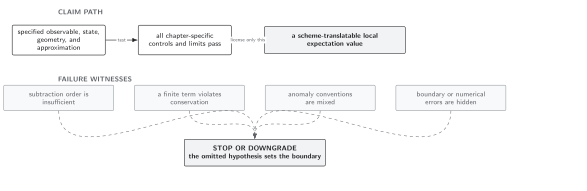
A nonzero divergence is interpreted only after regulator, source, boundary, and anomaly contributions are separated; the map is schematic and not to scale.
Use Domain and failure conditions. Check the field equation in both split arguments, contact terms, tensor covariance, all divergence components, boundary flux, background-force terms, anomaly class, dimensions, and finite coupling translation.
Check your understanding
Section titled “Check your understanding”Does a nonzero trace anomaly imply ?
Solution
No. In a theory with no diffeomorphism anomaly, the renormalized stress tensor can remain covariantly conserved while its trace is anomalous. Trace and diffeomorphism Ward identities test different symmetries.
Trace Anomalies and Convention Translation treats the trace identity. Chapter 9 owns causal mean backreaction; Volume XVI owns theorem-level local covariance and conservation.
References
Section titled “References”- Stefan Hollands and Robert M. Wald, “Conservation of the Stress Tensor in Perturbative Interacting Quantum Field Theory in Curved Spacetimes,” Reviews in Mathematical Physics 17 (2005), 227–312, DOI, arXiv:gr-qc/0404074.
- Robert M. Wald, “The Back Reaction Effect in Particle Creation in Curved Spacetime,” Communications in Mathematical Physics 54 (1977), 1–19, DOI.
Original QFT.org content:CC BY 4.0, unless an item supplies different terms. Third-party material retains its own terms.