

Horizons and Hawking Radiation
Hawking radiation is not a single inference from the word “horizon.” A controlled result begins with a specified horizon class and normalization, adds either collapse data or a stationary quantum state, derives a near-horizon mode or KMS relation, solves the independent scattering problem, and only then identifies an operational detector response or renormalized asymptotic flux. This chapter develops those steps while keeping thermality, transmission, superradiance, state regularity, and backreaction distinct.
Helpful background. The Unruh effect and accelerated detectors separates local detector thermality from particle flux; ground, KMS, and symmetry-selected states supplies the state criteria; and particle observables and detector dependence fixes the operational meaning of a spectrum.
Enter horizon QFT
Section titled “Enter horizon QFT”The background metric has signature . For a scalar field,
and the site curvature convention gives the four-dimensional conformal value . With , the smeared commutator is
These conventions matter when mode Klein–Gordon products, flux orientations, or results from sources with opposite curvature signs are compared.
For a nonextremal Killing horizon generated by , surface gravity is defined by
The statement presupposes the same normalization of , mode frequency, and Killing time on both sides. It is a local or stationary thermality scale, not yet an asymptotic luminosity. The latter also requires state boundary conditions, greybody transmission, angular degeneracy, and a renormalized flux component.
In a collapse derivation, the late-time thermal factor follows from the exponential relation between affine null parameters, while the physical flux still depends on propagation and state data (Fredenhagen and Haag 1990, §§ 2–4).
The construction map should therefore be read strictly from left to right. The checkpoint below the near-horizon step requires both horizon regularity and energy conservation; the note below the last step warns that a thermal occupation, a transmission probability, and a measured flux are three different objects.

Controlled construction of a horizon-radiation claim. The diagram is schematic and not to scale; each arrow adds independent hypotheses, and thermality is not identified with unit transmission or with a flux measurement.
The failure map gives the chapter’s stopping rule. Inspect the four lower witnesses: interchanging horizon classes, calling a KMS response a flux, dropping greybody or superradiant factors, or reordering extremal and late-time limits changes the licensed conclusion.
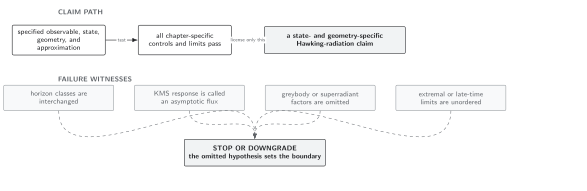
Validity path for horizon QFT. This schematic, not-to-scale map makes the first omitted hypothesis the boundary of the result rather than promoting a local thermal relation to a universal global flux.
Route by the missing step
Section titled “Route by the missing step”| Order | Use this page when the missing datum is… |
|---|---|
| 1 | Horizon taxonomy: whether the surface is causal, Killing, trapping, apparent, acceleration, or cosmological. |
| 2 | Surface gravity and redshift: the generator, affine parameter, tortoise coordinate, or frequency normalization. |
| 3 | Radiation from gravitational collapse: the regular early state and collapse-to-late-time causal map. |
| 4 | Ray tracing and Bogoliubov coefficients: the explicit exponential transform, wavepackets, and transients. |
| 5 | Stress-tensor flux and two-dimensional reductions: a renormalized energy flux rather than a number expectation. |
| 6 | Euclidean periodicity and KMS structure: stationary thermal analyticity and its Lorentzian interpretation. |
| 7 | Boulware, Hartle–Hawking, and Unruh states: global boundary conditions and horizon regularity. |
| 8 | Greybody scattering: radial transmission, Wronskian normalization, partial waves, and luminosity. |
| 9 | Rotation, charge, and superradiance: shifted horizon frequency, amplification, or chemical potentials. |
| 10 | Cosmological and multiple horizons: incompatible surface gravities or patch-dependent state selection. |
| 11 | Trans-Planckian sensitivity: the blueshifted ancestry and its actual low-energy sensitivity. |
| 12 | Modified dispersion and analogue horizons: controlled mode-conversion models and their evidentiary boundary. |
| 13 | Slow evaporation: time-dependent surface gravity and the fixed-background/backreaction interface. |
| 14 | Extremal and late-time limits: zero surface gravity, long throats, transients, and noncommuting limits. |
Domain and failure conditions
Section titled “Domain and failure conditions”This is the canonical comparison table for the chapter. Every leaf links back here and then states its narrower page-local conditions.
| Horizon or geometry | State or derivation input | Near-horizon result | Scattering input | Operational observable | Licensed domain | Failure and required downgrade |
|---|---|---|---|---|---|---|
| Collapse to a nonextremal asymptotically stationary black hole | Regular Hadamard in-state on past null infinity; exponential late-time ray map | Planck ratio at for late wavepackets | Partial-wave transmission still required | Outgoing number packets or renormalized flux at future null infinity | Fixed background, late compared with collapse transients, before appreciable evaporation | An eternal metric alone supplies no collapse preparation; a singular in-state removes the standard production claim. |
| Static bifurcate Killing horizon | Invariant horizon-regular Hartle–Hawking–Israel state, when it exists | KMS analyticity with Killing temperature | Equilibrium has both incoming and outgoing sectors | Detector detailed balance or local correlators; net flux can vanish | Static wedge and declared generator normalization | Euclidean periodicity without a Lorentzian state licenses only a geometric period, not a detector or flux claim. |
| Eternal static exterior in the Boulware state | Vacuum with respect to static time at both infinities | No thermal population at infinity; stress is singular at the horizons | Radial scattering defines vacuum polarization modes | Static-observer stress or detector response away from the horizon | Exterior region bounded away from the horizon | Calling it a regular black-hole vacuum fails at the horizon. |
| Eternal static exterior in the Unruh state | Vacuum incoming from past infinity; outgoing sector regular on the future horizon | Outgoing Hawking occupation, no matching incoming bath | Greybody factors transmit the outgoing sector | Positive late-time outward flux at future infinity | Collapse-like future exterior; not regular on the past horizon | The state label alone does not determine luminosity without the radial problem. |
| Rotating or charged Killing horizon | Mode energy and a specified state | Thermal factor uses | Wronskian permits amplification when | Signed energy and charge/angular-momentum fluxes | Region and boundary conditions without an uncontrolled superradiant instability | An unshifted Planck factor violates horizon energy accounting; a global bosonic Hartle–Hawking state may not exist. |
| Static region between two horizons | Candidate state tested at both horizons | Separate periods | Each boundary has its own ingoing/outgoing conditions | Local detector responses and inter-horizon flux | Global equilibrium only when periods and generator normalization are compatible | Averaging unequal temperatures does not remove either conical or Lorentzian singularity; use a nonequilibrium state. |
| Dispersive or analogue horizon | Preferred frame, dispersion law, prepared initial state, adiabatic mode conversion | Low-frequency near-Planckian spectrum under stated hierarchy | Extra roots and mode-conversion channels included | Analogue quasiparticle correlations or flux | The specified medium/model, not quantum gravity in general | Matching a spectrum alone cannot establish gravitational ultraviolet dynamics or backreaction. |
| Slowly evolving horizon | Transported Hadamard state and | Instantaneous thermal form plus controlled derivative corrections | Time-dependent transmission evaluated on matching timescales | Wavepacket flux over windows short relative to evaporation | Semiclassical adiabatic interval | If emission and evolution timescales are comparable, use the full nonstationary problem; no instantaneous temperature claim. |
| Near-extremal or extremal geometry | Order of state construction, , and stated explicitly | Near-extremal thermal sector may have a singular or nonuniform extremal limit | Long throat and low-frequency sectors treated separately | Finite-time correlators, flux, or late-time tails | Only the declared order of limits | Setting in a nonextremal formula can lose transients and modes; no conclusion transfers without a direct extremal analysis. |
What a complete result reports
Section titled “What a complete result reports”A reproducible horizon calculation names the horizon definition, generator normalization, affine and Killing coordinates, field equation and curvature convention, state and its regularity domain, collapse or stationarity assumptions, mode normalization, wavepacket resolution, radial boundary conditions, Wronskian convention, greybody and superradiant factors, detector or stress observable, renormalization prescription, asymptotic region, and all time/low-frequency/extremal limits. It also states whether the metric is fixed, slowly evolving, or solved self-consistently.
The chapter remains within semiclassical QFT. A nonzero fixed-background flux motivates mass loss, but computing a self-consistent evaporating geometry belongs to the backreaction chapter; generalized entropy and microscopic information recovery require additional frameworks.
References
Section titled “References”- Fredenhagen, Klaus, and Rudolf Haag. “On the Derivation of Hawking Radiation Associated with the Formation of a Black Hole.” Communications in Mathematical Physics 127 (1990): 273–284. doi:10.1007/BF02096757.
- Hawking, Stephen W. “Particle Creation by Black Holes.” Communications in Mathematical Physics 43 (1975): 199–220. doi:10.1007/BF02345020.
- Kay, Bernard S., and Robert M. Wald. “Theorems on the Uniqueness and Thermal Properties of Stationary, Nonsingular, Quasifree States on Spacetimes with a Bifurcate Killing Horizon.” Physics Reports 207 (1991): 49–136. doi:10.1016/0370-1573(91)90015-E.
- Wald, Robert M. Quantum Field Theory in Curved Spacetime and Black Hole Thermodynamics. Chicago: University of Chicago Press, 1994. Publisher record.
Original QFT.org content:CC BY 4.0, unless an item supplies different terms. Third-party material retains its own terms.