

de Sitter Infrared Physics and Stochastic Inflation
de Sitter infrared statements are meaningful only after the patch, state, field algebra, observable, gauge, regulator, order of limits, and duration are fixed. Stochastic inflation is a controlled leading-long-wavelength description in specified scalar regimes; it is not a universal replacement for in-in QFT, a solution of the gravitational observable problem, or an exact equilibrium description of finite slow roll.
Helpful background. Langevin fields and noise supplies stochastic normalization; influence functionals supplies reduced dynamics; cosmological loops and secular growth supplies in-in power counting; and Bunch–Davies and alpha-state diagnostics supplies the free-state distinction.
Infrared and stochastic control parameters
Section titled “Infrared and stochastic control parameters”In the spatially flat patch,
With the site’s curvature convention , a scalar governed by has
The standard massive Euclidean/Bunch–Davies state is distinct from the minimally coupled zero-mode problem. For , the long-field relaxation time scales as e-folds; taking before or after that time gives different answers. Allen’s state classification and zero-mode analysis make this scope distinction explicit Allen 1985, §§II–IV, pp. 3138–3147.
For a light spectator with fixed , the leading sharp-window stochastic equation in cosmic time is
Equivalently, with ,
The coefficient is tied to a specified state and moving coarse-graining window. Smooth windows generate finite correlation time and calculable matching corrections. Under fixed , zero probability current, no volume weighting, and normalizability, the stationary solution is
These formulas were established for light scalar long modes and their leading infrared dynamics Starobinsky and Yokoyama 1994, §§II–III, Eqs. (2.1)–(3.7). Every extension in this chapter states which assumptions survive.
For a light quartic scalar, the diagrammatic correspondence with in-in QFT is established at leading infrared order, not for every gradient or unequal-time observable Garbrecht et al. 2015, §§III–V, Eqs. (35)–(75).
The structure map separates free-state and zero-mode questions from interacting resummation, scalar coarse-graining, open-system corrections, first passage, and gravitational observables.

Free-field state selection, zero modes, interacting logarithms, resummation, stochastic coarse-graining, open-system dynamics, and relational gravity are distinct calculations with different control parameters. Schematic; not to scale.
Routes through the chapter
Section titled “Routes through the chapter”- de Sitter infrared regimes fixes patches, observables, regulators, and limit order.
- Euclidean and Bunch–Davies free fields derives the standard massive scalar state.
- Massless zero modes isolates the minimally coupled obstruction and restricted observables.
- Interacting infrared logs identifies perturbative nonuniformity by object and symmetry.
- Graviton infrared claims tests coordinate correlators against relational observables.
- Infrared resummation compares large-N, stochastic, and diagrammatic mass scales.
- Stochastic coarse-graining derives drift and noise from a moving split.
- Langevin and Fokker–Planck dynamics fixes calculus, measure, moments, and normalization.
- Open-system noise and dissipation restores colored noise, memory, and influence kernels.
- Stationary and first-passage observables imposes current and boundary conditions.
- QFT–stochastic matching states the renormalized observable subset that agrees.
- Quasi-de Sitter validity separates slow-variation, finite-duration, and evidence errors.
Domain and failure conditions
Section titled “Domain and failure conditions”This is the canonical comparison table for the chapter. Its evidence status is current through 10 August 2026 where a dispute is consequential.
| Problem | Patch, state, and object | Regulator or split | Controlled output | Decisive check | Failure or handoff |
|---|---|---|---|---|---|
| Infrared classification | Declared patch, state, field or local composite | Mass, volume, or invariant prescription | Limit-specific correlator | Exchange limit order | Noncommuting limits forbid a universal statement |
| Massive free field | Euclidean/BD state, | Euclidean continuation and | Hadamard Wightman function | Canonical jump and coincidence form | Does not cover the minimal massless zero mode |
| Minimal zero mode | Global mode algebra or shift-invariant subalgebra | Small mass and finite volume kept distinct | Derivative or difference observables | Regulator agreement on the same algebra | No standard invariant Fock vacuum for |
| Interacting logs | Specified in-in observable and interaction | UV subtraction plus declared IR regulator | Fixed-order secular interval | Compare with unity | A large log signals nonuniform perturbation, not automatically instability |
| Graviton infrared | Gauge, dressing, finite operational region | Residual-gauge and smearing prescription | Relational or curvature observable | Gauge/dressing comparison | Coordinate two-point growth alone is insufficient |
| Resummed scalar | Coupling, , mass, equal- or unequal-time object | Large-N, 2PI, stochastic, or RG scheme | Method-specific infrared scale | Translate conventions and observables | Equal-time agreement does not prove universal dynamics |
| Coarse-grained scalar | BD-like short modes and window | with hierarchy | Leading drift and noise | Window variation after matching | White noise is not exact for a smooth split |
| Fokker–Planck evolution | Field coordinate, measure, Itô/Stratonovich choice | Time step and field grid | Normalized moments or density | Drift conversion and ensemble agreement | Convention-dependent density is rejected |
| Open-system correction | Declared system/environment and initial state | Influence kernels and correlation time | Noise, dissipation, memory | Markov hierarchy and covariance positivity | KMS fluctuation–dissipation is not generic |
| Stationary or first passage | Fixed , normalizable current condition, boundaries | Absorbing/reflecting domain | Equilibrium density or hitting distribution | Relaxation and boundary variation | No volume-weighted eternal-inflation measure claim |
| QFT matching | Same renormalized in-in observable and order | UV scheme plus stochastic matching scale | Leading-IR equality for a stated subset | Unequal-time and gradient tests | One variance does not establish full-theory equivalence |
| Quasi-de Sitter transport | , slow parameters, state, duration | Local window and time-dependent matching | Finite-time prediction with two errors | Vary duration and formalism | Exact-de Sitter equilibrium may never be reached |
The validity map emphasizes wrong-order limits, gauge-dependent graviton claims, unjustified white-noise or stationary approximations, and overextended QFT–stochastic equivalence.
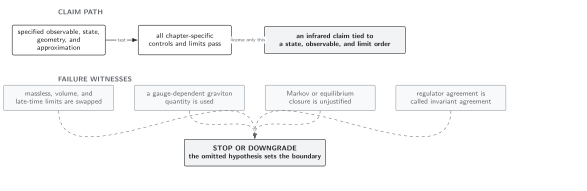
Each infrared or stochastic result is licensed only for its declared observable, limit order, coarse-graining hierarchy, and evidence class. Schematic; not to scale.
References
Section titled “References”- Allen, B., “Vacuum States in de Sitter Space,” Physical Review D 32, 3136–3149 (1985), doi:10.1103/PhysRevD.32.3136.
- Garbrecht, B., F. Gautier, G. Rigopoulos, and Y. Zhu, “Feynman Diagrams for Stochastic Inflation and Quantum Field Theory in de Sitter Space,” Physical Review D 91, 063520 (2015), doi:10.1103/PhysRevD.91.063520.
- Starobinsky, A. A., and J. Yokoyama, “Equilibrium State of a Self-Interacting Scalar Field in the de Sitter Background,” Physical Review D 50, 6357–6368 (1994), doi:10.1103/PhysRevD.50.6357.
Original QFT.org content:CC BY 4.0, unless an item supplies different terms. Third-party material retains its own terms.