

Gravity as Effective Field Theory
Gravity is a predictive quantum effective field theory when every claim is tied to a low-energy observable, an operator basis, a gauge and field parametrization, explicit internal loop content, and expansion parameters below their breakdown values. The framework quantizes the massless metric degrees of freedom and includes every local interaction allowed by diffeomorphism invariance; it does not claim ultraviolet completeness.
Helpful background. Effective Field Theory of Gravity: Architecture and Power Counting supplies the generic EFT organization; Local Field Redefinitions and the Equivalence Theorem supplies basis equivalence; One-Loop Matter Effective Actions in Curved Space supplies the matter-only determinant; and Effective-Action Variation, Stress Tensors, and Consistency Checks supplies background response.
The low-energy gravitational action
Section titled “The low-energy gravitational action”With the site’s (+---) metric and curvature convention, define the reduced Planck mass by and use
This sign is consequential: together with it gives . A local gravity EFT extends it as
In four boundary-free dimensions the Euler combination removes one curvature-squared bulk coupling, but boundaries, other dimensions, or topology-sensitive observables require its surface and global contributions. Expanding
canonically normalizes the graviton up to the chosen gauge. Let denote the largest independent curvature scale sampled in the observable’s physical tetrad. A typical calculation tracks
Coefficient enhancements, weak-field parameters such as , and secular duration are additional observable-specific controls. At fixed order, only finitely many local coefficients enter. Massless loops also generate nonanalytic functions such as that no local coefficient can absorb; those terms carry robust long-distance information Donoghue 1994, §§II–IV.
The structure map separates the two inputs most often confused: a matter determinant contains only internal matter lines, whereas quantum-gravity loops contain internal graviton and Faddeev–Popov ghost lines.

Local operators absorb short-distance dependence, while sector-resolved loops and nonanalytic terms feed matched relational, asymptotic, or curvature observables within a declared cutoff. The map is schematic and not to scale.
Choose the calculation
Section titled “Choose the calculation”The chapter’s leaves follow the order in which assumptions enter a calculation.
- Applying EFT Power Counting to Gravity assigns momentum, curvature, loop, and species order.
- Curvature Operator Bases and Field Redefinitions reduces local terms without discarding physical data.
- Background-Field Quantization, Gauge Fixing, and Ghosts constructs the metric and ghost Hessians.
- Local Supersymmetry and Supergravity as Low-Energy EFT adds the gravitino and local-supersymmetry constraints.
- One-Loop Graviton EFT isolates graviton/ghost divergences and nonanalytic amplitudes.
- Matter Contributions to Gravitational Matching matches matter loops without double counting.
- Heavy Thresholds, Species, and the Gravitational Cutoff makes active-field and multiplicity estimates scale dependent.
- Matching Amplitudes to Background Observables translates common invariant data between asymptotic and curved settings.
- Graviton and Matter Nonlocal Form Factors keeps sector coefficients and causal prescriptions separate.
- Long-Distance Quantum Corrections extracts infrared tails from nonanalytic momentum dependence.
- Relational and Gauge-Invariant Gravitational Observables attaches predictions to physical quantities.
- Vacuum Energy and the Cosmological Constant separates threshold sensitivity from the measured parameter.
- Higher-Derivative Poles, Ghost Diagnostics, and Order Reduction classifies poles relative to the cutoff.
- Validity, Unitarity, and Breakdown combines the independent stopping conditions.
Domain and failure conditions
Section titled “Domain and failure conditions”The following comparison is the chapter-wide contract. “Potential” always means a declared matching convention; the invariant information resides in the associated amplitude, scattering observable, or relational response.
| Calculation or observable | Dynamical fields and internal loops | Local basis and field redefinitions | Gauge-invariant datum | Threshold or nonanalytic input | Expansion and decisive failure |
|---|---|---|---|---|---|
| Tree graviton–matter amplitude | External matter/gravitons; no loop | EH plus required contact operators; EOM-redundant terms movable | On-shell amplitude | Heavy physics in Wilson coefficients | ; partial waves or omitted operators become large |
| Matter effective action | Internal matter only; metric prescribed | Curvature basis with matter-threshold matching | Renormalized background response | Mass-dependent form factors and cuts | Curvature/derivative expansion fails near threshold or strong background |
| Graviton one-loop amplitude | Internal graviton and ghost lines, plus declared mixed diagrams | Four-derivative counterterm closure | On-shell nonanalytic amplitude | Massless cuts and | or species-enhanced loop reaches unity |
| Heavy-threshold matching | Heavy fields integrated out once | Local Wilson coefficients below the mass | Equality of low-energy amplitudes/responses | Smooth decoupling around | Explicit heavy loop plus matched coefficient double counts |
| Weak-background response | Fields declared in the 1PI or in-in action | Basis translated before variation | Smeared curvature or relational response | Retarded continuation of nonlocal kernels | No asymptotic S-matrix assumed; instability or curvature expansion fails |
| Long-distance tail | Massless loop sectors resolved | Analytic terms remain coefficient/scheme dependent | Scattering angle, time delay, or other invariant response | Nonanalytic and pieces | Extrapolation to is forbidden |
| Relational observable | Gauge-fixed fields internally, clocks/dressings externally | Invariant under local EOM redefinitions to retained order | Event-defined curvature, asymptotic charge, or dressed amplitude | Matching residual tested across gauges/bases | Bare coordinate component or incomplete clock system |
| Vacuum energy | All thresholds contributing to the zero-derivative term | Renormalized is an independent measured coupling | Curvature response after matching | Contributions scale as heavy masses to the fourth power | Regulator power divergence mistaken for an observable, or naturalness claimed solved |
| Higher-derivative propagator | EH pole plus perturbative insertions below cutoff | EOM-redundant pieces removed only within observable | Pole/residue of a controlled low-energy amplitude | Extra exact pole compared with | Above-cutoff root treated as an EFT particle or order reduction used across a genuine low pole |
The failure map is therefore diagnostic rather than universal: loop misclassification, redundant operators, gauge dependence, spurious poles, and missing truncation errors require different repairs.
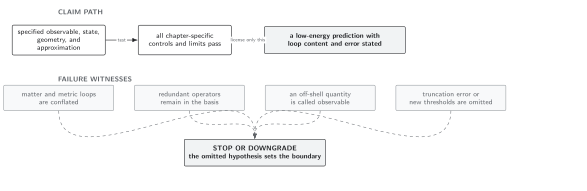
A low-energy gravitational claim survives only when its fields, basis, gauge-invariant observable, loop sector, threshold treatment, and truncation uncertainty are simultaneously controlled. The map is schematic and not to scale.
What may be exported
Section titled “What may be exported”A result should leave this chapter with the action and curvature signs; canonical normalization; active degrees of freedom; internal graviton, ghost, matter, and mixed lines; renormalization scheme and scale; field-redefinition class; gauge-invariant observable; analytic and nonanalytic pieces; matching conditions; cutoff; and numerical remainder estimate. Pure-gravity one-loop on-shell finiteness in a special theory is not off-shell finiteness, matter-coupled finiteness, or ultraviolet renormalizability. Likewise, a species scale is a regime-dependent estimate and a higher-derivative pole above the cutoff is not an additional EFT state.
Generic matching theory remains in Renormalization and EFT. Matter-only determinants remain in Chapter 8. Detailed ultraviolet completions and nonperturbative quantum geometry remain with Holography and Quantum Gravity.
References
Section titled “References”- Burgess, C. P. “Quantum Gravity in Everyday Life: General Relativity as an Effective Field Theory.” Living Reviews in Relativity 7, 5 (2004). doi:10.12942/lrr-2004-5. Open PDF
- Donoghue, J. F. “General Relativity as an Effective Field Theory: The Leading Quantum Corrections.” Physical Review D 50, 3874–3888 (1994). doi:10.1103/PhysRevD.50.3874. Open PDF
Original QFT.org content:CC BY 4.0, unless an item supplies different terms. Third-party material retains its own terms.