

Renormalized Stress Tensor: Axioms and Curvature Ambiguities
A renormalized stress tensor constrained by local covariance, the field equation, conservation, and scaling still admits conserved local curvature tensors. Additional finite renormalization conditions—such as setting the Minkowski-vacuum stress to zero—fix corresponding coefficients. Its expectation value contains state-dependent polarization; its remaining finite ambiguity is state independent and must be matched to the renormalized gravitational couplings when the tensor is used as a source.
Required background. Wick Polynomials and Hadamard Point Splitting supplies the composite fields; Spacetime Currents, Stress Tensors, and Charge Algebras supplies the Ward interpretation; Symmetry-Protected Operators, Currents, and Improvement supplies improvement mixing.
Helpful background. Local Covariance, Isometries, and Background Embeddings fixes covariance; Renormalization Conditions, Schemes, and Finite Parts fixes scheme language; Classical Symmetries, Currents, and Stress Tensors derives the classical tensor.
Stress definition and axioms
Section titled “Stress definition and axioms”For this page the metric-variation sign is
For the scalar action compatible with , the classical tensor includes the curvature improvement. A point-split definition has the form
where is derived from the classical bilinear and restores the declared field-equation and conservation convention. The result must be a local covariant tensor, have the correct dimension and scaling, depend continuously on the metric and parameters, agree with the chosen flat normalization, and satisfy
when there is no external force, boundary flux, or diffeomorphism anomaly. Wald’s axioms isolate these requirements and the remaining local freedom Wald 1977, pp. 1–19.
First application: the four-dimensional ambiguity basis
Section titled “First application: the four-dimensional ambiguity basis”Before optional finite normalization conditions are imposed, two admissible scalar prescriptions can differ by
up to degeneracies special to the field parameters and topology. In our variation convention define
The Euler density removes a third independent quadratic-curvature variation in four boundaryless dimensions. Each displayed tensor has mass dimension four and is identically conserved. Boundary terms change this classification and are treated separately.
If one explicitly imposes for every mass in Minkowski spacetime, that matter-sector condition fixes . It does not fix , which vanish in flat space. If the gravitational action contains coefficients multiplying , shifts left unfixed by the selected conditions are absorbed by finite redefinitions of those same couplings. Even for , the division between a matter vacuum term and the measured cosmological coupling is conventional until the complete gravitational renormalization condition is matched. Decanini and Folacci give an explicit four-dimensional ambiguity analysis and its dimensional identities Decanini and Folacci 2008, §§IV–V.
Adversarial raw-scheme comparison
Section titled “Adversarial raw-scheme comparison”Compute in two prescriptions but keep the numerical gravitational couplings fixed. Their component difference can be exactly the local tensor above. Calling it a measurable discrepancy compares two different renormalized theories.
The correct comparison translates both matter expectation and gravitational couplings. State differences computed in one fixed geometry cancel the terms, whereas absolute curvature-dependent components generally do not. The anomaly’s type-A and type-B coefficients also do not become arbitrary merely because are allowed; only the corresponding scheme-dependent trace term can move.
Conservation and ambiguity maps
Section titled “Conservation and ambiguity maps”The structure map makes the order explicit: point splitting produces a candidate tensor, finite freedom is classified, and conservation is imposed before the result is exported.

State dependence resides in the smooth two-point remainder, while the four-dimensional finite ambiguity tracks gravitational coupling definitions; the map is schematic and not to scale.
The failure map rejects a finite but nonconserved addition and a comparison that omits coupling translation.
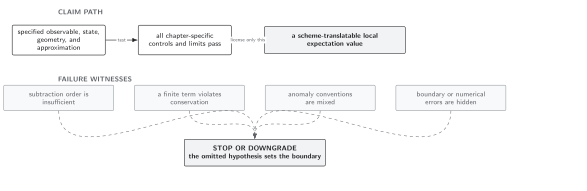
Only a locally covariant, conserved, dimensionally complete, scheme-translated stress expectation is licensed as a semiclassical source. Schematic and not to scale.
Use Domain and failure conditions. Check symmetry, dimension four, conservation, flat normalization, scale dependence, the Gauss–Bonnet relation, surface terms, state differences, and finite gravitational-coupling translation.
Check your understanding
Section titled “Check your understanding”Why does appear in the unrestricted ambiguity basis, and what happens when the Minkowski-vacuum stress is explicitly normalized to zero?
Solution
Local singular subtraction alone does not choose the finite constant . The additional condition fixes it in the matter prescription. In the coupled equation, moving the corresponding constant between the matter tensor and the cosmological term remains a convention until the measured cosmological coupling is held fixed.
Conservation, Local Covariance, and the Backreaction Source performs the divergence test. Chapter 8 owns effective-action counterterms, Chapter 9 the causal source equation, and Volume XVI the uniqueness proofs.
References
Section titled “References”- Yves Decanini and Antoine Folacci, “Hadamard Renormalization of the Stress-Energy Tensor for a Quantized Scalar Field in a General Spacetime of Arbitrary Dimension,” Physical Review D 78 (2008), 044025, DOI, arXiv:gr-qc/0512118.
- Robert M. Wald, “The Back Reaction Effect in Particle Creation in Curved Spacetime,” Communications in Mathematical Physics 54 (1977), 1–19, DOI.
Original QFT.org content:CC BY 4.0, unless an item supplies different terms. Third-party material retains its own terms.