

Semiclassical Breakdown Diagnostics
Semiclassical gravity can fail because the mean equation has a large residual, linear response is unstable, stress fluctuations drive an intolerable metric variance, the state ceases to be admissible, or the gravitational EFT ordering expires. No single diagnostic is necessary and sufficient in every state and observable.
Required background. Observable-specific validity contracts fixes the quantity and tolerance; linear response and semiclassical stability supplies the response kernel; stochastic-gravity validity limits supplies induced fluctuations; and gravitational-EFT validity supplies derivative and unitarity checks.
Helpful background. Renormalized stress and FLRW backreaction supplies a cosmological example, while black-hole evaporation and mean backreaction supplies a horizon example.
A hierarchy of diagnostics
Section titled “A hierarchy of diagnostics”With the site’s conventions, the renormalized mean equation is
For a numerical or approximate solution , first compute the covariantly conserved residual and compare with the observable tolerance. A small local residual is necessary but does not test stability.
Next perturb . The causal linear-response equation has the schematic form
where is the retarded stress response including contact terms and renormalization. Search for gauge-invariant solutions that grow within the domain faster than the declared error budget allows. Higher-derivative runaway roots above the EFT cutoff are removed by order reduction or boundary conditions; a low-frequency physical instability cannot be discarded this way. The criterion was formulated as a validity test by Anderson, Molina-París, and Mottola Anderson, Molina-París, and Mottola 2003, §§II–IV, Eqs. (2.1)–(4.9).
Finally include the noise kernel
It is distributional. Convolving it with a retarded metric response and finite test functions gives the induced metric covariance; only that smeared output is compared with a tolerance.
Metric fluctuations also have an intrinsic part fixed by the initial gravitational state. At linear order a general symmetrized covariance separates into intrinsic, induced, and—when the initial state is correlated—cross terms. Declaring only the matter noise omits the first and possibly the third. The comparison must use a gauge-invariant curvature, relational distance, detector phase, or another physical linear observable; the variance of in an arbitrary gauge is not a diagnostic.
Applying all three levels
Section titled “Applying all three levels”For a chosen semiclassical background, report separately:
- the mean-equation residual and renormalization uncertainty;
- the spectrum of physical linear-response modes below the EFT cutoff;
- the intrinsic initial metric variance and induced noise-driven variance for the declared smearing;
- the state admissibility, derivative expansion, and duration hierarchy.
The first application performs these tests for one FLRW or static background. A stable mean with small smeared induced variance is a controlled semiclassical result. A stable mean with large response-amplified variance licenses stochastic gravity or a narrower resolution, not automatically microscopic quantum gravity. A physical low-energy response instability invalidates that background as a semiclassical solution even if the mean residual is tiny.
State evolution supplies another independent check. The renormalized stress used on the right-hand side must be computed in the state actually propagated on the evolving geometry, with the constraints and Ward identity maintained. Updating the geometry while freezing a state-dependent source can create a fictitious stable solution. A self-consistent calculation monitors both the geometric constraint residual and the normalization or Hadamard diagnostics of the state.
The structure map orders these diagnostics so a downstream failure does not erase an upstream result.

Semiclassical control requires a small mean residual, stable physical response, tolerable smeared metric fluctuations, an admissible state, and a valid derivative expansion. Schematic; not to scale.
The zero-mean counterexample
Section titled “The zero-mean counterexample”Choose a state and smearing for which but is finite and small in the gravitational response norm. The ratio diverges, yet no physical diagnostic has diverged. This rejects a universal variance-over-mean-squared rule.
Conversely, a small such ratio can miss a narrow response resonance or an EFT ghost. The verdict must use absolute tolerance and causal response. See the chapter’s domain and failure conditions.
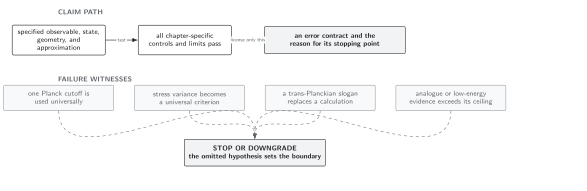
No isolated mean, variance, or response slogan is universal; the diagnostic must be smeared, gauge invariant, cutoff aware, causal, and tied to an observable tolerance. Schematic; not to scale.
References
Section titled “References”- Anderson, P. R., C. Molina-París, and E. Mottola, “Linear Response, Validity of Semiclassical Gravity, and the Stability of Flat Space,” Physical Review D 67, 024026 (2003), doi:10.1103/PhysRevD.67.024026.
Original QFT.org content:CC BY 4.0, unless an item supplies different terms. Third-party material retains its own terms.