

QFT–Stochastic Matching and Renormalization
QFT–stochastic agreement is an observable-by-observable matching statement. The two descriptions must use the same in-in state, interaction convention, smoothing scale, ultraviolet renormalization scheme, infrared expansion, and perturbative order. Agreement of one late-time variance does not identify a stochastic process with the full quantum field theory.
Required background. Interacting infrared logarithms fixes the in-in secular expansion; stochastic coarse-graining fixes the long field; Langevin and Fokker–Planck dynamics fixes stochastic moments; open-system noise and dissipation supplies influence-kernel corrections; and cosmological loops and renormalization fixes QFT subtraction. Helpful background. Curvature counterterms and operator mixing supplies local-composite renormalization, while renormalization of effective dynamics supplies open-system matching.
Matching fields and renormalized observables
Section titled “Matching fields and renormalized observables”Define the stochastic field by a window with . It is a smeared long operator, not the unsmeared local field. A renormalized local composite therefore has an effective-operator expansion such as
and
The coefficients encode short modes and scheme dependence; the stochastic evolution resums the licensed long dynamics. Changing moves contributions between coefficients and stochastic correlators, while a matched physical prediction remains invariant to the retained order. For point-separated smeared correlators the operator basis may simplify, but state, window, and external separations still have to coincide.
A diagram-by-diagram correspondence between stochastic and closed-time-path scalar correlators holds in the leading infrared approximation for a light massive quartic field Garbrecht et al. 2015, §§2–5, Eqs. (5)–(49). The hypotheses matter: the calculation expands in the leading behavior, uses a specified de Sitter state, and does not establish equality of arbitrary subhorizon, derivative, or gauge-constrained observables.
First application: two and four moments in light quartic theory
Section titled “First application: two and four moments in light quartic theory”Take , a Bunch–Davies-like initial state, fixed , and a sharp leading split. Let count e-folds since the matched initial surface and set
The Itô generator gives
Iterating from the Gaussian moments yields the leading secular terms
To turn this into a QFT comparison, renormalize the equal-time in-in two- and four-point functions, smear them with the same , apply the matching coefficients at the same and , and retain the same leading-infrared powers. Lower secular powers and constants can carry matching-scheme information even when the highest powers agree. The comparison must include the connected four-point function, not only , because interaction-generated non-Gaussianity tests the stochastic vertices.
As of the evidence cutoff of 10 August 2026, composite-operator matching beyond the classic leading treatment is active research. A current preprint explicitly renormalizes and matches soft de Sitter composites and derives a higher-order diffusion correction, while also emphasizing the need for Kramers–Moyal operators beyond a purely Gaussian Fokker–Planck ansatz Beneke, Hager, and Sanfilippo 2026, §§3–7, Eqs. (3.17), (6.21), and (7.1)–(7.8). That result is promising primary evidence, not yet a general theorem for interacting cosmological observables.
The structure map places renormalization and matching between the full in-in theory and the stochastic generator. Inspect the observable and approximation labels on both sides of that connection.

The stochastic process supplies long evolution, while short modes determine operator and diffusion matching coefficients at the chosen scale. Schematic; not to scale.
Domain and failure conditions
Section titled “Domain and failure conditions”Use the chapter’s canonical domain table. The worked match concerns a scalar, fixed de Sitter geometry, equal-time long-wavelength correlators, a common in-in state, and leading infrared perturbation theory. It does not by itself cover unequal times, finite physical momentum, stress tensors, constrained curvature perturbations, non-Markovian kernels, or gravitational backreaction.
Adversarial test. After matching the equal-time two- and connected four-point functions, compare an unequal-time correlator, a correlator with two spatial derivatives, and the first non-Gaussian correction beyond the retained stochastic operator basis. Vary and while running all matching coefficients. Agreement should persist only within the declared infrared and perturbative errors. If an unmatched observable happens to agree at one cutoff but changes at another, that coincidence is not evidence of full-theory equivalence.
The failure map rejects comparisons between a bare QFT composite and a smoothed stochastic moment, between different initial states, or between different orders in the light-mass and secular expansions. Memory or non-Gaussian environmental effects pass to open-system dynamics; slow background evolution passes to quasi-de Sitter validity.
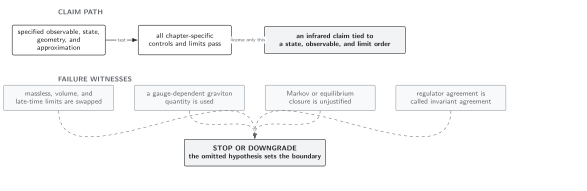
Leading equal-time infrared agreement licenses only the matched observable subset; gradients, unequal times, and higher cumulants require new tests and operators. Schematic; not to scale.
References
Section titled “References”- Beneke, M., P. Hager, and A. F. Sanfilippo, “Quantum Correction to the Diffusion Term in Stochastic Inflation from Composite-Operator Matching in Soft de Sitter Effective Theory,” arXiv:2604.14283 [hep-th] (2026), arXiv abstract and PDF.
- Garbrecht, B., F. Gautier, G. Rigopoulos, and Y. Zhu, “Feynman Diagrams for Stochastic Inflation and Quantum Field Theory in de Sitter Space,” Physical Review D 91, 063520 (2015), doi:10.1103/PhysRevD.91.063520.
Original QFT.org content:CC BY 4.0, unless an item supplies different terms. Third-party material retains its own terms.