

Species, Gauge Edges, and Contact Terms
Species multiplicity, gauge constraints, edge sectors, and nonminimal contact terms modify the two pieces of generalized entropy together. Apparent “species” or “contact-term” paradoxes usually signal that the observable algebra, regulator, or gravitational counterterm has changed between the compared calculations.
Required background. Generalized-entropy renormalization supplies the joint subtraction; edge modes and factorization supplies the subregion choices; and curved-space gauge fields supplies gauge fixing and ghosts. Helpful background. See factorization failure and gauge and gravitational anomaly response.
What must be specified for a gauge subregion
Section titled “What must be specified for a gauge subregion”Gauss’s law couples the normal electric flux through a boundary to the charge inside. A physical gauge-theory Hilbert space therefore does not canonically factorize across a sharp surface. Common choices include an electric-center algebra, a magnetic-center algebra, or an extended Hilbert space with boundary edge variables. They agree on strictly interior gauge-invariant operators but assign different boundary information and hence different entropy.
For an electric-center prescription, entropy takes the schematic form
where the first term is the classical entropy of superselection sectors. The measure and edge contribution are part of the regulator and algebra prescription. They cannot be dropped while retaining the same entropy question.
In covariant heat-kernel calculations, the Maxwell operator produces a surface-localized “contact term” Kabat 1995, §§2–3, pp. 286–293. With a compatible regulator, this term is accounted for by electric-flux edge modes rather than interpreted as a negative number of physical polarizations Donnelly and Wall 2015, pp. 2–4 and Eqs. (8)–(15). This is a model calculation under a specified algebra, not a universal factorization theorem for gauge theory or gravity.
First application: species and nonminimal coupling
Section titled “First application: species and nonminimal coupling”For comparable free species, the leading bare matter entropy scales as
The same appears in the matter-loop renormalization of and higher-curvature couplings Susskind and Uglum 1994, §§2–4, pp. 3743–3751. Thus does not acquire an unexplained regulator-dependent species factor. It may retain genuine finite species dependence because the theory has changed.
For a scalar with site convention , the conformal value in four dimensions is . Nonminimal coupling changes the conical effective action through curvature localized at the defect. Calling this solely “entanglement entropy” can be misleading: the contact contribution, Noether term, and algebraic entropy must be separated and then recombined in .
The structure map shows the page’s central comparison: scalar, gauge, and nonminimal fields enter through different surface data but the same renormalized functional.

Field content and subregion algebra change surface contributions; generalized entropy remains meaningful only after the matching geometric terms are included. Schematic; not to scale.
Domain and failure conditions
Section titled “Domain and failure conditions”Use the chapter’s canonical domain table to compare gauge entropy with ordinary matter entropy. A reproducible comparison states the gauge-invariant algebra, its center, edge measure, boundary conditions, regulator, ghosts, zero modes, and renormalized gravitational couplings.
Adversarial test. Compute Maxwell entropy once with an electric center and once with a magnetic center, but keep the same edge term and counterterm assignment. The mismatch is not a paradox: the accessible algebras differ. Recompute each quantity with its compatible edge and contact prescription, and compare only common operational observables or the fully matched .
The failure map marks an algebra change as a change of question, not evidence for an entropy inconsistency.
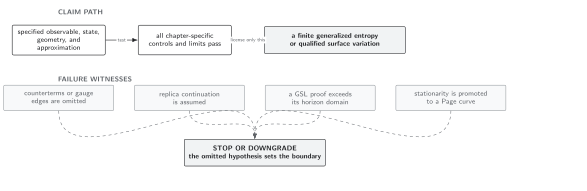
Gauge entropy comparisons require compatible center, edge, regulator, and counterterm choices; colorless agreement of bulk polarizations is insufficient. Schematic; not to scale.
References
Section titled “References”- Donnelly, W., and A. C. Wall, “Entanglement Entropy of Electromagnetic Edge Modes,” Physical Review Letters 114, 111603 (2015), doi:10.1103/PhysRevLett.114.111603.
- Kabat, D. N., “Black Hole Entropy and Entropy of Entanglement,” Nuclear Physics B 453, 281–299 (1995), doi:10.1016/0550-3213(95)00443-V.
- Susskind, L., and J. Uglum, “Black Hole Entropy in Canonical Quantum Gravity and Superstring Theory,” Physical Review D 50, 2700–2711 (1994), doi:10.1103/PhysRevD.50.2700.
Original QFT.org content:CC BY 4.0, unless an item supplies different terms. Third-party material retains its own terms.