

Interacting Infrared Logs and Secular Regimes
An interacting de Sitter logarithm signals that a perturbative coefficient depends strongly on scale or duration. It becomes a secular problem only when the complete dimensionless correction approaches unity for the stated observable. The logarithm’s origin—ultraviolet renormalization, a soft loop, a time integral, or an initial surface—must be identified before any resummation is chosen.
Required background. Euclidean/BD free fields fixes the propagator; massless zero modes fixes the obstructed sector; and cosmological loops fixes in-in renormalization. Helpful background. Review dynamical RG and the curved benchmark.
Secular power counting
Section titled “Secular power counting”Let . For a free massless minimally coupled scalar with a specified infrared initial scale, the leading long variance is
Now take . The leading-long stochastic moment equation—which reproduces the corresponding leading in-in logarithms in its domain—is
Using the free Gaussian value on the right gives
The relative correction is , so fixed-order perturbation becomes nonuniform around . The field variance itself already depends on its infrared preparation; the robust claim is the stated leading-log series and its breakdown parameter, not a universal local instability.
Ultraviolet logarithms such as instead run local operators and couplings. They can multiply secular terms, but changing and changing the duration are different operations. Renormalization-group invariance should remove the former from the final observable to the computed order; no scale choice can remove genuine long-time nonuniformity.
First application: a two-point leading-log interval
Section titled “First application: a two-point leading-log interval”Compute the renormalized in-in two-point function of the quartic spectator through one nontrivial order, extracting the highest power of at each order. Verify its coefficient by the moment iteration above, then retain only times satisfying both and . Weinberg’s nested-commutator analysis constrains late-time growth under explicit assumptions on interactions and fields Weinberg 2005, §§III–IV, pp. 043514-5–043514-12; it does not make every correlator time independent.
Next change the object. A derivative correlator removes constant soft legs, while an unsmeared coordinate-space field correlator retains them. Change the interaction to a shift-symmetric derivative vertex: additional soft momenta alter the leading power count. Diagram-by-diagram stochastic/QFT agreement has been established for the leading infrared approximation of a light potential-interacting scalar Garbrecht et al. 2015, §§III–V, Eqs. (35)–(75). That result is powerful but observable- and approximation-specific.
The structure map locates secular counting between the free propagator and any resummation, with separate branches for shift-symmetric and potential interactions.

Secular logarithms are organized by coupling, duration, interaction symmetry, and observable; ultraviolet running and late-time nonuniformity remain distinct. Schematic; not to scale.
Domain and failure conditions
Section titled “Domain and failure conditions”See the chapter’s canonical domain table. The displayed coefficients use exact fixed , the potential convention , a leading-long split, and the prepared massless scalar variance. Finite mass cuts off growth after ; finite slow roll adds a separate duration and drift error.
Adversarial test. Compute an unsmeared field correlator and one local derivative composite for both the quartic potential and a shift-symmetric derivative interaction. Repeat with a small-mass regulator, a finite-volume regulator, and a de Sitter-invariant ultraviolet subtraction. Reject universal “secular instability” or “stochastic necessity” language if the highest logarithm changes with the object, symmetry, or regulator after legitimate local translations.
The failure map downgrades a large but gauge-, scheme-, or object-specific term to perturbative nonuniformity in that object. Only the surviving scalar sector passes to infrared resummation.
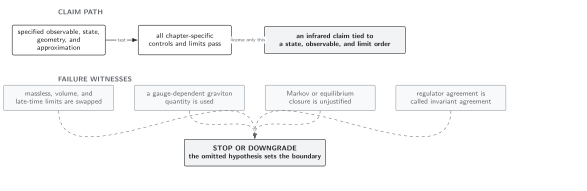
The strongest licensed statement is the fixed-order interval or resummation need for the exact renormalized observable whose secular parameter reaches unity. Schematic; not to scale.
References
Section titled “References”- Garbrecht, B., F. Gautier, G. Rigopoulos, and Y. Zhu, “Feynman Diagrams for Stochastic Inflation and Quantum Field Theory in de Sitter Space,” Physical Review D 91, 063520 (2015), doi:10.1103/PhysRevD.91.063520.
- Weinberg, S., “Quantum Contributions to Cosmological Correlations,” Physical Review D 72, 043514 (2005), doi:10.1103/PhysRevD.72.043514.
Original QFT.org content:CC BY 4.0, unless an item supplies different terms. Third-party material retains its own terms.