

Detector Response Along Curved and Accelerated Worldlines
A localized detector responds to the field’s two-point function pulled back to its own proper-time history. Geometry and state enter through that distribution; acceleration and rotation enter through the worldline; switching, smearing, and the energy gap define the apparatus. The result is a transition probability or rate for that protocol, not an observer-independent particle density.
Required background. Particles, Local Observables, and Detector Dependence supplies the observable distinction; Green Operators, Causal Propagators, and State-Dependent Two-Point Functions supplies ; Localized Probe and Detector Models supplies the two-level model.
Helpful background. Particle Detectors versus Field Observables clarifies interpretation; Wavepackets, Modes, Frames, and Localization supplies finite resolution; System–Probe Scattering and Measurement Models gives the broader measurement setting.
Response along a timelike worldline
Section titled “Response along a timelike worldline”For a detector following , take the interaction Hamiltonian in detector proper time
With detector gap , first-order transition amplitudes give the second-order response
A spatially smeared detector replaces by an integral over a profile in a specified comoving frame. Smooth switching and a Hadamard state make the pullback and pairing well controlled; Louko and Satz derive a regulator-free expression in four-dimensional curved spacetime Louko and Satz 2008, §§2–4.
When the pulled-back two-point function is stationary,
the long-time response rate is its Fourier transform,
This rate exists only under an appropriate stationary or asymptotic limit. A finite probability divided by an arbitrary duration is not automatically the same object.
First application: inertial and circular motion
Section titled “First application: inertial and circular motion”Use the Minkowski vacuum of a massless scalar. Along an inertial worldline,
Its stationary Fourier transform has no excitation support for ; the ground-state detector can de-excite but does not excite in the infinite-time inertial limit.
For uniform circular motion with radius , speed , and ,
The invariant separation of two points on the orbit is
so the pulled-back Wightman function has a different pole structure and a nonzero excitation spectrum. The response is stationary because the orbit follows a Killing flow, but it is not exactly Planckian at one temperature for all gaps. Letaw classifies stationary worldlines and their vacuum excitation spectra Letaw 1981, pp. 1709–1714.
Thus one fixed state gives zero long-time inertial excitation and nonzero circular excitation. The difference belongs to the trajectory and coupling, not to a changed state particle population.
Adversarial trajectory and duration changes
Section titled “Adversarial trajectory and duration changes”Hold fixed. Shorten the interaction so that broadens, or perturb the circular orbit. The response changes, and a stationary rate may cease to exist. None of this alters the state’s inertial mode occupation.
The strongest robust report is the finite response with its switching and trajectory, or a rate after a controlled long-time limit. A detector can be a thermometer only when the pulled-back correlation satisfies the relevant detailed-balance relation over the gap range probed.
Construction and failure maps
Section titled “Construction and failure maps”In the construction map, this page chooses the detector-worldline branch and computes a switched response before interpreting it.

Detector response is a state-and-trajectory functional regulated by the apparatus protocol; the map is schematic and not to scale.
The failure map warns that acceleration, curvature, and state population cannot be inferred from one finite-time response without comparison controls.
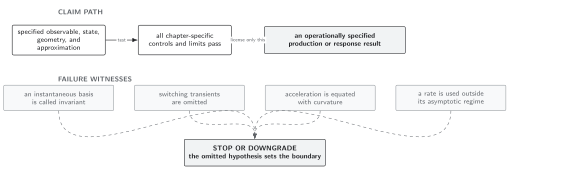
Only the declared worldline response is licensed until a stationary limit, detailed-balance test, and protocol controls justify a stronger interpretation. Schematic and not to scale.
Compare the response row in Domain and failure conditions. This page requires a timelike trajectory, proper-time gap, Hadamard pullback, smooth interaction, perturbative control, and a separate test for any claimed rate or temperature.
Check your understanding
Section titled “Check your understanding”Why does uniform circular motion not automatically produce the Unruh temperature ?
Solution
Equal proper acceleration does not fix the entire worldline two-point function. Circular and hyperbolic trajectories have different invariant separations and different complex singularities. The circular spectrum is stationary but does not satisfy one exact KMS detailed-balance relation for all gaps.
Switching, Smearing, Finite-Time Response, and Transients controls finite protocols, and Unruh Effect and Uniformly Accelerated Detectors treats the hyperbolic KMS case. Volume XIII owns the abstract detector model.
References
Section titled “References”- John R. Letaw, “Stationary World Lines and the Vacuum Excitation of Noninertial Detectors,” Physical Review D 23 (1981), 1709–1714, DOI.
- Jorma Louko and Alejandro Satz, “Transition Rate of the Unruh–DeWitt Detector in Curved Spacetime,” Classical and Quantum Gravity 25 (2008), 055012, DOI, arXiv:0710.5671.
- William G. Unruh, “Notes on Black-Hole Evaporation,” Physical Review D 14 (1976), 870–892, DOI.
Original QFT.org content:CC BY 4.0, unless an item supplies different terms. Third-party material retains its own terms.