

Stress-Tensor Flux and Two-Dimensional Reductions
A Hawking occupation number and an energy flux are different observables. In two dimensions the renormalized stress tensor can be fixed by conservation, the trace anomaly, and state boundary conditions; for a conformal field its outgoing flux is encoded directly by the null ray map. Lifting that result to four dimensions requires the angular reduction, dilaton terms, greybody transmission, and the correct asymptotic area normalization.
Required background. Collapse radiation supplies the null map, causal propagators fixes the state two-point function, and the Hadamard parametrix supplies local stress renormalization.
Helpful background. Moving mirrors provides the conformal ray-map analogue, and in–out versus in–in observables distinguishes a physical state expectation from an effective-action amplitude.
Null stress from a ray map
Section titled “Null stress from a ray map”For a two-dimensional conformal field of central charge , choose an in-vacuum defined by affine null coordinate . In an asymptotically flat outgoing region, the state-dependent renormalized flux is
where
is the Schwarzian derivative. Local geometric polarization terms must be retained away from the asymptotically flat region; their curvature-anomaly sign must be translated with the site’s curvature convention.
For ,
This is the chiral thermal energy flux at . It is finite even though a continuum number integral can require infrared care. Christensen and Fulling derive the two-dimensional black-hole flux from conservation, anomaly, and horizon regularity (1977, §§ III–IV).
The structure map places stress renormalization in the last box. The near-horizon thermal relation fixes a source term, but a measured asymptotic flux requires state boundary conditions and, in higher dimensions, the scattering step.

Stress flux as the final observable in the Hawking construction. The diagram is schematic and not to scale; the two-dimensional Schwarzian result does not itself contain four-dimensional greybody data.
The failure map targets the most common uplift error: treating a KMS or two-dimensional flux as a four-dimensional luminosity without angular modes and transmission factors.
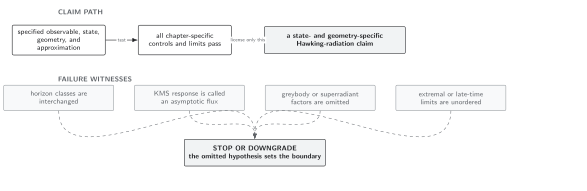
Failure boundary for flux uplift. This schematic, not-to-scale map licenses the two-dimensional channel result while downgrading any uncontrolled area-multiplied luminosity.
Application: collapse flux and one partial wave
Section titled “Application: collapse flux and one partial wave”For the exponential collapse map and one massless scalar channel, gives
If the map contains subleading time dependence, the full Schwarzian gives the transient flux. A negative transient is possible without violating the late positive value; local renormalized energy densities need not be pointwise positive.
Spherical reduction of a four-dimensional scalar writes
Near a nonextremal horizon, the potential vanishes and each partial wave is approximately a two-dimensional channel. Away from the horizon, the centrifugal and curvature potential scatter it. The asymptotic four-dimensional energy spectrum is therefore
for a neutral boson in the Unruh state, with additional polarizations or species as appropriate. The factor and the degeneracy are absent from the single two-dimensional flux.
Multiplying by is dimensionally tempting but wrong: it neither reconstructs the spherical harmonic normalization nor solves the radial barrier. At low frequency the Schwarzschild scalar wave has , far from unit transmission. The strongest controlled uplift before solving scattering is only the near-horizon result for one radial channel.
Domain and failure conditions
Section titled “Domain and failure conditions”Consult the chapter domain and failure-conditions table. The Schwarzian formula assumes a two-dimensional conformal channel, an affine in-vacuum coordinate, Hadamard renormalization, and an asymptotically flat . It licenses and its transients. A four-dimensional flux additionally requires angular degeneracies, the reduced-field normalization, dilaton/geometric terms, and . Omitting them forces a downgrade to a channel-level result; it cannot be handed to backreaction as a luminosity.
Exercise
Section titled “Exercise”Evaluate the Schwarzian for .
Solution
, , and . Hence
which gives .
Handoff
Section titled “Handoff”The next page derives the same temperature scale from Euclidean smoothness and KMS analyticity, while emphasizing that equilibrium thermality need not imply an outward net flux.
References
Section titled “References”- Christensen, Steven M., and Stephen A. Fulling. “Trace Anomalies and the Hawking Effect.” Physical Review D 15 (1977): 2088–2104. doi:10.1103/PhysRevD.15.2088.
- Davies, P. C. W., Stephen A. Fulling, and William G. Unruh. “Energy-Momentum Tensor Near an Evaporating Black Hole.” Physical Review D 13 (1976): 2720–2723. doi:10.1103/PhysRevD.13.2720.
Original QFT.org content:CC BY 4.0, unless an item supplies different terms. Third-party material retains its own terms.