

Interacting Fields and Local Covariant Renormalization
Perturbation theory on a curved background is viable only when its ultraviolet subtractions are formulated with the same locality and covariance as the underlying field theory. This chapter builds that formulation from renormalized time-ordered products and compactly supported interactions, then tracks the finite curvature freedom through running couplings, background splitting, Ward identities, gauge theory, the operator-product expansion, and infrared limits. The endpoint is a one-loop scalar benchmark in which the state, subtraction, counterterms, and comparison rules are all explicit.
Helpful background. Products, scaling degree, and distributional extensions explains why coincident-point products require extensions; local counterterms and subdivergences supplies the general locality argument; and the Hadamard parametrix identifies the state-independent short-distance singularity used below.
Enter the local interacting theory
Section titled “Enter the local interacting theory”Let be a time-oriented globally hyperbolic spacetime. The metric has signature , and curvature signs follow the volume conventions. For a real scalar, a useful reference action is
With the site’s Riemann convention this action gives and the four-dimensional conformal value is . Sources using instead have ; their quoted nonminimal coupling must be translated before comparison.
The formal expression is familiar, but three flat-space shortcuts are unavailable in general. There need not be a preferred vacuum, a Fourier transform, or an asymptotic scattering region. Ultraviolet singularities must therefore be extended in position space; the extension may use only local geometric data; and the interaction is first switched on with compact support. Hollands and Wald showed that locality, covariance, scaling, microlocal regularity, and causal factorization leave precisely finite local covariant ambiguities rather than arbitrary background-dependent subtractions (Hollands and Wald 2001, §§ 4–5; Hollands and Wald 2002, §§ 3–4).
This gives a practical separation of questions:
- Ultraviolet definition: which distribution is being extended to which diagonal, and with what scaling degree?
- Finite local freedom: which matter and curvature operators can be added consistently?
- Structural identities: do causal factorization, field equations, diffeomorphism or BRST identities, and perturbative agreement hold for one common prescription?
- State and infrared input: which Hadamard state is used, and is the claim local or does it require a global switching limit?
The construction is perturbative: interacting fields are formal power series unless a separate convergence result is supplied. It treats quantum matter on a prescribed classical geometry. Matter-induced geometric counterterms are included because they occur in the effective action and stress tensor, but graviton loops are not.
The construction map should be read from left to right. In this chapter, the important transition is from free Hadamard products to locally extended time-ordered products; every later interacting observable inherits the locality, covariance, scaling, causal, and Ward-identity checks marked beneath that transition.

Controlled construction of perturbative interacting observables. The route is schematic and not to scale; a global adiabatic limit is deliberately shown as an additional, possibly obstructed step rather than part of the local definition.
The companion map states the claim rule used throughout the chapter. Inspect the lower branches: a nonlocal counterterm, broken causal factorization, surviving split dependence, or uncontrolled infrared limit stops the argument at the first failed hypothesis.
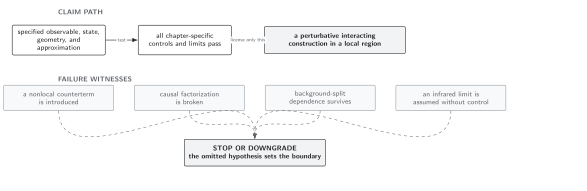
Validity path for the chapter’s claims. This schematic, not-to-scale map makes the omitted hypothesis the boundary of the result: passing all local checks licenses a perturbative construction in a local region, not an automatic global interacting theory.
Route by the missing datum
Section titled “Route by the missing datum”The pages are ordered so that each new constraint acts on objects already defined.
| Order | Use this page when the missing step is… |
|---|---|
| 1 | Why local and covariant renormalization is compulsory: the subtraction must be compatible with embeddings of locally identical backgrounds. |
| 2 | Interacting correlators and time-ordered products: a singular coefficient distribution must be extended to a partial or total diagonal. |
| 3 | Curvature counterterms and operator mixing: the allowed finite local basis, especially mixing with , is incomplete. |
| 4 | Local S-matrices and causal factorization: the interaction must define local observables without presupposing a global S-matrix. |
| 5 | Running couplings and curvature couplings: a scale change or finite redefinition must be translated between coupling coordinates. |
| 6 | Background splitting and perturbative agreement: the same quadratic term has been assigned differently to the free and interacting actions. |
| 7 | Interacting stress tensors and Ward identities: metric variation, contact terms, and conservation must be imposed together. |
| 8 | Gauge, BRST, and BV interfaces: gauge-fixed products must descend to physical cohomology and satisfy the master identity. |
| 9 | The curved-space OPE: state-independent short-distance coefficients must be distinguished from expectation values. |
| 10 | Adiabatic limits and infrared obstructions: a local construction is being promoted to a global state or constant-coupling limit. |
| 11 | The curved benchmark: state, scale, geometry, counterterms, and one-loop errors must be checked in one reproducible example. |
Domain and failure conditions
Section titled “Domain and failure conditions”The table is a compact claim-domain record. A result should be stated no more broadly than the row whose hypotheses have actually been verified.
| Claimed result | Domain that must be declared | Required check | Failure condition and surviving claim |
|---|---|---|---|
| Renormalized local product | Convex normal neighborhoods or globally hyperbolic region; field content; diagonal being extended | Wavefront compatibility off the diagonal and a local covariant extension with bounded scaling degree | If the unextended product is undefined, only the separated-point distribution survives. |
| Interacting observable | Compact support of interaction and observable; perturbative order | Causal factorization and independence from switching changes outside the relevant causal region | Failure of a constant-coupling limit does not remove the compactly supported local observable. |
| Counterterm classification | Dimension, symmetries, equations-of-motion quotient, boundary assumptions | Complete local scalar/tensor basis including curvature terms | A flat-space list supports only the flat or zero-curvature restriction. |
| Running coupling | Coupling normalization, subtraction scheme, operator basis, scale convention | Transform beta functions and operators under every finite redefinition used in the comparison | An individual beta coefficient is not comparable until the coupling coordinates are matched. |
| Split-independent prediction | Two free/interacting splits and the map between their propagators, states, and counterterms | Perturbative agreement through the stated order | Holding the state or finite terms fixed after changing the split proves only a mismatch of descriptions. |
| Stress-tensor identity | Definition by metric variation, insertion convention, contact terms, anomaly class | Distributional Ward identity, not merely conservation away from insertions | If contacts are omitted, separated-point conservation is the strongest remaining statement. |
| Gauge-independent observable | Gauge fixing, ghost/antifield complex, support, anomaly cohomology | Renormalized master identity and BRST-closed observable modulo exact terms | Coordinate covariance alone does not imply gauge independence. |
| OPE truncation | Coalescence scaling, operator basis, perturbative and engineering-dimension order, class of Hadamard states | Remainder estimate and associativity on overlapping fusion limits | A fit to one raw state-dependent correlator is not a state-independent Wilson coefficient. |
| Global interacting state | Geometry, spectrum or mass gap, switching sequence, state topology | Uniform infrared control beyond every fixed compact region | Local algebraic convergence alone yields a local net, not a global vacuum or KMS state. |
What a complete calculation should report
Section titled “What a complete calculation should report”A reproducible curved-space perturbative result names the background and boundary assumptions; free operator and propagator; Hadamard state or state class; interaction and switching function; perturbative and derivative orders; extension prescription; complete finite local basis; Ward or master identities; renormalization scale and scheme; and the local or global character of the observable. It should also give at least one independent check—flat or ultrastatic limit, causal support, scale translation, background-split agreement, or a Ward identity—and separate truncation error from unproved convergence.
The proof-level construction and classification of perturbative algebraic QFT are developed in the Mathematical QFT volume. Here the goal is physical use: enough structure to perform, compare, and falsify interacting calculations on curved backgrounds.
References
Section titled “References”- Brunetti, Romeo, and Klaus Fredenhagen. “Microlocal Analysis and Interacting Quantum Field Theories: Renormalization on Physical Backgrounds.” Communications in Mathematical Physics 208 (2000): 623–661. doi:10.1007/s002200050004.
- Hollands, Stefan, and Robert M. Wald. “Existence of Local Covariant Time Ordered Products of Quantum Fields in Curved Spacetime.” Communications in Mathematical Physics 231 (2002): 309–345. doi:10.1007/s00220-002-0719-y.
- Hollands, Stefan, and Robert M. Wald. “Local Wick Polynomials and Time Ordered Products of Quantum Fields in Curved Spacetime.” Communications in Mathematical Physics 223 (2001): 289–326. doi:10.1007/s002200100540.
- Hollands, Stefan, and Robert M. Wald. “Quantum Fields in Curved Spacetime.” Physics Reports 574 (2015): 1–35. doi:10.1016/j.physrep.2015.02.001.
Original QFT.org content:CC BY 4.0, unless an item supplies different terms. Third-party material retains its own terms.