

Quantum Trapped Surfaces and Semiclassical Singularity Theorems
A quantum trapped surface is a compact cut whose generalized entropy decreases under both future-directed null deformations. It replaces a pointwise stress assumption with a renormalized stress–entropy statement. Semiclassical singularity theorems built from such a cut conclude null geodesic incompleteness only after adding precise causal, regularity, entropy, and completeness hypotheses; they do not determine whether the endpoint is a curvature blow-up, a boundary of an effective description, or a transition to quantum gravity.
Required background. Quantum expansion and the covariant entropy bound defines the entropy variation; Raychaudhuri evolution and null focusing supplies the classical local mechanism; and ANEC distinguishes integrated stress hypotheses from entropy hypotheses.
Helpful background. The generalized second law supplies the horizon monotonicity input, while global hyperbolicity supplies the causal compactness step.
Quantum trapped cuts
Section titled “Quantum trapped cuts”Let be a smooth compact spacelike codimension-two cut with future null normals and . For a deformation along , define the renormalized quantum expansion
in units . The stress tensor, entropy, Newton coupling, and local geometric terms must be expressed in one prescription. A cut is future quantum trapped when
for every generator, after the orientations and the choice of “outside” have been fixed. This is stronger than negative ordinary expansion and different from . In the classical limit, when entropy variations are subleading, reduces to the ordinary null expansion .
There are two logically different routes from this initial datum.
- A generalized-second-law route compares generalized entropy on suitable causal horizons. Wall’s theorem shows, under its global and semiclassical assumptions, that an appropriate quantum trapped surface is incompatible with future null completeness if the generalized second law holds (Wall 2013, §§ 2–4).
- A generalized-focusing route assumes a specified form of quantum focusing, propagates the sign of , and then invokes a global causal argument. Its force is only that of the chosen focusing statement; the status of QFC variants cannot be omitted.
Neither route follows merely from QNEC at one cut. QNEC constrains a diagonal second entropy variation under additional local hypotheses, whereas a singularity theorem needs control along generators and a global conclusion.
The structure map separates the initial quantum trapped cut, the entropy or focusing input, and the causal theorem. Each arrow has an independent domain.

Logical structure of a semiclassical singularity theorem. The diagram is schematic and not to scale; a negative quantum expansion is initial data, while generalized-entropy control and the global causal step are separate hypotheses.
A theorem chain with all assumptions visible
Section titled “A theorem chain with all assumptions visible”Consider a globally hyperbolic semiclassical spacetime with a noncompact Cauchy surface and a compact future quantum trapped surface . Choose the outward future null congruence and suppose:
- the metric and quantum state are regular enough for and its first null variation to exist;
- the relevant renormalized generalized entropy uses fixed couplings and a common stress–entropy prescription;
- the causal-horizon form of the generalized second law applies to the horizons used in the comparison;
- the null generators admit the completeness and causal-boundary constructions required by the theorem; and
- fluctuations are controlled well enough that a mean semiclassical geometry and generalized entropy are meaningful.
Assume for contradiction that every relevant future null generator is complete. The boundary of the future of can then be followed far enough to compare its cuts with the causal horizons used in the generalized-second-law argument. Quantum trapping says that an outward displacement initially lowers . The causal comparison transfers that decrease to a horizon ordering for which the generalized second law requires nondecrease. The assumptions therefore cannot all coexist with future null completeness. The conclusion is that at least one future-directed null geodesic is incomplete.
This is the quantum analogue of the logic, not a term-by-term replacement, of the Penrose theorem. In the classical proof, negative ordinary expansion and generate conjugate points, after which global hyperbolicity and a noncompact Cauchy surface make a compact future boundary impossible (Penrose 1965, pp. 57–59). In the entropy proof, the contradiction is formulated with generalized entropy and horizon monotonicity. In both cases, local sign information alone is insufficient.
The conclusion is deliberately modest:
It does not imply divergence of a curvature scalar, identify a unique singular endpoint, prove cosmic censorship, or validate the semiclassical equation arbitrarily close to the incomplete boundary.
Two adversarial removals
Section titled “Two adversarial removals”First remove global hyperbolicity while retaining the local cut and entropy sign. A causal curve may escape through a timelike boundary, identification, or Cauchy horizon; the compactness comparison used in the global step no longer follows. The local quantum-trapped calculation can remain correct while the singularity-theorem conclusion is unlicensed.
Next retain global hyperbolicity but remove the strict entropy sign on part of . If becomes positive on even a subset of generators, “quantum trapped” is no longer established. An averaged negative value is not a substitute unless the cited theorem is explicitly formulated with that average. Likewise, substituting an unrenormalized entropy or changing the outside convention can reverse the apparent sign without changing the physics.
The failure map should therefore be read as a sequence of possible downgrades, not as alternative names for one assumption.
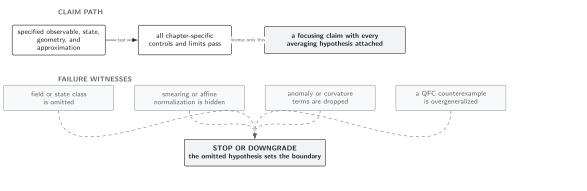
Failure conditions for a quantum singularity theorem. The diagram is schematic and not to scale; removing a global causal hypothesis or the pointwise quantum-trapped sign blocks a different step of the argument even when all earlier calculations remain valid.
Domain and failure conditions
Section titled “Domain and failure conditions”See the chapter domain and failure-conditions table. The theorem chain above concerns a compact quantum trapped cut, a controlled semiclassical state, a fixed generalized-entropy prescription, an applicable horizon law, and the stated global causal hypotheses. It yields geodesic incompleteness. It does not describe the high-curvature endpoint, apply across arbitrary timelike boundaries, or turn a conjectural focusing principle into a theorem.
Exercise
Section titled “Exercise”Explain why on average over does not establish that is quantum trapped under the definition used here.
Solution
Quantum trapping is a generator-by-generator sign condition. A negative integral
allows on part of the cut. Those generators need not obey the initial decrease required by the causal comparison or a pointwise focusing hypothesis. An averaged condition can be used only with a theorem proved for that particular averaging prescription.
References
Section titled “References”Original QFT.org content:CC BY 4.0, unless an item supplies different terms. Third-party material retains its own terms.