

Many-Body QFT and Quantum Matter
Many-body quantum field theory explains how a microscopic Hamiltonian becomes a low-energy account of matter: which degrees of freedom survive, which collective variables emerge, what a detector or calculation actually measures, and how strongly the result supports a phase or mechanism. The reliable route is therefore not “choose a named phase and fit it.” It is
This volume develops that chain for quantum gases, correlated electrons, paired matter, impurities, one-dimensional systems, magnets, critical metals, topological and fractionalized phases, disorder, synthetic platforms, integrable systems, and driven or open matter. It is intended both for a first graduate encounter and for readers who need to move between theory, computation, and experiment. The field-theoretic viewpoint and its range of many-body applications are developed systematically in Altland and Simons 2023, Parts I–II and Coleman 2015, chs. 1–18.
Helpful background. Canonical quantization and Fock space supply the operator language. Symmetry realization supplies order parameters and phases, power counting supplies scale separation, and thermodynamic response with retarded correlators supplies the state and observable grammar. These are recommended repairs, not requirements for reading this overview.
Begin with the object and the claim
Section titled “Begin with the object and the claim”An evidence-qualified quantitative claim about quantum matter becomes assessable only after six declarations.
- Degrees of freedom: particles, bands, orbitals, spins, partons, defects, or collective fields, together with all constraints and redundancies.
- State and setting: dimension, geometry, density, temperature, boundary conditions, preparation, drive, bath, and order of limits.
- Observable: an operator or response function with normalization, causal prescription, probe kernel, and sum rules.
- Control: a small parameter, exact identity, symmetry, dimensional or large-coordination limit, converged numerical representation, or calibrated experimental hierarchy.
- Failure test: a Ward identity, sum rule, competing approximation, cutoff scan, held-out observable, alternative mechanism, or null control.
- Conclusion: the strongest statement that survives the weakest element of the preceding chain.
The same Hamiltonian can produce different effective fields in different windows, and the same low-energy spectrum can support different microscopic interpretations. Conversely, an exact finite-size calculation can fail to identify a thermodynamic phase. The diagram shows the information that must travel with a conclusion; dashed connections are handoffs, not shortcuts.
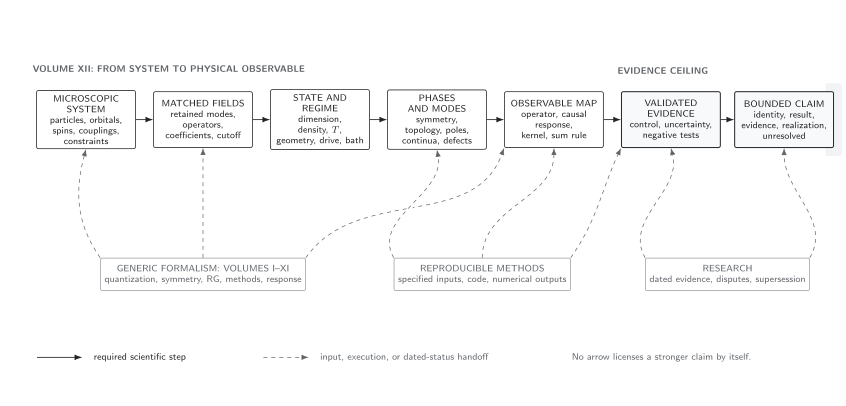
A defensible many-body claim connects a declared microscopic system to matched low-energy variables, a state and regime, physical excitations, a normalized observable, and independently tested evidence. Earlier volumes develop the generic formalism, versioned calculation packages provide executable implementations, and dated Research records track changing material or frontier status. The map is schematic and not to scale.
The solid scientific path has the following nonvisual form:
| Stage | Question that must be answered | Scientific output | Failure that stops the claim |
|---|---|---|---|
| Microscopic system | Which particles, orbitals, spins, couplings, symmetries, and constraints are present? | Hamiltonian or action with a state-preparation protocol | A model name without calibrated parameters or constraints |
| Low-energy reduction | Which modes are retained, integrated out, or gauge redundant, and at what matching scale? | Effective fields, operators, coefficients, and breakdown scale | A continuum model asserted without scale separation or matching |
| State and regime | What are the dimension, density, temperature, geometry, drive, bath, and limit order? | A specified ensemble or dynamical state | Phase language detached from dimension or thermodynamic limit |
| Phases and excitations | Which symmetry, topology, fractionalization, poles, continua, or collective modes are predicted? | Candidate phase data and observable consequences | Mean field, a parton ansatz, or one finite system treated as the physical phase |
| Correlator and response | Which operator and causal function couples to the probe? | Normalized spectral, transport, thermodynamic, or scattering response | A pole, peak, stiffness, or fitted rate used without its sum rule and limits |
| Evidence | Which analytic, numerical, and experimental tests are independent? | Uncertainty-aware comparison with alternatives and negative controls | Shared assumptions counted as independent confirmation |
| Claim | What statement remains after every declared limitation? | Identity, controlled result, evidence, realization, or unresolved status | Theory existence promoted to material identification or mechanism |
The dashed handoffs do not replace a scientific step. Their exact adjacencies are:
| Provider | Target stage | What the handoff supplies |
|---|---|---|
| Earlier volumes | Microscopic system | quantization and Hamiltonian language |
| Earlier volumes | Matched fields | symmetry, RG, EFT, and functional methods |
| Earlier volumes | Correlator and response | equilibrium, kinetic, hydrodynamic, and open-system response theory |
| Reproducible calculations | Phases and excitations | executable spectrum, state, and diagnostic calculations |
| Reproducible calculations | Correlator and response | frozen-input numerical observables and normalization checks |
| Reproducible calculations | Evidence | reproducible outputs, tolerances, convergence, and failure cases |
| Research | Evidence | dated measurements, benchmarks, disputes, corrections, and replications |
| Research | Claim | supersession-aware status of platform, material, and frontier interpretations |
Download the structured node-and-edge data (JSON), which preserves every node, solid step, dashed handoff, grouping, and line-style meaning encoded by the figure.
Choose a chapter by the missing link
Section titled “Choose a chapter by the missing link”The chapters appear below in their sidebar order. This order makes the main dependencies visible, but it is not a compulsory curriculum.
| Chapter | Begin here when… | Exit capability |
|---|---|---|
| 1. Nonrelativistic Fields and Low-Energy Reduction | the particles and microscopic Hamiltonian are known but the field variables or power counting are not | construct second-quantized and coherent-state descriptions, match continuum fields, and test currents and finite-density Goldstone counting |
| 2. Many-Body Correlators, Response, and Quasiparticles | a Green function, self-energy, screening approximation, or collective pole needs a physical interpretation | move among spectral, retarded, vertex, dielectric, and conserving descriptions with Ward and sum-rule checks |
| 3. Resonant Interactions and Universal Quantum Gases | a contact coupling must be replaced by scattering data or a resonance model | connect scattering length, range, shallow poles, Tan relations, virial data, Efimov input, and loss to a declared universality window |
| 4. Bose Quantum Fluids and Lattice Bosons | condensation, superfluidity, Bogoliubov modes, BKT behavior, or a Bose–Hubbard transition is at issue | distinguish order from response and derive controlled dilute, hydrodynamic, low-dimensional, and lattice-boson results |
| 5. Fermi Surfaces and Fermi Liquids | low-energy fermions live near a Fermi surface | derive Landau response, self-energy criteria, Luttinger constraints, zero sound, and patch-flow instabilities with conventions explicit |
| 6. Correlated Lattice Fermions and Mott Physics | localization by interactions, spectral-weight transfer, or a solver-based phase claim must be diagnosed | distinguish band, Slater, Mott, charge-transfer, and Anderson physics and assess the validity of DMFT, cluster, and QMC evidence |
| 7. Pairing, Superfluidity, and Superconductivity | a Cooper instability, stiffness, vortex, pairing symmetry, or Majorana claim is central | connect BCS, Nambu–Gor’kov, BdG, collective, electromagnetic, Eliashberg, topological, and evidence descriptions without conflating them |
| 8. Quantum Impurities, Polarons, and Kondo Matter | a local degree of freedom reorganizes a bath or lattice | derive Anderson-to-Kondo matching, screening and strong coupling, polaron structure, solver tests, heavy Fermi volumes, and breakdown evidence |
| 9. One-Dimensional Quantum Matter | fermions, bosons, or spins require a compact bosonic description | translate Jordan–Wigner and bosonization conventions, calculate Luttinger exponents, and analyze commensurability and boundary flows |
| 10. Quantum Magnetism and Frustration | exchange, Berry phases, magnons, sigma models, or frustrated order must be connected to probes | derive continuum and spin-wave limits and distinguish ordered, valence-bond, itinerant, and candidate frustrated regimes |
| 11. Quantum Phase Transitions and Critical Metals | zero-temperature scaling meets a Fermi surface or a contested strange-metal interpretation | construct critical fans and metallic field theories while testing hyperscaling, damping, hot-spot, local-critical, and transport claims |
| 12. Band Geometry and Symmetry-Protected Matter | Berry geometry and symmetry data must be used to diagnose an invertible band phase | calculate polarization, pumping, Chern and symmetry-class data, protected boundaries, crystalline indices, and nodal responses under the required gap, locality, charge, and symmetry hypotheses |
| 13. Fractional Quantum Hall Matter and Anyons | projected interactions are proposed to stabilize a gapped phase with intrinsic topological order | extract Hall, -matrix, anyon, edge, and entanglement data and separate theoretical order from interferometric evidence |
| 14. Fractionalization and Emergent Gauge Fields | a parton, dimer, spin-liquid, dual, or fracton description is proposed | impose constraints and projection, distinguish and regimes, and test confinement, symmetry fractionalization, and positive diagnostics |
| 15. Disorder, Localization, and Glasses | quenched randomness, diffusion, rare regions, localization, or glassiness controls the physics | use replica or supersymmetry methods and scaling diagnostics without promoting finite-size crossings to thermodynamic phases |
| 16. Cold Atoms and Synthetic Matter | an engineered platform is intended to realize a many-body model | relate trap, lattice, resonance, long-range, synthetic-gauge, or moiré scales to calibrated Hamiltonians and measured observables |
| 17. Integrable Quantum Matter and Generalized Hydrodynamics | Bethe-integrable gases or chains require state and transport predictions | move from root densities and charges to quench action, GHD evolution, diffusion, integrability breaking, and finite-size tests |
| 18. Nonequilibrium, Driven, and Open Quantum Matter | quenches, ramps, Floquet drives, constraints, or dissipation create the phenomenon | distinguish transient, prethermal, asymptotic, finite-size, heating, and open-system claims across Kibble–Zurek, scars, time crystals, and dynamical transitions |
| 19. Quantum-Matter Probes, Inference, and Evidence | a measured intensity or numerical output must become a bounded physical conclusion | propagate matrix elements, resolution, covariance, finite-size drift, discrepancy, competing models, and provenance into a reproducible claim |
Eight supported reading routes
Section titled “Eight supported reading routes”These routes reuse the same chapter contracts for different goals. Follow only the repair links and side branches needed for the stated outcome.
| Route | Recommended sequence | Outcome |
|---|---|---|
| Graduate many-body core | 1 → 2 → 4 → 5 → 7 | fields, correlators, Bose and Fermi liquids, and pairing |
| Strong-correlation route | 1 → 2 → 5 → 6 → 10 → 11 → 19 | Hubbard and Mott matter, magnetism, criticality, and evidence |
| Ultracold-gas route | 1 → 3 → 4 → 7 → 16 → 17 → 19 | resonances, quantum gases, platforms, generalized hydrodynamics, and probes |
| Low-dimensional route | 1 → 5 → 8 → 9 → 10 → 17 | impurities, bosonization, spin chains, and integrability |
| Superconductivity route | 2 → 5 → 6 → 7 → 11 → 19 | pairing theory, mechanisms, topology, and evidence |
| Topological-matter route | 2 → 10 → 12 → 13 → 14 → 19 | bands, anyons, emergent gauge fields, and diagnostics |
| Disorder and dynamics route | 2 → 11 → 15 → 18 → 19 | localization, glassiness, driven matter, and evidence limits |
| Experimental and computational inference route | Lattice Hamiltonians and Thermal and Nonequilibrium QFT as needed → 2 → selected system chapter → 19 | observable definition, method validity, and bounded inference |
Check your preparation by doing, not self-rating
Section titled “Check your preparation by doing, not self-rating”Readiness is route-specific. A failed row tells you what to repair; it does not bar entry to unrelated chapters.
| Capability | Short diagnostic | A sufficient answer includes | Repair route |
|---|---|---|---|
| Operator fields | Derive the density commutator for from canonical brackets | statistics, delta-function normalization, and operator ordering | Canonical quantization |
| Fock representation | Explain what changes when a mode is occupied by a boson rather than a fermion | commutator versus anticommutator, state normalization, and exclusion | Fock space |
| Symmetry and order | Give one observable distinction between broken symmetry and a symmetric finite-volume state | limit order, source or correlator, and an invariant response | Symmetry realization |
| Scale separation | Decide whether a derivative operator is relevant for a stated dynamical exponent | field dimensions, measure scaling, coefficient dimension, and breakdown scale | Power counting |
| Ensembles | Derive a susceptibility from | held-fixed variables, volume normalization, connected fluctuation, and thermodynamic limit | Thermodynamic response |
| Causal response | Explain why a Matsubara function cannot be replaced by a retarded function by symbol substitution | spectral representation, boundary value, analytic domain, and prescription | Retarded and spectral correlators |
Six continuous problems organize the volume
Section titled “Six continuous problems organize the volume”From a microscopic Hamiltonian to response. Start with degrees of freedom, second quantization, coherent-state fields, and low-energy matching in Chapter
- Chapter 2 adds self-energies, vertices, Ward identities, screening, and the measured response. The thread stops before a particular material is identified.
From scattering data to a quantum fluid. Chapter 3 replaces a regulator- dependent contact coupling by scattering length, effective range, resonance, and few-body data. Chapters 4 and 7 develop Bose condensation, Fermi pairing, stiffness, vortices, and collective modes; Chapters 16 and 19 close the platform-to-probe map. Loss or an uncontrolled density window stops the route.
From a Hubbard model to Mott evidence. Chapter 1 matches orbitals to fields, Chapter 5 supplies the Fermi surface, and Chapter 6 distinguishes interaction- driven localization from band, Slater, charge-transfer, and disorder effects. Chapter 19 asks whether spectral, numerical, and transport evidence actually discriminates those alternatives.
From band geometry to anyons. Chapter 12 develops Berry curvature, Chern response, pumping, and invertible boundary physics. Chapter 13 adds Landau- level projection, intrinsic topological order, fractional charge and statistics, edges, and interferometry. The transition is conceptual: a nonzero band invariant alone does not imply anyons.
From a parton ansatz to a spin-liquid claim. Chapters 10 and 14 connect microscopic exchange to partons, gauge constraints, projection, gauge dynamics, symmetry fractionalization, and candidate excitations. Chapters 15 and 19 test finite-size, disorder, and probe alternatives. Absence of magnetic order is only the beginning of this thread.
From a quench to reproducible evidence. Chapters 17 and 18 separate integrability, fragmentation, prethermalization, heating, finite observation windows, and open-system effects. Chapter 19 then combines analytic, computational, and experimental evidence without counting shared assumptions twice.
Conventions that determine physical conclusions
Section titled “Conventions that determine physical conclusions”The site-wide conventions provide natural units, the (+---) Lorentzian metric, and Fourier and causal baselines. The choices below remain local whenever the system demands it.
| Translation | Information that travels with the formula | Invariant check |
|---|---|---|
| Hamiltonian ↔ continuum fields | lattice spacing, filling, mode normalization, matching scale, irrelevant operators | spectrum or conserved charge in an overlap window |
| Operators ↔ coherent states | normal ordering, time slicing, Berry term, fermion boundary conditions | exact one-site or quadratic partition function |
| Bare contact coupling ↔ scattering data | regulator, dimension, -matrix normalization, effective range and pole sheet | phase shift or bound-state pole |
| Euclidean ↔ spectral ↔ retarded functions | Fourier sign, spectral-density normalization, analytic domain and boundary value | sum rule and causal support |
| Self-energy ↔ Landau data | spin-resolved density of states, residue, mass, linewidth, static/dynamic limits | compressibility, susceptibility, or pole location |
| BCS ↔ Nambu–Gor’kov ↔ BdG | Nambu spinor, doubled-space factor, gap phase, particle–hole operation and charge | spectrum and gauge-invariant current response |
| Fermion or spin chain ↔ bosonization | normalization, compactification, zero modes, Klein factors | finite-size spectrum or correlation exponent |
| Berry or -matrix gauge ↔ physical topology | Brillouin-zone orientation, patch changes, integral basis and edge chirality | Chern number, Hall response, charge and braiding phase |
| Ideal model ↔ platform or probe | preparation, calibration, matrix element, resolution, background and covariance | held-out observable or null control |
Evidence fixes the ceiling of the conclusion
Section titled “Evidence fixes the ceiling of the conclusion”The following table gives the volume-wide evidence classes and their claim ceilings. It is not a strict total order: theorem, numerical, experimental, and platform evidence can form partly independent branches. Moving from a model-side statement toward a platform, material, or mechanism claim adds the obligations on the relevant branches; no row follows automatically from the one above it.
| Evidence level | What may be concluded | Required support | What it does not establish |
|---|---|---|---|
| Exact identity or theorem | The stated relation holds under its definitions and hypotheses | derivation or theorem with domains, state, limits, and conventions | applicability to a material, uncontrolled approximation, or different limit |
| Controlled calculation | An observable has a stated expansion or error in a declared regime | power counting, remainder or convergence evidence, and independent checks | behavior beyond the control window |
| Effective-description result | A low-energy model reproduces specified observables over a calibrated range | matching data, retained symmetries, breakdown scale, and negative tests | unique microscopic origin or universal phase identity |
| Numerical phase evidence | Finite representations support or disfavor candidate phases | symmetry sectors, cutoff and size sequences, solver errors, drift, and competing diagnostics | a thermodynamic phase boundary from one crossing or cluster |
| Experimental response evidence | A normalized response feature is present within stated uncertainty | probe matrix element, resolution, background, covariance, reproducibility, and alternatives | unique quasiparticle, order, topology, or mechanism from one feature |
| Platform realization evidence | A device or atomic system implements and probes an effective Hamiltonian in a calibrated window | preparation, scale hierarchy, loss/heating/control errors, and observable validation | exact realization outside the window or equivalence to a target material |
| Model-phase identification | A specified Hamiltonian or field theory has the stated phase under declared limits | a theorem or converged complementary diagnostics, phase-boundary control, and exclusion of viable model phases | realization of that phase in a platform or material |
| Platform, material, or mechanism attribution | Multiple independent observations favor a specific realization or mechanism over viable alternatives | calibrated model-to-system matching, joint comparison, shared-systematic accounting, predictive and null tests, and a supersession record | certainty stronger than the weakest analytic, numerical, or experimental input |
Download the structured evidence-class table (JSON), which preserves the scoped columns, row order, qualifications, and claim ceilings.
For quantum critical phenomena, even a compelling scaling collapse must retain its finite-temperature window, irrelevant variables, and competing crossover descriptions; Sachdev 2011, Parts I–III develops the relation between zero-temperature criticality and nonzero- temperature regimes. For topological and emergent-gauge descriptions, the field-theoretic map and the physical diagnostic must likewise remain distinct, as emphasized across Fradkin 2013, chs. 7–13.
Exact interfaces with the rest of QFT.org
Section titled “Exact interfaces with the rest of QFT.org”Volumes I–XI develop the generic mathematics, quantization, symmetry and gauge structure, scattering, RG and EFT, functional methods, lattice algorithms, CFT, duality, equilibrium response, kinetics, hydrodynamics, and open-system formalism used here. Volume XII treats their realization in quantum matter: the specific degrees of freedom, phase structure, observables, controlled regimes, and evidence boundaries. Later volumes address information-theoretic definitions, curved-spacetime applications, holographic models, and theorem-first many-body results.
Executable verification should accompany the corresponding calculation package. In particular, the chapter workbenches test Green functions, Bose and Fermi liquids, Mott and paired matter, impurities, one-dimensional systems, magnetism, topology, fractionalization, disorder, platforms, integrability, nonequilibrium matter, and inference. A page specifies the equations, normalizations, invariants, and pass criteria; a calculation supplies the environment, execution, frozen inputs, and numerical output.
Changing material evidence, active disputes, benchmark comparisons, and platform status belong to Research: Quantum Matter and Emergence. The durable pages here state what an observation would mean and what could falsify it. The quantum-matter pathway offers a shorter orientation route for readers assembling prerequisites.
Exercises
Section titled “Exercises”Set the claim ceiling
Section titled “Set the claim ceiling”Exact diagonalization of a 20-site disordered chain shows Poisson-like level statistics and a slowly decaying imbalance. What is the strongest immediate conclusion?
Solution
The data are finite-size evidence that this Hamiltonian, sector, disorder ensemble, and time window exhibit two diagnostics compatible with localized dynamics. They do not establish a thermodynamic many-body-localized phase or a phase boundary. One must vary size, geometry, boundary conditions, disorder samples, energy density, observation time, and interaction range; test eigenstate, dynamical, entanglement, and rare-region diagnostics; and compare thermal, prethermal, fragmented, and avalanche scenarios.
Distinguish a saddle from a mechanism
Section titled “Distinguish a saddle from a mechanism”A repulsive microscopic model admits a self-consistent -wave BCS solution. What additional work is required before claiming a pairing mechanism?
Solution
The saddle establishes a possible broken-symmetry mean-field solution within the chosen decoupling and approximation. A mechanism claim requires a derived irreducible pairing interaction, scale and channel hierarchy, control or systematic convergence, competition with other orders, gauge-invariant response, and predictions not used to choose the decoupling. Material identification additionally requires multi-probe comparison with alternative interactions and correlated uncertainties.
Build an observable chain
Section titled “Build an observable chain”Write the minimum chain needed to interpret a peak in an experimental intensity as a quasiparticle.
Solution
Specify the probe cross section and its matrix element, remove or model the background and resolution kernel, identify the associated retarded correlator and spectral normalization, and fit the pole together with the continuum. Then require a non-negligible residue, a width small compared with the relevant energy and dispersion scales, sum-rule closure, reproducibility, and agreement with at least one independent observable. A peak without these steps is a response feature, not yet a quasiparticle identification.
References
Section titled “References”- Altland, A., and Simons, B. Condensed Matter Field Theory. 3rd ed. Cambridge University Press, 2023. DOI.
- Coleman, P. Introduction to Many-Body Physics. Cambridge University Press, 2015. DOI.
- Fradkin, E. Field Theories of Condensed Matter Physics. 2nd ed. Cambridge University Press, 2013. DOI.
- Sachdev, S. Quantum Phase Transitions. 2nd ed. Cambridge University Press, 2011. DOI.
Original QFT.org content:CC BY 4.0, unless an item supplies different terms. Third-party material retains its own terms.