

Superfluid Order and Phase Stiffness
Superfluid order can be diagnosed without assigning an observable meaning to the phase of an anomalous average. In a neutral paired system, long-distance pair correlations diagnose coherence, while the equilibrium free-energy cost of a slow twist defines phase rigidity. A pairing gap or a nonzero in a symmetry-broken representation establishes neither rigidity nor its normalization by itself. This page uses for the helicity modulus of the pair phase, for the superfluid number density of constituent particles, and for their superfluid mass density. A bare symbol such as is unsafe until its definition and phase normalization are known.
Required background. Phase–density hydrodynamics supplies the long-wavelength action. Symmetry realization and Goldstone poles distinguish an order parameter from a response. Kubo response fixes the static and dynamic limits.
Pair order without an anomalous average
Section titled “Pair order without an anomalous average”Write for position and internal labels. The number-conserving two-body density matrix is
It is a positive Hermitian operator on antisymmetric two-particle wavefunctions. Its eigenproblem is
For fermions, pair off-diagonal long-range order means that at least one eigenvalue is extensive, , rather than . The associated eigenfunction is the coherent pair orbital. This statement survives in an exact fixed- state, where the particle-number-two operator obeys by number symmetry. A symmetry-broken saddle replaces the same long-distance information by a convenient complex field , but its absolute phase is representation dependent. Yang 1962, pp. 694–704 gives the density-matrix criterion and its fermion-pair interpretation.
For a neutral local singlet pair , the simpler correlator
is invariant under the global particle-number symmetry and exposes the center-of-mass coherence of that channel. Nonlocal or unconventional pairs require the corresponding bilocal . With dynamical electromagnetism, separated charged operators also require gauge transport; the Meissner-response page instead formulates the observable through a gauge-invariant current kernel.
Pair ODLRO, algebraic pair order, and stiffness answer related but distinct questions. A three-dimensional ordered phase may have an extensive ; a finite-temperature two-dimensional BKT phase has algebraically decaying and nonzero long-distance stiffness but no true ODLRO; and a gapped paired state can lose stiffness through phase disorder. The twist test below therefore measures rigidity independently of the anomalous average or gap.
Pair-phase twist and helicity modulus
Section titled “Pair-phase twist and helicity modulus”When the long-distance correlations select one pair phase, write the infrared neutral pair field as . Under the physical particle-number symmetry,
Put the system in spatial dimensions on a torus of lengths , volume , and fixed aspect ratios. Impose a small pair-phase twist
The ratio is the uniform phase gradient in direction ; repeated spatial indices below are summed. At fixed temperature and particle number, expand the Helmholtz free energy about a zero-current minimum:
This equation defines the helicity-modulus tensor . Equivalently, a finite sample supplies the estimator
A thermodynamic phase claim requires the fixed-aspect-ratio limit of this curvature; a nonzero value on one finite torus can be a finite-size flux sensitivity rather than superfluid rigidity. Kohn 1964, pp. A171–A181 explains why boundary-flux sensitivity also distinguishes conductors from insulators, while Pollock and Ceperley 1987, pp. 8343–8352 relates superfluid response to boundary motion and winding statistics. If the chosen equilibrium state is invariant under reversal of the twist, odd terms vanish and the remainder begins at . The curvature belongs to one locally stable free-energy branch; for large twists, phase slips connect different -periodic branches. Fisher, Barber, and Jasnow 1973, pp. 1111–1114 develops the boundary-twist definition and its relation to superfluid response.
For a slowly varying configuration, the same coefficient appears in the phase free energy,
This is an infrared statement. It requires wavelengths longer than every non-Goldstone correlation, healing, or amplitude length and any microscopic inhomogeneity. Those cutoffs need not equal the pair size, especially across the BCS–BEC crossover. The local phase energy does not determine the vortex-core energy or the frequency dependence of the response.
Particle-number and pair-normalized sources
Section titled “Particle-number and pair-normalized sources”The common factor-of-four ambiguity comes from coupling the same pair phase to differently normalized sources. Introduce a fictitious particle-number source , not the electromagnetic vector potential, with inverse-length units and unit charge for each constituent particle. In units with ,
Allowing a position-dependent here expresses background-field gauge covariance of the global particle-number symmetry. It does not promote particle number to a new dynamical local symmetry.
Because the pair has particle number two, the invariant phase gradient is
It is sometimes cleaner to introduce the pair-normalized source , which transforms as . Then is invariant, and the phase-only free energy is
Define the constituent-number current by and the pair-normalized current by . This is a source convention, not a claim that microscopic pair number is independently conserved. At fixed uniform phase and for a transverse source,
whereas
Thus a printed formula or may describe the same physics. The decisive question is whether the source couples to one constituent or to one pair. A smooth longitudinal source can be relaxed by changing ; a transverse source cannot be written as a phase gradient, so its equilibrium response diagnoses rigidity.
The twist–response equivalence is now explicit. Write and , where is periodic. Then
within the phase-only theory. Differentiating twice reproduces and . On a torus the uniform source represents a holonomy and cannot be removed by a single-valued gauge change. This mapping assumes that a pair phase is already a valid infrared coordinate. In the normal phase, a microscopic particle-number boundary flux can still diagnose Kohn or Drude sensitivity, but it is not a twist of a selected pair phase; size scaling and the response limit must decide which quantity was measured.
The twist above uses fixed , whereas diagrammatic response is often computed at fixed chemical potential . At a zero-current state invariant under twist reversal, the mixed derivative vanishes at zero source, so the canonical and grand-canonical quadratic curvatures agree after the thermodynamic limit. Without that symmetry or when comparing finite systems, one must perform the Legendre transform and hold the same ensemble rather than identify the curvatures by notation alone.
Static stiffness versus Drude weight
Section titled “Static stiffness versus Drude weight”For the constituent-number source, write the full response kernel in one sign convention as
is the contact term obtained by differentiating the Hamiltonian twice with respect to the source; is the current–current response. Their relative sign is contained in the definition above. Neither term is the stiffness by itself.
For , the pair-phase helicity modulus is related to the equilibrium transverse response by
Here the equilibrium zero-frequency kernel is formed first, the component transverse to a nonzero is selected, the thermodynamic limit is controlled, and only then is taken. Literature that defines the paramagnetic correlator with the opposite sign prints a subtraction rather than the sum above. The invariant checks are that the normal-state static transverse kernel vanishes in a gauge-consistent continuum calculation and that the paired phase leaves a positive curvature. In the complete density–current response, contact terms and the phase/vertex sector must restore background transversality, . A dressed propagator must therefore be accompanied by a vertex consistent with its self-energy; otherwise the cancellation and associated sum rules can fail. Nambu 1960, abstract and §§III–IV constructs the paired-state Ward identity linking those vertices to the self-energy.
The order of limits separates this equilibrium stiffness from ballistic charge or number transport. Schematically,
with the retarded continuation and any momentum-relaxing rate specified before the second limit. A clean normal system can have when its current has nonzero overlap with an exactly conserved quantity and no effective relaxation channel removes that overlap, while . Ballistic transport then persists without pair-phase rigidity. Translation invariance alone is not sufficient on a lattice, where Umklapp can relax current. Scalapino, White, and Zhang 1993, §§II–III gives the lattice response criteria and the noncommuting limits.
Our delta-function convention is . Sources that absorb the factor into the quoted weight must be translated before numerical comparison.
The transverse test has no one-dimensional version. A short-range one-dimensional system has no thermodynamic finite-temperature rigidity; at zero temperature, a Luttinger liquid is instead characterized through its twist response and long-distance correlations, with Kohn/Drude and superfluid interpretations separated by the model and limit order. Two spatial dimensions admit BKT rigidity without true long-range order, while spatial dimensions may support conventional long-range order.
The preceding collective-mode calculation writes the analytic long-wavelength kernel as . Its equals the static used here only after the phase normalization, ensemble, conserving vertex approximation, and zero-frequency/long-wavelength limit order are matched.
Helicity modulus, number density, and mass density
Section titled “Helicity modulus, number density, and mass density”In a Galilean-invariant continuum of constituents of mass , the superflow velocity associated with the pair phase is
If is the number density of constituent particles carried by the superflow, then
Comparison with the phase action gives
for an isotropic continuum in units. Restoring units gives . In a homogeneous one-component superfluid ground state, Galilean invariance forces at zero temperature even when interactions deplete the condensate. This is one reason condensate fraction and superfluid density are not interchangeable; Leggett 2006, chs. 3 and 5 develops the distinction.
To restore units in a source response, also specify the source dimension. If in the covariant derivative is retained as an inverse-length source, its curvature is . If instead is a momentum-valued source, the physical number-current kernel is . These are the same response written in two source units.
On a lattice, Galilean invariance is absent and no unique bare mass converts into a density. Band curvature, filling, and interactions enter the stiffness; in multiband systems, quantum geometry can contribute as well, as the flat-band example of Peotta and Törmä 2015, “Effective lattice Hamiltonian” through Eq. (23) makes explicit. The helicity modulus or source-response kernel is therefore the primary quantity; a reported “superfluid density” must include the conversion convention. Mixtures, multiband condensates, and components with unequal masses generally require a matrix of phase and current responses rather than the single translation used here.
Order and transport diagnostics. These quantities answer different questions even when one model relates them.
| Diagnostic | Definition used here | Does not by itself establish |
|---|---|---|
| Pair ODLRO | An eigenvalue of the fermionic two-body density matrix | A particular stiffness value in every dimension |
| Anomalous average | A charged one-point function in a symmetry-broken representation | Number-conserving order or phase rigidity |
| Condensate fraction | A macroscopic density-matrix eigenvalue divided by the relevant particle or pair number | The superfluid fraction |
| Drude weight | Homogeneous dynamic response | Equilibrium pair-phase rigidity |
Pair-phase normalization dictionary. The conversions in the last column require an isotropic Galilean continuum.
| Response quantity | Definition used here | Continuum translation |
|---|---|---|
| Pair-phase helicity modulus | Curvature with respect to | |
| Constituent-number curvature | Response to inverse-length | |
| Constituent-number current kernel | Response to momentum source | |
| Pair-normalized curvature | Response to inverse-length | |
| Superfluid number density | Constituent particles carried by superflow | |
| Superfluid mass density |
Two-dimensional phase rigidity and the BKT jump
Section titled “Two-dimensional phase rigidity and the BKT jump”At nonzero temperature in two dimensions, a short-range system with a continuous symmetry has no true long-range order in the thermodynamic limit Hohenberg 1967, pp. 383–386. Its low-temperature phase can nevertheless have algebraic correlations and nonzero helicity modulus. After short-distance fluctuations and bound vortex pairs have been absorbed into a scale-dependent modulus , the Gaussian phase field gives
Thus stiffness controls how quickly the pair phase decoheres even when the correlator tends to zero. At the BKT jump below, .
For
and a one-component elementary vortex with the smallest allowed winding , the long-distance energy is
Here is the infrared size scale, is a core-scale cutoff, and contains the nonuniversal short-distance energy. The positional entropy is . This single-vortex energy–entropy balance motivates ; the vortex-pair renormalization group establishes that the universal statement uses the large-distance renormalized modulus Kosterlitz and Thouless 1973, pp. 1181–1203:
For the inverse-length constituent-number source this is ; in a Galilean continuum it is . Quoting for would miss the pair-phase factor of four. Nelson and Kosterlitz 1977, pp. 1201–1205 derives the universal relation. If an independently allowed proliferating defect has winding , its energy scales as and the jump becomes . Fractional vortices attached to confining domain walls do not qualify as such elementary defects.
Finite systems round the jump, and the measured modulus depends on scale before the renormalization flow saturates. A nonzero or a rounded crossing on one lattice does not establish a thermodynamic BKT jump; the size dependence must follow the BKT flow or another justified scaling form. In an anisotropic system with principal moduli and , a coordinate rescaling replaces in the jump by .
A charged film has a Pearl length beyond which the vortex interaction is no longer logarithmic. In the strict infinite-film limit with finite , that screening rounds the neutral asymptotic transition; BKT-like scaling is controlled only across the window . Pearl 1964, pp. 65–66 derives the thin-film current and flux distribution. These qualifications are essential when simulations or finite films are compared with the neutral thermodynamic jump.
The chapter structure makes stiffness the bridge from a paired saddle to vortex energetics and, after coupling charge, gauge-invariant Meissner response.
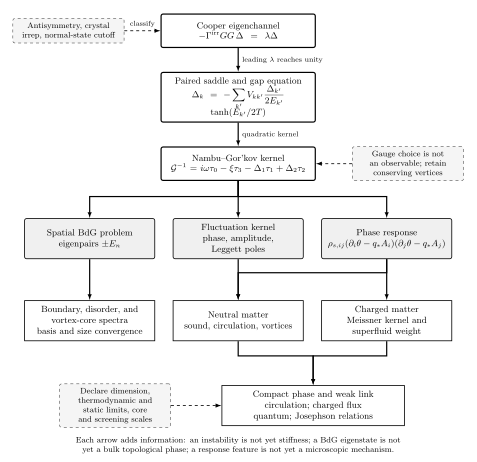
Phase stiffness is an observable free-energy curvature. It is distinct from condensate fraction, a quasiparticle gap, the homogeneous Drude weight, and the charged Meissner kernel until the appropriate hypotheses connect them. Original schematic, not to scale.
Download the SVG · Download the structured JSON equivalent
The paired-matter claim test matrix records these definitions and their negative tests.
Common pitfalls
Section titled “Common pitfalls”A gap or anomalous average is not a stiffness. Those quantities can establish pair formation or describe a chosen saddle, but rigidity requires a twist curvature or the matched static response.
Boundary-flux sensitivity or a Drude peak is not automatically superfluidity. A finite system or ballistic normal state can have such a response. The thermodynamic scaling and order of limits decide whether the result is , a Kohn curvature, or a Drude weight.
, , and charged superfluid weight are not bare synonyms. The phase charge, source units, constituent mass, electromagnetic charge, and powers of must be translated before coefficients are compared.
Exercises
Section titled “Exercises”1. Translate the source normalization
Section titled “1. Translate the source normalization”An isotropic phase-only theory is
Find the constituent-number current, its static transverse kernel, and the relation between and in a Galilean continuum.
Solution
By definition,
At fixed uniform phase, , so . The superflow velocity is , and matching to the phase free energy gives in units. Therefore . If instead one differentiates with respect to , the pair-normalized kernel is .
2. Separate stiffness from ballistic transport
Section titled “2. Separate stiffness from ballistic transport”Consider a Galilean-invariant normal continuum in which the current is proportional to conserved momentum and no relaxation channel is present. Its response has
Which quantity is the equilibrium pair stiffness, which is the Drude weight, and why does not establish superfluidity?
Solution
The first limit is the static transverse equilibrium kernel. In a paired phase it would equal , so its vanishing implies no pair-phase helicity modulus. The second limit is the homogeneous dynamic response and defines the Drude weight. It is nonzero here because the current overlaps an exactly conserved momentum. Persistent ballistic transport is compatible with an ordinary normal state; superfluidity additionally requires the equilibrium twist curvature or static transverse rigidity. Broadening a normal-state Drude peak alone neither creates nor diagnoses a helicity modulus.
3. Derive and translate the BKT jump
Section titled “3. Derive and translate the BKT jump”For a two-dimensional pair phase, use the vortex energy and positional entropy to find the unbinding criterion. Translate it into the constituent-number kernel and, for a Galilean continuum, into .
Solution
The logarithmic part of the vortex free energy is
It changes sign at . The full BKT argument identifies with the large-distance renormalized modulus just below the transition. Since for the inverse-length source,
In a Galilean continuum, when the source is written in inverse-length units, so
The factor eight rather than two reflects that counts constituent particles while is the phase of a number-two pair. A convention in which counts pairs and the mass is gives the same physical jump.
4. Classify order, rigidity, and transport
Section titled “4. Classify order, rigidity, and transport”Compare three systems:
- a homogeneous Galilean paired superfluid at with an extensive pair-density-matrix eigenvalue but a condensate fraction below one;
- a two-dimensional BKT phase at with and ; and
- the ballistic normal continuum from Exercise 2.
Which has pair ODLRO, algebraic pair order, helicity modulus, and Drude weight?
Solution
System 1 has pair ODLRO and nonzero helicity modulus. Galilean invariance gives at , even though the condensate fraction can be smaller than one; its homogeneous transport is also nondissipative in the ideal limit.
System 2 has algebraic pair order and nonzero long-distance helicity modulus, but no true finite-temperature ODLRO in the thermodynamic limit. Its BKT classification follows from correlations and the scale-dependent twist response, not from a nonzero one-point anomalous average.
System 3 has a Drude weight but neither pair ODLRO nor pair-phase helicity modulus. The example isolates why ballistic transport and superfluid order require different limits.
Continue
Section titled “Continue”The collective-mode page supplies the dynamic phase pole whose gradient coefficient must be matched to . Gauge-invariant Meissner response couples the same phase normalization to electromagnetism and derives . Vortices and topological defects owns compact winding, circulation, interactions, charged-vortex energetics, and core structure beyond the long-distance estimate used here.
References
Section titled “References”- Fisher, M. E., Barber, M. N., and Jasnow, D. (1973). “Helicity modulus, superfluidity, and scaling in isotropic systems.” Physical Review A 8, 1111–1124. doi:10.1103/PhysRevA.8.1111.
- Hohenberg, P. C. (1967). “Existence of long-range order in one and two dimensions.” Physical Review 158, 383–386. doi:10.1103/PhysRev.158.383.
- Kohn, W. (1964). “Theory of the insulating state.” Physical Review 133, A171–A181. doi:10.1103/PhysRev.133.A171.
- Kosterlitz, J. M., and Thouless, D. J. (1973). “Ordering, metastability and phase transitions in two-dimensional systems.” Journal of Physics C: Solid State Physics 6, 1181–1203. doi:10.1088/0022-3719/6/7/010.
- Leggett, A. J. (2006). Quantum Liquids: Bose Condensation and Cooper Pairing in Condensed-Matter Systems. Oxford University Press. doi:10.1093/acprof:oso/9780198526438.001.0001.
- Nambu, Y. (1960). “Quasi-particles and gauge invariance in the theory of superconductivity.” Physical Review 117, 648–663. doi:10.1103/PhysRev.117.648.
- Nelson, D. R., and Kosterlitz, J. M. (1977). “Universal jump in the superfluid density of two-dimensional superfluids.” Physical Review Letters 39, 1201–1205. doi:10.1103/PhysRevLett.39.1201.
- Pearl, J. (1964). “Current distribution in superconducting films carrying quantized fluxoids.” Applied Physics Letters 5, 65–66. doi:10.1063/1.1754056.
- Peotta, S., and Törmä, P. (2015). “Superfluidity in topologically nontrivial flat bands.” Nature Communications 6, 8944. doi:10.1038/ncomms9944.
- Pollock, E. L., and Ceperley, D. M. (1987). “Path-integral computation of superfluid densities.” Physical Review B 36, 8343–8352. doi:10.1103/PhysRevB.36.8343.
- Scalapino, D. J., White, S. R., and Zhang, S. C. (1993). “Insulator, metal, or superconductor: The criteria.” Physical Review B 47, 7995–8007. doi:10.1103/PhysRevB.47.7995.
- Yang, C. N. (1962). “Concept of off-diagonal long-range order and the quantum phases of liquid helium and of superconductors.” Reviews of Modern Physics 34, 694–704. doi:10.1103/RevModPhys.34.694.
Original QFT.org content:CC BY 4.0, unless an item supplies different terms. Third-party material retains its own terms.