

Bose Quantum Fluids and Lattice Bosons
A Bose-matter statement is justified only after four questions have been answered separately: what long-distance order exists, what response is nonzero, in what dimension and order of limits the statement is made, and which small parameter controls the calculation. This chapter develops that discipline from the ideal gas through dilute superfluids, low-dimensional fluids, the Bose–Hubbard model, and self-bound droplets Pitaevskii and Stringari 2016, chs. 2–9.
The chapter covers Bose-fluid and lattice-boson realizations. General equilibrium and hydrodynamic formalisms are developed in Volume XI, while generic renormalization-group constructions are developed in Volume V. Numerical benchmarks should publish their code, frozen inputs, and checks; changing platform records belong in Research.
Helpful background. Ideal-gas condensation supplies Bose occupations and thermodynamic-limit counting; contact interactions and the scattering length supplies the low-energy matching used for dilute gases.
Enter this chapter
Section titled “Enter this chapter”You are ready for the main route if you can (i) obtain Bose occupation numbers from a grand-canonical ensemble, (ii) distinguish a one-body density matrix from a response coefficient, and (iii) replace a bare three-dimensional contact coupling by the scattering length. If the third step is unfamiliar, begin with short-range scattering data. For the quickest conceptual entry, start with the ideal gas and then separate condensation from superfluidity.
| Reader goal | Suggested route | Capability at the end |
|---|---|---|
| Graduate core | Ideal gas → distinctions → weak gas → Bogoliubov theory → phase–density EFT | Derive the equation of state, sound mode, depletion, and stiffness without conflating them |
| Low dimensions | Phase–density EFT → BKT → one-dimensional fluids | Decide whether order is true long-range, algebraic, or absent and identify the controlling infrared theory |
| Lattice bosons | Bose–Hubbard limits → superfluid–Mott criticality | Separate an atomic charge gap from critical scaling at a lobe tip or edge |
| Beyond mean field | Bogoliubov theory → dilute expansion → droplets | Track the gas parameter, ultraviolet matching, and metastability ceiling |
Order, response, and control
Section titled “Order, response, and control”The diagram should be read from left to right: a microscopic Bose Hamiltonian supplies a state and dimension; correlation functions establish condensation or algebraic order; free-energy response establishes stiffness; spectra and compressibility diagnose gapless or insulating behavior. None of these arrows is reversible without extra hypotheses.
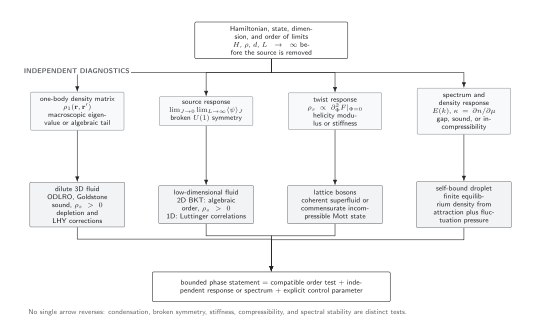
Independent tests supporting Bose-matter claims. The figure is schematic and not to scale: a momentum-space peak alone does not establish stiffness, while a nonzero stiffness does not by itself establish three-dimensional off-diagonal long-range order.
The second map organizes the approximation boundaries. Inspect where the expansion parameter changes: for a dilute three-dimensional gas, vortex fugacity and stiffness for BKT flow, near an atomic Mott state, and competing energy-density terms plus loss scales for a droplet. The continuum and lattice limits are developed respectively in Altland and Simons 2023, §§ 5.2 and 6.5 and Fisher et al. 1989, §§ IV–V, pp. 555–562.
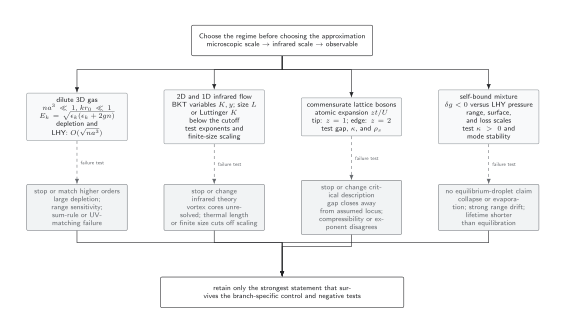
Control parameters and decisive failure tests across the chapter. The map is schematic: finite size, traps, disorder, finite range, and loss can cut off the displayed asymptotic regimes.
Bose-phase validity table
Section titled “Bose-phase validity table”| Regime | Dimension and order | Stiffness and compressibility | Excitation test | Control parameter | Finite-size signature | Negative test or model boundary |
|---|---|---|---|---|---|---|
| Ideal condensation | Homogeneous ; macroscopic one-body eigenvalue below | Condensation alone does not determine interacting-fluid stiffness | Quadratic particles; saturation of excited states | Thermodynamic limit at fixed density | Rounded occupation crossover with only asymptotically | No superfluid claim without an independent response test |
| Weak three-dimensional superfluid | 3D ODLRO with perturbative depletion | and positive compressibility | from phonon to particle | and | Depletion and low- phonon scaling stabilize with volume | Large depletion, range sensitivity, or a violated sum rule |
| BKT fluid | 2D algebraic below ; no finite- ODLRO | Finite renormalized helicity modulus with the universal jump | Phonons plus bound vortex–antivortex pairs | Long wavelengths and controlled initial | Size drift of stiffness crossings and the BKT correlation length | Exponential correlations or failure of BKT finite-size scaling |
| One-dimensional Bose fluid | 1D algebraic order at ; no extensive condensate eigenvalue | Finite phase rigidity and compressibility in the Luttinger theory | Sound mode with parameter | Energy below microscopic, thermal, and integrability-breaking scales | Algebraic occupations and correlators with one consistent | Finite- exponential decay or incompatible exponents |
| Commensurate Bose–Hubbard Mott state | Integer-filled lattice; no thermodynamic condensate | and | Nonzero particle and hole gaps | near the atomic limit, with tip or edge scaling declared | Gap and stiffness crossings follow the chosen and aspect ratio | Nonzero thermodynamic compressibility or closing charge gap |
| Self-bound droplet | 3D finite-density stationary state without external confinement | Positive compressibility; superfluid response is a separate test | Real collective modes below the emission threshold | Dilute matched functional plus range, surface, and loss scales | Minimum particle number and surface-to-volume drift | Collapse, evaporation, strong range drift, or lifetime below equilibration |
Together with the preceding relationship-centered explanations and alt text, this table supplies the nonvisual account of both diagrams. It deliberately keeps dimension, order, response, spectrum, finite-size behavior, control, and falsification in separate columns.
Guide to the pages
Section titled “Guide to the pages”- The Ideal Bose Gas and Bose–Einstein Condensation derives occupations, critical density, and condensate fraction, with finite-volume and dimensional qualifications.
- Condensation, Off-Diagonal Order, and Superfluidity defines four nearby but inequivalent notions and supplies counterexamples.
- The Weakly Interacting Bose Gas builds the Gross–Pitaevskii saddle from a scattering-length-matched interaction.
- Bogoliubov Theory and Bose Quasiparticles diagonalizes quadratic fluctuations and derives the phonon-to-particle crossover and depletion.
- Beyond Bogoliubov Theory in the Dilute Expansion obtains the Lee–Huang–Yang term and makes ultraviolet cancellation explicit.
- Phase–Density EFT for Bose Superfluids integrates density fluctuations to obtain the compact phase theory, sound speed, and stiffness.
- Low-Dimensional Bose Gases and BKT Physics explains algebraic order, vortex energetics, and the universal stiffness jump.
- Strongly Correlated One-Dimensional Bose Fluids connects the Lieb–Liniger and Tonks–Girardeau limits to Luttinger-liquid observables.
- The Bose–Hubbard Model and Controlled Limits derives atomic Mott gaps and their leading hopping corrections.
- The Superfluid–Mott Quantum Phase Transition distinguishes the relativistic lobe tip from the density-driven edge.
- Self-Bound Quantum Droplets balances mean-field attraction against fluctuation pressure while retaining range, surface, and loss limits.
Conventions that recur
Section titled “Conventions that recur”We use . In the continuum, and . In three dimensions the low-energy coupling is only after matching to the -wave scattering length ; it is not a bare ultraviolet parameter. On a lattice, appears as , and filling means particles per site. Page-local dimensions, ensembles, and orders of limits are stated before they matter.
Review the chapter
Section titled “Review the chapter”Classification. Can a uniform ideal Bose gas be condensed but fail an interacting-fluid stiffness test? Can a two-dimensional BKT phase be superfluid without true ODLRO? A successful answer names the thermodynamic limit and uses independent definitions rather than vocabulary alone.
Answer criterion
Yes to both. Ideal-gas macroscopic occupation is an eigenvalue statement about and does not by itself supply the metastable current response of an interacting superfluid. A BKT phase has algebraic one-body correlations and finite renormalized helicity modulus, but no nonzero infinite-distance limit of at .
Control assessment. For a proposed droplet calculation, list the minimum checks that connect it back to the dilute-gas expansion. The answer must include scattering-data matching, a gas/range parameter, a positive-compressibility or mode-stability test, a finite-size surface term, and a lifetime comparison.
Translation. Starting from the phase action , recover and explain why neither coefficient alone equals a condensate fraction. This tests dimensions and the distinction between order and response.
References
Section titled “References”- Alexander Altland and Ben Simons, Condensed Matter Field Theory, 3rd ed., Cambridge University Press (2023), §§ 5.2 and 6.5, doi:10.1017/9781108781244.
- Michael P. A. Fisher, Peter B. Weichman, Geoffrey Grinstein, and Daniel S. Fisher, “Boson Localization and the Superfluid–Insulator Transition,” Physical Review B 40 (1989) 546–570, doi:10.1103/PhysRevB.40.546.
- Lev P. Pitaevskii and Sandro Stringari, Bose–Einstein Condensation and Superfluidity, Oxford University Press (2016), chs. 2–9, doi:10.1093/acprof:oso/9780198758884.001.0001.
Original QFT.org content:CC BY 4.0, unless an item supplies different terms. Third-party material retains its own terms.