

Kondo Breakdown and Local-Criticality Evidence
Kondo breakdown is a zero-temperature claim that the local-moment contribution to the heavy Fermi surface disappears at or near a quantum critical point. A narrowing Hall crossover, mass enhancement, non-Fermi-liquid resistivity, or dynamical scaling can be consistent with that scenario, but none uniquely establishes a Fermi-volume jump. Spin-density-wave reconstruction, Lifshitz transitions, valence fluctuations, Zeeman effects, disorder, and multiband scattering must be fitted as explicit alternatives using a common dataset and uncertainty model.
Evidence cutoff. This comparison covers sources available through 10 August 2026. Material-specific conclusions and datasets remain in the Quantum Matter and Emergence Research map, where corrections and superseding evidence can be dated.
Required background. Heavy Fermi liquids and large Fermi surfaces supplies the screened reference state.
Helpful background. Quantum phase-transition scales and evidence triangulation supply scaling and model comparison.
Competing zero-temperature scenarios
Section titled “Competing zero-temperature scenarios”| Scenario | Fermi-surface expectation | Critical dynamics | Discriminating liabilities |
|---|---|---|---|
| Kondo destruction or fractionalized breakdown | Large-to-small count after unit-cell and topological sectors are handled | Critical hybridization and possible local spin/charge scaling | Must establish the phase and Fermi-volume reference on both sides and exclude ordinary reconstruction |
| Itinerant spin-density-wave criticality | Large Fermi surface reconstructed by the ordering wavevector; hot regions can lose coherence | Order-parameter scaling with fermionic damping | Multiband transport can look abrupt; very low crossover scales may hide continuity |
| Valence transition or crossover | Carrier weights and scattering change with occupancy | Critical or sharp charge fluctuations possible | Requires direct valence and volume/strain constraints |
| Lifshitz or Zeeman reconstruction | Sheet appears or disappears without loss of Kondo screening | Band-edge scaling; often strong field dependence | Must model band curvature, factors, and interaction shifts |
| Disorder or inhomogeneous Kondo scales | Broad or sample-dependent transport and thermodynamics | Griffiths-like or smeared scaling | Test residual resistivity, distributions, sample dependence, and local probes |
The table is a model-discrimination template, not a list of mutually exclusive universal phases. Real materials can combine magnetic reconstruction, valence change, and Kondo weakening.
What each observable actually measures
Section titled “What each observable actually measures”Hall effect. In a multiband metal, depends on carrier densities, mobilities, anisotropic lifetimes, and vertex corrections. A sharpening field-tuned crossover extrapolated toward is evidence for an abrupt change in transport, not a direct topological measurement of Fermi volume. Paschen et al. 2004 reported such a crossover in YbRhSi and interpreted its zero-temperature extrapolation as Fermi-surface collapse.
Quantum oscillations. Frequencies measure extremal orbits when quasiparticles are coherent and magnetic breakdown is controlled. Compare all observed and missing sheets, field evolution, masses, and the ordered unit cell. Shishido et al. 2005 reported a pressure-tuned reconstruction in CeRhIn; separating magnetic, valence, and Kondo effects remains model-specific.
Spectroscopy. ARPES and STM can track hybridized bands, Fano line shapes, and coherence, but surface termination, tunnelling matrix elements, resolution, and temperature limit volume inference. A disappearing resonance can reflect decoherence without a zero-temperature topological change.
Dynamics and thermodynamics. Fractional frequency–temperature scaling, anomalous spin response, critical charge fluctuations, divergent masses, and entropy transfer constrain the critical theory. Schröder et al. 2000 reported fractional dynamical scaling in CeCuAu. Scaling over a finite window must include corrections, covariance, and alternative Griffiths or crossover descriptions.
A valid joint test
Section titled “A valid joint test”For a tuning parameter , fit a common crossover scale to raw Hall, magnetoresistance, thermodynamic, oscillation, and spectroscopic observables only where the forward models justify a shared scale. Report width, center, covariance, background, and sample dependence. Then test:
- whether the width tends to zero under several extrapolation forms;
- whether band-resolved probes independently support the proposed large and small counts;
- whether magnetic ordering and Brillouin-zone folding alone reproduce the change;
- whether valence, Zeeman, Lifshitz, or disorder models fit held-out data; and
- whether dynamical exponents and amplitudes agree across spin and charge channels.
The review by Hu, Chen, and Si 2024, pp. 1863–1873 synthesizes evidence from the Kondo-destruction perspective. It is a valuable current interpretation, not a substitute for the primary data or a consensus theorem.
The strongest durable conclusion as of the cutoff is that several heavy-fermion systems show quantum-critical crossovers, Fermi-surface reconstruction evidence, and dynamical behavior difficult to compress into one weak-coupling description. Whether a particular critical point realizes Kondo destruction requires the joint material-specific test above.
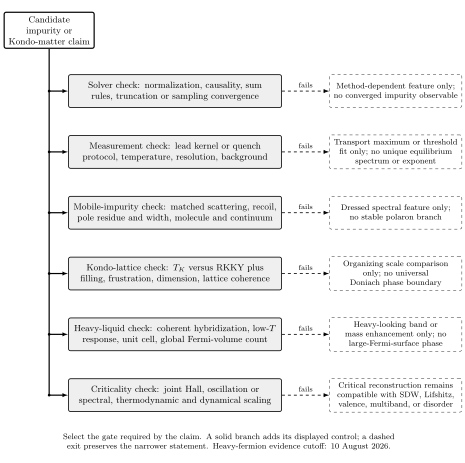
An abrupt proxy is not automatically a zero-temperature Fermi-volume jump. Independent band, transport, dynamics, valence, and disorder tests determine the strongest surviving critical scenario. Original schematic, not to scale; evidence cutoff 10 August 2026.
The impurity claim test matrix is the structured equivalent.
Exercise
Section titled “Exercise”Set a claim ceiling. A Hall crossover narrows linearly with temperature, but quantum oscillations exist only on the high-field side and residual resistivity varies strongly across samples. What follows?
Solution
The data support a sharpening transport crossover and motivate a zero-temperature discontinuity hypothesis. They do not establish a large-to-small Fermi-volume jump because the low-field sheets are unmeasured and sample-dependent scattering directly affects Hall transport. The next decisive work is a band-resolved low-field probe or controlled reconstruction calculation, matched sample series with covariance, and explicit disorder and Zeeman/Lifshitz alternatives. The Kondo-breakdown label remains a preferred or compatible model only if it wins those tests.
References
Section titled “References”- Hu, H., Chen, L., and Si, Q. (2024). “Quantum critical metals and loss of quasiparticles.” Nature Physics 20, 1863–1873. doi:10.1038/s41567-024-02679-7.
- Paschen, S., Lühmann, T., Wirth, S., Gegenwart, P., Trovarelli, O., Geibel, C., Steglich, F., Coleman, P., and Si, Q. (2004). “Hall-effect evolution across a heavy-fermion quantum critical point.” Nature 432, 881–885. doi:10.1038/nature03129.
- Schröder, A., Aeppli, G., Coldea, R., Adams, M., Stockert, O., von Löhneysen, H., Bucher, E., Ramazashvili, R., and Coleman, P. (2000). “Onset of antiferromagnetism in heavy-fermion metals.” Nature 407, 351–355. doi:10.1038/35030039.
- Shishido, H., Settai, R., Harima, H., and Ōnuki, Y. (2005). “A drastic change of the Fermi surface at a critical pressure in CeRhIn: dHvA study under pressure.” Journal of the Physical Society of Japan 74, 1103–1106. doi:10.1143/JPSJ.74.1103.
Original QFT.org content:CC BY 4.0, unless an item supplies different terms. Third-party material retains its own terms.