

Quantum Magnetism and Frustration
Quantum magnetism begins with a microscopic spin representation and exchange hierarchy, then asks which semiclassical, continuum, fermionic, or entangled description is controlled. This chapter follows that chain through Berry phases, magnons, sigma models, Haldane physics, frustration, valence bonds, itinerant fluctuations, and dynamical structure factors. The recurring discipline is to distinguish a Hamiltonian, an approximation, an observable, and the strength of the conclusion.
Helpful background. Exchange Interactions and Effective Spin Hamiltonians provides a direct diagnostic of signs and spin normalization; Superexchange and the – Projection provides the charge-fluctuation reduction behind a central class of antiferromagnetic models.
Enter this chapter
Section titled “Enter this chapter”We use for antiferromagnetic Heisenberg exchange and take ,
The factor makes this symmetric-matrix convention count each bond once. An effective spin model must state the local representation, lattice, bond orientation, anisotropies, and degrees of freedom removed. A continuum treatment adds its Berry-phase gauge and topological convention; a semiclassical calculation adds its , gradient, temperature, and finite-size regime. An itinerant treatment instead retains gapless carriers and declares the particle–hole geometry.
The two principal reductions meet at correlation functions rather than at identical microscopic pictures.
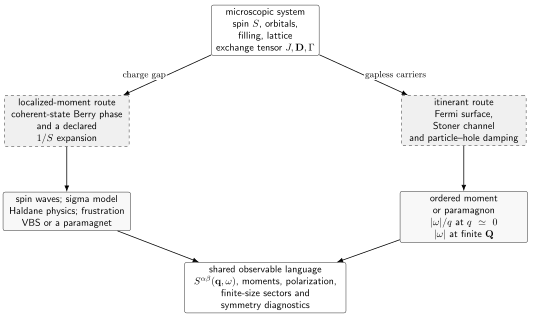
Localized and itinerant descriptions have different controlled reductions, but both must predict normalized spin correlations and symmetry diagnostics. The diagram is schematic; denotes clean small- ferromagnetic damping, whereas denotes generic finite- damping.
A route through the subject
Section titled “A route through the subject”Exchange Interactions and Effective Spin Hamiltonians derives antiferromagnetic superexchange and classifies the anisotropic interactions developed by Moriya 1960, pp. 91–98. Spin Coherent States and Berry Phases constructs the quantized solid-angle phase and its precession dynamics. Spin Waves and Magnons uses the boson representation of Holstein and Primakoff 1940, pp. 1098–1113 to contrast ferro- and antiferromagnetic spectra, vacuum fluctuations, and control.
Antiferromagnets, Sigma Models, and Theta Terms carries the lattice Berry phase into . Quantum Spin Chains and Haldane Physics separates the gap conjectured by Haldane 1983, pp. 1153–1156, the half-integer obstruction, and odd-integer symmetry protection, with the exact valence-bond representative of Affleck et al. 1987, pp. 799–802. Frustration and Order by Disorder distinguishes constraint competition from fluctuation selection.
Valence-Bond Solids and Quantum Paramagnets distinguishes lattice symmetry breaking, featureless states, SPT phases, and intrinsic topological order. Itinerant Magnetism and Spin-Fluctuation Physics develops the per-spin Stoner convention and the different damping kernels near zero and finite wave vector. Spin Correlations and Dynamical Structure Factors closes the chapter with spectral normalization, sum rules, probe factors, and alternative explanations for continua.
Phase, approximation, and evidence table
Section titled “Phase, approximation, and evidence table”This is the chapter’s canonical comparison. Each row names the positive signature and a condition that would weaken or falsify the stated interpretation.
| Regime | Symmetry or order | Berry or topological datum | Low-energy excitation | Structure-factor signature | Control | Distinguishing check |
|---|---|---|---|---|---|---|
| Heisenberg ferromagnet | uniform dipole order | summed first-order Berry phase | one quadratic magnon | transverse pole near | dilute magnons, | stiffness and absolute moment agree |
| Bipartite antiferromagnet | staggered dipole order | pairwise Berry cancellation plus residual events | linear magnons | poles near ordering vector, Bragg weight | gradients and | finite order reduction and sum-rule closure |
| Integer-spin chain | no bulk dipole order | modulo | massive triplet in the simplest chain | gapped one- and multi-particle weight | continuum matching plus numerics | gap persists with size; symmetry class stated |
| Half-integer chain | translation and spin symmetry constrain the ground state | critical spinons or a degenerate gapped alternative | continuum or symmetry-breaking tower | anomaly/theorem plus model solution | no unique symmetric gapped state | |
| Valence-bond solid | broken lattice symmetry | monopole Berry phases may select pattern | singlets, triplons, domain defects | dimer Bragg order; spin gap possible | finite-size symmetry sectors | dimer order extrapolates nonzero |
| Symmetric quantum paramagnet | no conventional order | SPT or intrinsic topological data must be specified | gapped edge, anyon, or conventional modes depending on phase | absence of Bragg order is insufficient | representation per cell and topology | projective edge, topology, or trivial deformation |
| Itinerant paramagnon regime | Fermi-surface spin channel | no fixed-spin Berry reduction | damped collective spin response | broad weight tied to particle–hole continuum | weak coupling/RPA or declared extension | band-resolved bubble and total spectral weight agree |
| Fractionalization candidate | no required dipole order | emergent gauge/topological sector | fractional quasiparticles | structured continuum | controlled model or converged numerics | exclude magnon decay, disorder, and phonons |
From Hamiltonian to a bounded conclusion
Section titled “From Hamiltonian to a bounded conclusion”A magnetic interpretation must survive several transformations: microscopic operators to an effective Hamiltonian, Hamiltonian to an approximation, approximation to a normalized correlator, and correlator to a resolution-convolved probe signal. Each transformation has independent failure modes. The next diagram makes those checks part of the scientific claim.
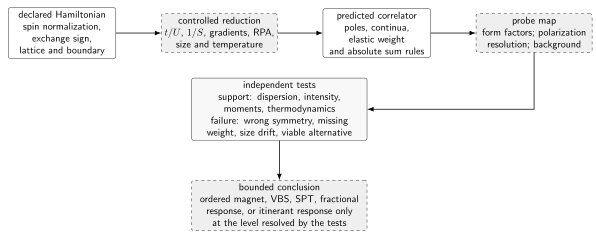
Dispersion agreement is only one check. Absolute intensity, total-moment sum rules, symmetry, thermodynamics, finite-size drift, and viable alternative mechanisms determine how strongly a magnetic phase or excitation can be identified. The diagram is schematic.
Review the chapter
Section titled “Review the chapter”- Derive on a Hubbard bond and identify the charge-gap assumption that controls the spin-only description.
- Starting from the north-patch coherent-state one-form, show why changing patches is harmless only for .
- Compare the ferromagnetic and antiferromagnetic spectra and explain their different order reductions.
- Trace the lattice Berry phase of a spin chain into , then state what the Lieb–Schultz–Mattis obstruction does and does not imply.
- Construct a finite-size test that distinguishes a VBS tower from topological sector splitting.
- Use the total-moment sum rule and polarization projector to assess whether a broad magnetic continuum can be assigned uniquely to fractionalization.
References
Section titled “References”- Affleck, I., T. Kennedy, E. H. Lieb, and H. Tasaki. “Rigorous Results on Valence-Bond Ground States in Antiferromagnets.” Physical Review Letters 59 (1987): 799–802. DOI.
- Haldane, F. D. M. “Nonlinear Field Theory of Large-Spin Heisenberg Antiferromagnets: Semiclassically Quantized Solitons of the One-Dimensional Easy-Axis Néel State.” Physical Review Letters 50 (1983): 1153–1156. DOI.
- Holstein, T., and H. Primakoff. “Field Dependence of the Intrinsic Domain Magnetization of a Ferromagnet.” Physical Review 58 (1940): 1098–1113. DOI.
- Moriya, T. “Anisotropic Superexchange Interaction and Weak Ferromagnetism.” Physical Review 120 (1960): 91–98. DOI.
Original QFT.org content:CC BY 4.0, unless an item supplies different terms. Third-party material retains its own terms.