

Orthogonality Catastrophe and the X-Ray Edge
A sudden local potential changes the scattering boundary condition of every occupied bath state. Although each one-particle orbital changes only slightly, their many-body overlap vanishes as a power of system size—the Anderson orthogonality catastrophe. In a core-level absorption or emission problem, this shake-up combines with the attraction of the excited electron to the core hole, producing a threshold power law rather than a single quasiparticle pole.
Required background. Impurity phase shifts supplies the scattering data. Lehmann spectral functions supplies the response representation.
Helpful background. Abelian bosonization gives an efficient channel-by-channel derivation.
Vanishing ground-state overlap
Section titled “Vanishing ground-state overlap”Let be a Fermi sea and include a local potential switched on suddenly. If the scattering phase-shift change at the Fermi energy in channel is , define
With a consistent infrared size variable , the overlap scales as
Equivalently, the squared overlap has exponent . Partial-wave degeneracies and spin or flavor channels must be included in the sum. The ultraviolet length and prefactor are nonuniversal; the phase-shift exponent is the low-energy result. Anderson 1967 gives the determinant argument.
The time-domain core-hole correlator has the long-time form
Its Fourier transform begins at a threshold and has a power-law edge. There is no finite quasiparticle residue because the overlap with the unshaken Fermi sea vanishes.
X-ray edge: two contributions
Section titled “X-ray edge: two contributions”An absorption operator also creates a conduction electron at the core. That electron is attracted to the core hole, producing the Mahan or excitonic contribution linear in the relevant phase shift. For a simple single active channel, one common convention gives
The linear term depends on which local electron operator is inserted and on the sign convention for an attractive potential; the quadratic orthogonality term sums over all shaken channels. Emission, absorption, and photoemission therefore need separate exponent translations. Nozières and De Dominicis 1969 solves the threshold problem.
A sufficiently strong potential can also create a true bound state. A threshold singularity is not such a discrete state: change system size or core-hole lifetime and test whether a normalizable pole remains separated from the continuum.
Cutoffs and extensions
Section titled “Cutoffs and extensions”Finite temperature rounds the asymptotic time dependence schematically to
A finite core-hole lifetime, detector resolution, recoil, and noninstantaneous switching provide additional infrared cutoffs. Interacting or one-dimensional baths replace the free-fermion exponent by boundary scaling dimensions. For a mobile impurity, recoil changes the available phase space and connects the edge problem to polarons.
The validity map shows the route from phase shifts to an edge exponent and its experimental rounding.
Orthogonality supplies the quadratic phase-shift exponent; the absorption operator supplies an additional excitonic term. Their signs, channel multiplicities, and infrared cutoffs must be translated before comparing edges. Original schematic, not to scale.
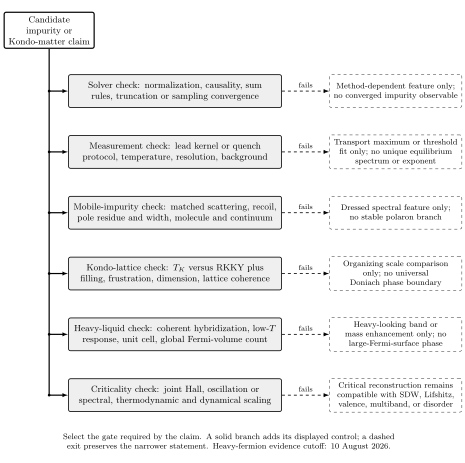
The impurity claim test matrix records the distinction between edge and bound-state claims.
Exercise
Section titled “Exercise”Include spin multiplicity. Both spin species experience the same phase-shift change . Find the orthogonality exponent for the squared overlap.
Solution
There are two independent channels, so . The overlap amplitude scales with exponent . Omitting spin would underestimate the shake-up exponent by two in the squared overlap.
References
Section titled “References”- Anderson, P. W. (1967). “Infrared catastrophe in Fermi gases with local scattering potentials.” Physical Review Letters 18, 1049–1051. doi:10.1103/PhysRevLett.18.1049.
- Nozières, P., and De Dominicis, C. T. (1969). “Singularities in the X-ray absorption and emission of metals. III. One-body theory exact solution.” Physical Review 178, 1097–1107. doi:10.1103/PhysRev.178.1097.
Original QFT.org content:CC BY 4.0, unless an item supplies different terms. Third-party material retains its own terms.