

Heavy Fermi Liquids, Hybridization, and Large Fermi Surfaces
A coherent heavy Fermi liquid forms when lattice-scale hybridization incorporates one local-moment degree of freedom per unit cell into long-lived charged quasiparticles. A constrained hybridization saddle displays the resulting avoided crossing and large effective mass. The robust zero-temperature statement is the Fermi-volume count under Luttinger–Oshikawa hypotheses; the slave-boson amplitude itself is gauge dependent, and a large heat-capacity coefficient alone does not uniquely establish Kondo coherence.
Required background. Kondo lattices and RKKY competition supplies the lattice setting. Luttinger’s theorem and its failure modes supplies the volume hypotheses.
Helpful background. Parton constraints supplies gauge projection and fluctuation cautions.
Minimal hybridized bands
Section titled “Minimal hybridized bands”A periodic Anderson mean-field Hamiltonian for one conduction and one narrow orbital is
with eigenvalues
Near the avoided crossing, a nearly flat -derived dispersion transfers large mass to a charged quasiparticle. The coherence scale governing a narrow band can be below the single-impurity ; finite-temperature local screening is not yet a Bloch-coherent heavy Fermi liquid.
In a large-degeneracy Kondo or Anderson representation, one may write a physical local state using auxiliary fermions and a boson with constraint
At saddle level and a Lagrange multiplier shifts . The phase of is an internal gauge choice. Saying that “condenses” is shorthand for a Higgs-like mean-field regime; it is not a gauge-invariant local order parameter. Constraint enforcement, corrections, and gauge fluctuations set the validity of conclusions beyond the band reconstruction.
Coleman 1987, §§II–IV develops the constrained large-degeneracy hybridization construction and its gauge structure.
Large Fermi volume
Section titled “Large Fermi volume”For a translationally invariant, symmetry-unbroken, topologically trivial Fermi liquid with conserved charge and one local moment per primitive cell, the Fermi volume counts conduction electrons plus the moment contribution modulo filled bands. If is the primitive-cell volume and are counts per cell, the spin-degenerate schematic relation is
The precise modular statement depends on unit cell and degeneracy. Oshikawa’s flux-insertion argument establishes the count without relying on the slave-boson saddle Oshikawa 2000. This is the part that survives beyond mean field under its hypotheses.
A “small” Fermi surface can arise through translation-symmetry breaking, which changes the Brillouin zone, or through a fractionalized phase with topological order that carries the missing momentum. Zeros or singular non-Fermi-liquid Green functions require additional care. One cannot infer Kondo breakdown merely by drawing the unhybridized conduction surface.
Observable cross-checks
Section titled “Observable cross-checks”Heavy quasiparticles should form a coherent set across probes:
- quantum oscillations or momentum-resolved spectra identify reconstructed sheets and masses;
- and susceptibility constrain the thermodynamic density of states and Wilson-like ratios;
- optical spectral-weight transfer and a low coherence scale test hybridization dynamics;
- resistivity crosses from incoherent scattering to a low-temperature Fermi-liquid form where applicable; and
- the carrier count respects filled bands and the crystallographic unit cell.
Disorder, multiband compensation, crystal-field levels, and momentum-dependent hybridization can make any one probe ambiguous. Large can also come from critical fluctuations or disorder; a hybridization fit without the constraint is not a physical-state construction.
The validity map routes the mean-field bands through gauge and volume checks.
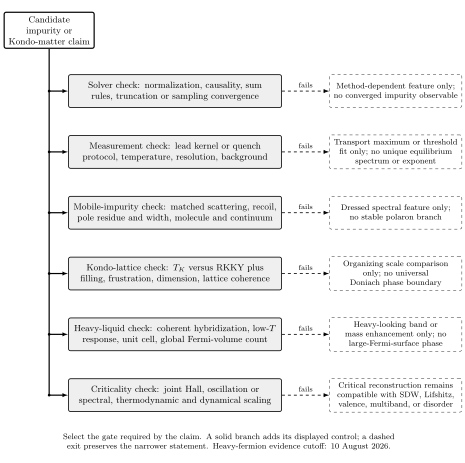
Hybridized bands explain a heavy mass at saddle level. The large Fermi-volume constraint is more robust, but only with conserved charge, translation symmetry, a Fermi-liquid ground state, and no compensating topological order. Original schematic, not to scale.
See the impurity claim test matrix for the coherence and counting tests.
Exercise
Section titled “Exercise”Find the direct hybridization gap. At a momentum where , find the two eigenvalues and their separation.
Solution
The square root reduces to , so . The direct gap is . The indirect coherence scale can be smaller and depends on dispersions and filling; identifying it with this direct gap would be an additional assumption.
References
Section titled “References”- Coleman, P. (1987). “Mixed valence as an almost broken symmetry.” Physical Review B 35, 5072–5116. doi:10.1103/PhysRevB.35.5072.
- Oshikawa, M. (2000). “Topological approach to Luttinger’s theorem and the Fermi surface of a Kondo lattice.” Physical Review Letters 84, 3370–3373. doi:10.1103/PhysRevLett.84.3370.
Original QFT.org content:CC BY 4.0, unless an item supplies different terms. Third-party material retains its own terms.