

Majorana Platforms and Evidence Standards
Experiments do not measure a Majorana operator directly. They measure currents, differential conductances, capacitances, charge-sensor outputs, spectra, and switching records, then infer which low-energy states could have produced them. Because ordinary Andreev states, quantum-dot transitions, Kondo physics, disorder, and the measurement circuit can imitate parts of the expected response, every conclusion on this page stops at the strongest claim that survives a calibrated forward model and explicit alternatives.
Evidence cutoff. This synthesis covers public sources available through 23 August 2026. Platform status is mutable: a new data release, correction, retraction, independent reanalysis, or accepted paper reaching its version of record can change the ceiling. Later developments belong in the dated Quantum Matter and Emergence Research synthesis.
Required background. Topological BdG boundary modes supplies the model-level invariant, end-mode profile, and finite-size splitting. Flux and Josephson dynamics supplies the gauge, periodicity, and poisoning caveats needed to interpret interferometers and parity devices.
Helpful background. Model selection supplies the likelihood, nuisance-parameter, and held-out-test framework used below.
From platform Hamiltonians to measured data
Section titled “From platform Hamiltonians to measured data”Two effective Hamiltonians organize much of the evidence, but neither is itself an observation. For a continuous semiconductor–superconductor wire, one useful real-space BdG representative is
This expression uses , , and a gauge with ; if a vector potential is retained, must be replaced by the gauge-covariant momentum and transformed consistently. The Pauli matrices act on spin and on Nambu space. The ideal single-band criterion is developed on the boundary-mode page. A device model must additionally include every occupied subband, orbital coupling, field-dependent parent-superconductor self-energy, electrostatic profile , disorder, interactions where relevant, contacts, and the actual boundary conditions.
For an -site quantum-dot Kitaev chain, choose the bookkeeping convention
Local rephasings of move phases between and , so only gauge-invariant relative phases matter. At a two-site sweet spot, and produce exact zero modes in the ideal finite model. They are often called poor man’s Majoranas because generic parameter errors split them without the exponential length protection of a long gapped chain Bordin et al. 2026, Introduction and Fig. 2.
The inference problem begins only after connecting either Hamiltonian to the apparatus. Schematically,
denotes controlled gates, fields, fluxes, and biases; denotes device parameters; describes the contacts; includes broadening and poisoning; and is the calibrated measurement and processing chain. The raw record might be , the full conductance matrix, a quantum-capacitance time trace, or a charge-sensor trace. Different Hamiltonians and nuisance parameters can map to nearly the same , which is why fitting one signal is not identification.
For example, consider an ideal three-terminal normal–superconductor–normal device in zero-temperature linear response, with the superconductor grounded. Define and as the mode-summed probabilities for an electron incident from normal terminal to emerge at normal terminal as an electron or a hole, respectively, and choose the measured-current sign so that elastic cotunnelling (ECT) gives positive nonlocal conductance, as in the experiment discussed below Feng et al. 2025, “SC–TINW hybrid device” and “Non-local conductance and CAR”. Then
Each transmission in this formula is already summed over open spin and orbital channels; for one spin-resolved channel, each lies between zero and one. Finite temperature adds an energy convolution with . A negative can support crossed Andreev reflection (CAR) dominance under a stated scattering and electrostatic model, but the measured difference alone does not determine its two nonnegative terms. Outside this linear, fixed-electrostatics limit, even a full nonlinear conductance matrix need not remove self-gating and process-decomposition ambiguities Tikhonov and Khrapai 2026, pp. 1198–1199 and Fig. 1.
A cumulative evidence ladder
Section titled “A cumulative evidence ladder”Every rung includes the obligations below it. A high-fidelity parity trace, for example, cannot repair an uncalibrated or demonstrably gapless operating region.
| Rung | Evidence required | Alternative that must be tested | Strongest licensed claim |
|---|---|---|---|
| 0. Provenance and selection | Raw and processed data, code or algorithm, calibration history, full sweep ranges, inclusion rules, device yield, corrections, and retractions | Cherry-picking, hidden preprocessing, unstable analysis windows, mislabeled axes, or an untracked data version | An auditable record exists; no state has yet been identified |
| 1. Hamiltonian and operating regime | A device-specific forward model; parent and induced gaps; electrostatics; occupied modes; orbital, Zeeman, spin–orbit, disorder, charging, temperature, tunnel, and transfer-function scales | A missing band, soft or collapsed gap, uncontrolled dot, heating, leakage, or apparatus response | A calibrated superconducting device in a stated regime |
| 2. Reproducible local subgap state | Local spectroscopy over declared gates, fields, barriers, temperatures, and repetitions, with resolution and background shown | Smooth-confinement Andreev state, dot singlet–doublet crossing, Kondo resonance, class-D disorder peak, weak antilocalization, or instrumental feature | A reproducible local low-energy state |
| 3. Bulk and multiterminal compatibility | A bulk-sensitive gap proxy, full conductance matrix where available, closing/reopening or spectral-flow test, and forward fits including trivial extended bands | Orbital destruction of the parent gap, an extended trivial Andreev band, contact nonlocality, or self-gating | Compatibility with a specified gapped transition model, not topology by itself |
| 4. Paired boundaries and localization | Correlated ends, independent local perturbations, charge or wavefunction probes, length dependence, and a resolved separation from other subgap states | One extended trivial state, two unrelated end states, common-gate response, cross-talk, or an accidental oscillatory splitting zero | A spatially separated, correlated low-energy pair within stated resolution |
| 5. Parity readout and control | Single-shot fidelity, integration time, state preparation, backaction or QND checks, poisoning and dwell times, charge response, and ordinary-parity comparators | A fine-tuned Andreev fermion, dot charge state, telegraph noise, or flux-dependent matrix element | Readout and control of a fermion-parity-sensitive low-energy degree of freedom |
| 6. Protected encoded subspace | scaling, , coherence and error suppression under local perturbations, operational time-scale separation, and independent devices | A sweet-spot cancellation, unresolved splitting, favorable device selection, or protection confined to one perturbation direction | Operational protection in the tested regime |
| 7. Fusion and braiding | Fusion-channel probabilities, protocol-order dependence, noncommuting transformations or process tomography, adiabaticity and leakage bounds, dynamical-phase controls, and replication | Landau–Zener transfer, ordinary calibrated gates, dynamical or geometric phases, crosstalk, postselection, and Abelian parity dynamics | A non-Abelian material-platform operation |
The ladder separates three statements that are often compressed into one word: a Hamiltonian can contain Majorana operators; a device can realize low-energy states described by that Hamiltonian; and a protocol can demonstrate the protected non-Abelian operation. Each requires new evidence.
Platform comparison
Section titled “Platform comparison”The table maps each platform from its effective description to its raw observable, most important rival explanation, and present claim ceiling. It is a comparison of inference obligations, not a ranking of research programmes.
| Platform and control | Raw observable | Leading alternative or limitation | Licensed statement at the cutoff |
|---|---|---|---|
| Continuous partial-shell nanowire or planar junction — Rashba BdG model; gates, field, phase, barriers, and length | Local and nonlocal , gap proxies, end correlations, charge sensing | Smooth Andreev or quasi-Majorana states, dots, disorder, orbital gap collapse, multiband occupancy | After rungs 0–1 pass, a reproducible local peak can reach rung 2; after those controls and a valid multiterminal model, a transition-compatible record can reach rung 3; protection still needs rung 4–6 scaling Prada et al. 2020, §§3–6 |
| InAs–Al parity interferometer — gate-defined wire coupled through quantum dots; flux and RF reflectometry | -periodic bimodal quantum capacitance, random-telegraph traces, assignment fidelity, dwell time | A fine-tuned low-energy Andreev fermion and the disputed gap status of the transport tune-up | Parity-sensitive single-shot readout with strong two-end constraints, but not a uniquely topological or protected Majorana pair |
| Few-site dot Kitaev chain — , , , relative phase, local detunings, and an added probe dot | Excitation spectra, local/global detuning response, added-dot splitting test, quantum-capacitance parity trace | Sweet-spot tuning, finite size, next-neighbour couplings, thermal population, poisoning, and finite spectral resolution | Phase-resolved few-site Kitaev spectra and localization tests; in the two-site device, single-shot parity readout; no exponential length protection |
| Full-shell hybrid nanowire — angular-momentum sectors and a flux-induced synthetic vortex | Local tunnelling would probe edge spectra; the cited 2026 result is a calculation, not new device data | The calculation suppresses the smooth-confinement quasi-Majorana channel through a trivial end skin, not arbitrary disorder or every trivial state | An architecture-specific theoretical prediction; no empirical rung is raised by the calculation alone |
| Topological-insulator nanowire with Nb — proximitized surface states, gate and two-lead bias control | Full local/nonlocal conductance matrix; occasional negative nonlocal conductance over devices up to | CAR and ECT enter as a difference; local resonances, disorder, and self-gating affect the decomposition | Long-range superconducting correlation and a CAR contribution under the stated model; neither unique CAR probability nor Majorana evidence |
| Magnetic-adatom chain — Shiba-chain BdG model; chain length, exchange, substrate, disorder, and tip position | Spatially and spin-resolved tunnelling spectra along both ends and the interior | Ordinary Yu–Shiba–Rusinov band edges, termination states, tip convolution, unresolved minigap, and model-dependent topology | End-localized zero-energy weight can be robust across the tested chains and measured disorder; a Majorana attribution still requires a resolved minigap, model-independent bulk test, parity, and protection evidence Jang et al. 2026, “Emergence of zero-energy end states” and Figs. 2–4 |
| Vortex platform — vortex BdG model; field, vorticity, core profile, and tip position | Spatially and spin-resolved tunnelling spectra around a vortex core | Ordinary Caroli–de Gennes–Matricon levels, unresolved level spacing, disorder, tip-induced shifts, and surface reconstruction | A localized vortex-core subgap state until the core minigap, vorticity dependence, allowed perturbations, and parity structure are jointly controlled |
| Floating island or network — charging energy, Josephson coupling, tunnel links, gates, flux, and measurement sequence | Charge stability, parity switching, microwave response, and sequence-dependent readout | Ordinary island parity, quasiparticle poisoning, residual overlap, charge leakage, dynamical phases, and calibration cross-talk | A parity device or gate network; fusion and braiding require the separate rung-7 protocol Aasen et al. 2016, §§II–VI |
Claim, source, and supersession record
Section titled “Claim, source, and supersession record”The direct measurement, the authors’ interpretation, and this page’s licensed claim are deliberately separate. “Theory” below means a result within the stated model, not a failed or weaker form of experiment.
| Source chain | Direct record | Alternative, dispute, or update | Evidence ceiling used here |
|---|---|---|---|
| Retracted quantized-conductance claim | A 2018 paper reported a quantized Majorana conductance plateau | Reanalysis and recalibration no longer supported quantization; the paper was retracted Zhang et al. 2021, retraction notice | The original quantization claim supplies no positive rung; the retraction is mandatory provenance at rung 0 |
| Microsoft interferometric readout | Flux--periodic bimodal quantum capacitance; signal-to-noise ratio one in ; state dwell longer than ; optimal assignment error Microsoft Azure Quantum 2025, abstract and main text | The original paper explicitly retains fine-tuned trivial Andreev states. Legg argues that the transport tune-up regions appear disordered and gapless Legg 2026, pp. E22–E26. Microsoft replies that stable -periodic RF bimodality would wash out in a gapless system and supplies corrected TGP maps Microsoft Quantum 2026, pp. E27–E28. | The observable supplies rung-5-type parity-sensitive readout evidence. Because the rung-1 gapped-regime premise remains disputed, the cumulative ladder does not license rung 5 unconditionally; neither does the readout establish a uniquely topological, exponentially protected pair |
| Phase-controlled three-site chain | A phase period; maximal gap near relative phase zero and near closing at ; persistence under one- or two-dot detuning but splitting under global detuning; added-dot localization test Bordin et al. 2026, Figs. 2–4 | Three sites, an approximately gap on one side versus about on the other, finite phase offsets, no deterministic zero-field phase switching, inferred added-dot spin, and roughly localization-test resolution Bordin et al. 2026, “Limitations of our device” | A phase-resolved, model-consistent three-site emulator with local/global perturbation and localization tests; not an arbitrarily long chain, exponential protection, fusion, or braiding |
| Minimal-chain parity readout | Quantum-capacitance parity readout, millisecond-scale switching lifetimes, and simultaneous local charge sensing that does not distinguish the two charge-neutral parity states van Loo et al. 2026, abstract and Figs. 2–4 | The device is a minimal two-site chain whose “poor man’s” modes have limited protection compared with a long chain | Single-shot readout supplies a rung-5-type measurement capability, but the two-site device cannot satisfy rung 4’s length-dependent separation obligation and therefore does not earn cumulative rung 5, length protection, or non-Abelian statistics |
| Short disordered-wire protection theory | Calculated Majorana splitting versus length and disorder in experimentally motivated finite-wire models Pan and Das Sarma 2026, abstract | The exponential regime is highly constrained and is suppressed by disorder somewhat below the modeled topological gap | A quantitative warning and design constraint, not a disproof of Majorana physics and not experimental evidence for a device |
| Full-shell false-positive theory | In the modeled full-shell geometry, smooth confinement produces a trivial end skin from Caroli–de Gennes–Matricon analogues that hides smooth-disorder quasi-Majoranas from local tunnelling Payá et al. 2026, accepted-paper abstract | Accepted 6 August 2026 and not yet assigned final volume/pages at the cutoff; mechanism- and architecture-specific; no new experiment | Theoretical suppression of one local false-positive mechanism, not immunity to arbitrary disorder or proof of a full-shell device |
| Magnetic chains on a disordered Rashba alloy | For atom-built Fe chains with three through eleven atoms, spatial tunnelling maps showed approximately -linewidth zero-energy weight at both ends while the substrate exhibited nanoscale potential disorder Jang et al. 2026, “Emergence of zero-energy end states” and Fig. 2 | The Majorana interpretation relies on a fitted tight-binding model. The experiment bounds a very small minigap by its resolution rather than resolving it, while the disorder-robust topological/trivial distinction is supplied by model calculations Jang et al. 2026, “Robustness of Majorana zero modes” and Figs. 3–4 | Paired, end-localized zero-energy spectral weight that survives the measured substrate disorder and is consistent with the stated topological Shiba-chain model; not a model-independent invariant, resolved protecting minigap, parity measurement, or length-protection law |
| Long-range CAR experiment and exchange | A hard local gap, zero-energy Andreev states, and occasional negative nonlocal conductance over distances up to Feng et al. 2025, abstract, “SC–TINW hybrid device,” “Non-local conductance and CAR,” and Figs. 1–6 | Tikhonov and Khrapai argue that the conductance matrix cannot uniquely separate CAR from ECT and that self-gating can reproduce the bias symmetry. Feng et al. reply that the criticism itself requires a sizable long-range CAR term and that the original conclusion already emphasized CAR–ECT interplay Feng et al. 2026, reply. A publisher correction inserted the missing relation Feng et al. 2026, publisher correction. | Negative nonlocal conductance supports a CAR contribution under a forward model; conductance alone does not uniquely decompose CAR and ECT, and this experiment is not a Majorana claim |
The Microsoft exchange concerns whether one device’s operating region was adequately shown to be gapped; the Feng exchange concerns whether a nonlinear conductance matrix uniquely decomposes microscopic scattering probabilities. They are different disputes, but they teach the same methodological lesson: the raw observable, inverse model, data version, and claim must remain visibly distinct.
Alternative explanations and discriminating tests
Section titled “Alternative explanations and discriminating tests”Rung labels in the last column are conditional ceilings: they apply only after every lower rung has passed. If a lower control fails, retain the descriptive observable but stop the cumulative inference there.
| Observed feature | Viable non-Majorana explanation | Discriminating next test | Stop if the test fails |
|---|---|---|---|
| Stable local zero-bias peak | Smooth or partially separated Andreev state, dot crossing, Kondo resonance, class-D disorder accumulation, weak antilocalization, heating, or processing artefact | Repeat full unselected sweeps versus barrier, temperature, field orientation, and local gates; measure the other end and the bulk gap; compare held-out data under all forward models Kells et al. 2012, pp. 100503-1–100503-5 | Conditional rung 2 after rungs 0–1: local subgap state |
| Local peaks plus nonlocal closing/reopening | A trivial extended Andreev band or orbital suppression of the parent superconductor | Fit the entire conductance matrix, gap edge, length and disorder dependence, not only selected boundaries; test a spatially moved perturbation Hess et al. 2023, abstract | Conditional rung 3 after rungs 0–2: compatibility with a transition model |
| Negative off-diagonal conductance | CAR–ECT difference shaped by local resonances and self-gating | Add a calibrated scattering/electrostatic model and an independent observable such as noise, heat, or charge cross-correlation that separates electron and hole transfer | Superconducting nonlocality under a model, not a unique microscopic probability |
| Similar response at two ends | One extended trivial state, two correlated dots, common-gate motion, or electrical cross-talk | Perturb each end independently; map charge and spatial weight; repeat over lengths and devices while keeping the bulk regime fixed | Conditional rung 4 only if a paired, separated response survives after rungs 0–3 |
| Flux-periodic bimodal RF switching | Ordinary low-energy Andreev-fermion parity, flux-dependent matrix elements, or telegraph noise | Calibrate state energy and charge, readout backaction, gap and parity lifetime; reproduce the joint flux, gate, and field dependence with topological and trivial models | Rung-5-type parity observable; cumulative rung 5 only after rungs 0–4 |
| Robust few-site zero mode | Exact or approximate sweet spot, finite resolution, or omitted next-neighbour term | Compare local and global detunings, phase dependence, the added-dot test, spectral resolution, and chains of several lengths | Few-site localization within resolution, not exponential protection |
| Magnetic-chain end zero-energy weight | Yu–Shiba–Rusinov band edge, ordinary termination state, unresolved minigap, tip convolution, or surface reconstruction | Resolve the complete spatial and spin structure, substrate and Shiba-band gap, chain-length dependence, independent local perturbations, and parity response | End-localized subgap state; model-dependent topology until the protecting gap and invariant are independently established |
| Vortex-core zero-bias weight | Ordinary Caroli–de Gennes–Matricon level, unresolved minigap, disorder, tip-induced shift, or surface reconstruction | Resolve the core spectrum, vorticity and field dependence, particle–hole structure, spatial evolution, and response to symmetry-allowed perturbations | Localized vortex-core subgap state |
| Sequence-dependent “fusion” or “braid” output | Dynamical phase, Landau–Zener transfer, ordinary unitary control, leakage, crosstalk, or postselection | Reverse protocol order, reconstruct the operation on the degenerate subspace, bound splitting and leakage, and reproduce across devices | Parity dynamics or calibrated gates, not non-Abelian statistics |
For a continuous wire with end-mode overlap, the protection diagnostic is not merely “near zero over a gate interval.” Its generic envelope has the form
so a single accidental cosine zero can imitate perfect protection. One needs , a splitting envelope small relative to the topological gap and operational scales, and systematic length dependence. The 2026 finite-disordered-wire calculation finds that this exponential regime can be much narrower than an ideal phase diagram suggests Pan and Das Sarma 2026, abstract.
The current evidence ceiling
Section titled “The current evidence ceiling”Through the cutoff, the reviewed experiments establish increasingly controlled low-energy states, phase-resolved few-site spectra and localization tests, and parity-sensitive single-shot readout. The reviewed source chain does not establish a uniquely topological, reproducibly gapped, exponentially length-protected Majorana pair in a scalable material device. None of the material-platform sources in this record reports a fusion-order test or noncommuting braid acting on a protected superconducting Majorana subspace.
That ceiling is narrower than “Majorana physics is absent” and stronger than “a zero-bias peak is enough.” It recognizes substantial control advances while leaving the missing tests explicit. The validity map supplies one aggregate Majorana-platform gate; the evidence ladder above expands that gate into distinct stops at local spectroscopy, nonlocality, paired boundaries, parity, protection, and non-Abelian operation.
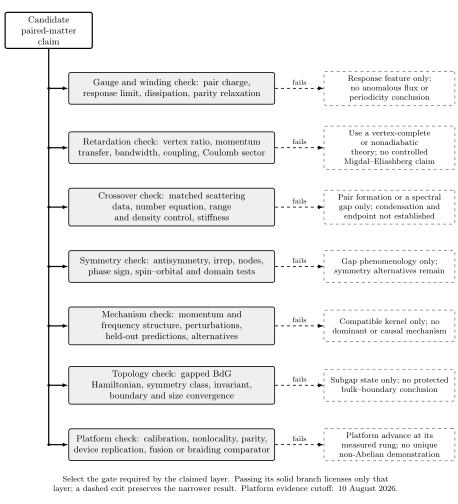
The map’s aggregate platform gate requires calibration, nonlocality, parity, replication, and a non-Abelian operation; the ladder above supplies the finer tests for paired spatial structure, exponential protection, fusion, and braiding. A failed gate retains only a narrower, nonunique subgap claim. Original schematic, not to scale; evidence cutoff 23 August 2026.
The cumulative ladder is a semantic expansion of the figure’s aggregate platform branch. The paired-matter claim test matrix gives the structured equivalent of the map’s broader claim boundaries.
Common pitfalls
Section titled “Common pitfalls”Calling parity readout uniquely topological. Any low-energy fermionic state has parity. A parity-sensitive signal becomes Majorana evidence only through the independently calibrated gap, spatial support, alternative models, and protection tests.
Replacing length scaling with gate robustness. A state can remain near zero because of smooth confinement, a sweet spot, or an oscillatory cancellation. Exponential protection is a scaling statement about the splitting envelope relative to , temperature, linewidth, and operation time.
Reading a microscopic process directly from a conductance sign. Off-diagonal conductance is a combination of electron and hole transmission. Its sign can support CAR under a model, but it is not a model-free decomposition of CAR and ECT.
Promoting a theory paper into a device result. The Pan–Das Sarma and Payá studies constrain interpretations within explicit models. Neither changes an experimental rung until a device-specific measurement tests the prediction.
Treating a few-site emulator as a long topological phase. A three-site spectrum can agree beautifully with the Kitaev Hamiltonian and survive selected perturbations without exhibiting asymptotic length protection. More sites also need not improve protection monotonically when next-neighbour and even–odd effects matter.
Importing braid language from an analogue platform. Digital demonstrations with anyons and acoustic or photonic Majorana-like modes can test algorithms, wave equations, or exchange algebras. They do not fill rung 7 for superconducting-material Majorana zero modes, whose gap, fermion parity, locality, and protected many-body subspace must be established in the material device itself.
Exercises
Section titled “Exercises”1. Triage a local anomaly
Section titled “1. Triage a local anomaly”A single tunnel contact shows a repeatable near-zero peak over a magnetic-field interval. The opposite end was not measured, the parent gap softens over the same interval, and only the successful gate window was saved. Assign the highest licensed rung and design the next measurement package.
Solution
The saved trace supports the descriptive statement “a repeatable near-zero feature occurred in this selected window,” but it does not earn a cumulative rung. The missing full sweep and selection record first fail rung 0. Even if that provenance is recovered, the softening parent gap prevents rung 1 from establishing the intended calibrated superconducting regime; rung 2 is therefore unavailable until both lower rungs are satisfied. Only after that repair could the same local signal license a reproducible local subgap state at rung 2, still not a topological transition or paired end modes.
The next package should preserve all gate, field, and barrier sweeps; calibrate electron temperature, line broadening, parent and induced gaps, contact response, and field orientation; and measure the complete two-ended conductance matrix on the same operating grid. Independent local gates should test whether perturbing one end affects only a local state or a separated pair. The comparison set must include smooth Andreev states, a dot or Kondo model where applicable, disorder-induced class-D states, orbital gap collapse, and instrumental response. If no gapped regime survives, the inference stops before parity or braiding.
2. Read the three-site phase spectrum and localization test
Section titled “2. Read the three-site phase spectrum and localization test”At the ideal three-site sweet spot, define . The two nonzero positive excitation energies used in the Bordin analysis are Bordin et al. 2026, Methods, “Extraction of the zero-field phase shift”
(a) Set and evaluate both energies at and .
(b) An added-dot sweep produces no resolvable zero-mode splitting with energy resolution . What follows about localization?
Solution
For equal couplings,
and therefore
At , : the excited-state gap is maximal. At ,
so the lower branch closes. This phase dependence is a sharp test of the fitted few-site Hamiltonian.
The added dot can split the zero mode when it resolves coupling to overlapping Majorana components. No observed splitting therefore bounds the relevant overlap-induced energy below the probe’s model-dependent resolution; it does not prove exact zero overlap. The result bounds the probe-induced overlap or splitting below roughly and is consistent with localization in the fitted three-site model; it does not establish exponential protection with chain length.
3. Test exponential protection rather than an accidental zero
Section titled “3. Test exponential protection rather than an accidental zero”Suppose the splitting envelope is with and . Compare and . The electron temperature is and the spectroscopic linewidth is . What would constitute evidence for protection?
Solution
The envelopes are
with ratio
At , . The longer-device envelope lies below both thermal and linewidth scales, so an unresolved splitting there is only an upper bound. A convincing test needs several lengths, the same calibrated gapped regime, and gate scans broad enough to estimate the oscillatory maxima rather than selecting a zero of . One must then show a common exponential envelope, , and splitting small relative to the gap and operational error scale. Two isolated unresolved points do not establish rung 6.
4. Show why nonlocal conductance is not process identification
Section titled “4. Show why nonlocal conductance is not process identification”In the simplified convention
an experiment measures . Give two distinct nonnegative pairs compatible with the result. What extra evidence is needed before claiming a CAR probability or a topological transition?
Solution
For example, both
and
give . The sign supports a larger hole-transmission contribution within this simplified convention, but it neither fixes the CAR probability nor eliminates bias-dependent electrostatics, local resonances, and other channels. The full conductance matrix adds constraints but, beyond linear response, still requires a calibrated scattering and self-gating model.
An independent process-sensitive observable—such as suitably modeled current cross-correlations, noise, heat transport, or charge-resolved detection—can help separate electron and hole transfer. A topological claim needs still more: a calibrated full gap, a device-specific invariant or transition model, paired boundary response, trivial extended-band comparators, and protection scaling. CAR is superconducting nonlocality, not by itself a Majorana invariant.
References
Section titled “References”- Aasen, D., Hell, M., Mishmash, R. V., Higginbotham, A., Danon, J., Leijnse, M., Jespersen, T. S., Folk, J. A., Marcus, C. M., Flensberg, K., and Alicea, J. (2016). “Milestones toward Majorana-based quantum computing.” Physical Review X 6, 031016. doi:10.1103/PhysRevX.6.031016.
- Bordin, A., Bennebroek Evertsz’, F. J., Roovers, B., Torres Luna, J. D., Huisman, W. D., Zatelli, F., Mazur, G. P., ten Haaf, S. L. D., Badawy, G., Bakkers, E. P. A. M., Liu, C.-X., Seoane Souto, R., van Loo, N., and Kouwenhoven, L. P. (2026). “Probing Majorana localization of a phase-controlled three-site Kitaev chain with an additional quantum dot.” Nature Communications 17, 2313. doi:10.1038/s41467-026-68897-0. Data and gate settings.
- Feng, J., Legg, H. F., Bagchi, M., Loss, D., Klinovaja, J., and Ando, Y. (2025). “Long-range crossed Andreev reflection in a topological insulator nanowire proximitized by a superconductor.” Nature Physics 21, 708–715. doi:10.1038/s41567-025-02806-y.
- Feng, J., Legg, H. F., Bagchi, M., Loss, D., Klinovaja, J., and Ando, Y. (2026a). “Reply to: Conductance measurements cannot distinguish crossed Andreev reflection from elastic co-tunnelling in normal–superconductor–normal junctions.” Nature Physics 22, 1200–1201. doi:10.1038/s41567-026-03376-3.
- Feng, J., Legg, H. F., Bagchi, M., Loss, D., Klinovaja, J., and Ando, Y. (2026b). “Publisher Correction: Reply to: Conductance measurements cannot distinguish crossed Andreev reflection from elastic co-tunnelling in normal–superconductor–normal junctions.” Nature Physics 22, 1360. doi:10.1038/s41567-026-03430-0.
- Hess, R., Legg, H. F., Loss, D., and Klinovaja, J. (2023). “Trivial Andreev band mimicking topological bulk gap reopening in the nonlocal conductance of long Rashba nanowires.” Physical Review Letters 130, 207001. doi:10.1103/PhysRevLett.130.207001.
- Jang, H., Crawford, D., Ton, K. T., Schneider, L., Wiebe, J., Shimizu, M., Jeschke, H. O., Rachel, S., and Wiesendanger, R. (2026). “Robustness of Majorana modes to a disorder potential in atomic chains on a superconducting Rashba alloy.” Nature Physics 22, 1050–1056. doi:10.1038/s41567-026-03322-3.
- Kells, G., Meidan, D., and Brouwer, P. W. (2012). “Near-zero-energy end states in topologically trivial spin-orbit coupled superconducting nanowires with a smooth confinement.” Physical Review B 86, 100503(R). doi:10.1103/PhysRevB.86.100503.
- Legg, H. F. (2026). “On the robustness of topological gap detection via transport.” Nature 654, E22–E26. doi:10.1038/s41586-026-10567-8.
- Microsoft Azure Quantum. (2025). “Interferometric single-shot parity measurement in InAs–Al hybrid devices.” Nature 638, 651–655. doi:10.1038/s41586-024-08445-2. Data and corrected TGP maps.
- Microsoft Quantum. (2026). “Reply to: On the robustness of topological gap detection via transport.” Nature 654, E27–E28. doi:10.1038/s41586-026-10568-7.
- Pan, H., and Das Sarma, S. (2026). “Majorana zero modes in semiconductor-superconductor hybrid structures: Defining topology in short and disordered nanowires through Majorana splitting.” Physical Review B 113, 165420. doi:10.1103/2v41-yvs1.
- Payá, C., Robles, C., San-Jose, P., and Prada, E. (2026). “Absence of quasi-Majorana false positives in full-shell hybrid nanowires.” Physical Review Letters, accepted 6 August 2026; final volume and pages not assigned at the evidence cutoff. doi:10.1103/w9tp-3bbq.
- Prada, E., San-Jose, P., de Moor, M. W. A., Geresdi, A., Lee, E. J. H., Klinovaja, J., Loss, D., Nygård, J., Aguado, R., and Kouwenhoven, L. P. (2020). “From Andreev to Majorana bound states in hybrid superconductor–semiconductor nanowires.” Nature Reviews Physics 2, 575–594. doi:10.1038/s42254-020-0228-y.
- Tikhonov, E. S., and Khrapai, V. S. (2026). “Conductance measurements cannot distinguish crossed Andreev reflection from elastic co-tunnelling in normal–superconductor–normal junctions.” Nature Physics 22, 1198–1199. doi:10.1038/s41567-026-03377-2.
- van Loo, N., Zatelli, F., Steffensen, G. O., Roovers, B., Wang, G., Van Caekenberghe, T., Bordin, A., van Driel, D., Zhang, Y., Huisman, W. D., Badawy, G., Bakkers, E. P. A. M., Mazur, G. P., Aguado, R., and Kouwenhoven, L. P. (2026). “Single-shot parity readout of a minimal Kitaev chain.” Nature 650, 334–339. doi:10.1038/s41586-025-09927-7. Data and code.
- Zhang, H., Liu, C.-X., Gazibegovic, S., Xu, D., Logan, J. A., Wang, G., van Loo, N., Bommer, J. D. S., de Moor, M. W. A., Car, D., Op het Veld, R. L. M., van Veldhoven, P. J., Koelling, S., Verheijen, M. A., Pendharkar, M., Pennachio, D. J., Shojaei, B., Lee, J. S., Palmstrøm, C. J., Bakkers, E. P. A. M., Das Sarma, S., and Kouwenhoven, L. P. (2021). “Retraction note: Quantized Majorana conductance.” Nature 591, E30. doi:10.1038/s41586-021-03373-x.
Original QFT.org content:CC BY 4.0, unless an item supplies different terms. Third-party material retains its own terms.