

Many-Body Localization: Diagnostics and Evidence
Many-body localization is a proposed nonergodic regime of isolated, interacting, strongly disordered systems. Finite systems can show Poisson-like level statistics, persistent local memory, suppressed transport, logarithmic entanglement growth, and quasi-local conserved structures, but every diagnostic has severe size, time, symmetry-sector, bath, and rare-region limits. A crossing in exact diagonalization is therefore a crossover datum, not by itself a thermodynamic phase boundary.
Required background. Anderson localization supplies the noninteracting comparison. Hubbard-model controlled limits supplies a representative interacting lattice setting. The eigenstate thermalization hypothesis supplies the ergodic alternative.
Evidence cutoff. This disputed-status synthesis covers primary sources available through 10 August 2026. New scaling studies, experiments, corrections, and supersession belong in the dated Quantum Matter and Emergence Research synthesis.
Benchmark model and spectral test
Section titled “Benchmark model and spectral test”A standard random-field spin chain is
Boundary condition, disorder distribution, magnetization sector, energy-density window, and whether are truly random or quasiperiodic must be fixed. Sort energies within one irreducible symmetry sector, let , and define
Poisson levels give , whereas the Gaussian orthogonal ensemble gives approximately . The adjacent-gap ratio avoids unfolding, but unresolved symmetries create artificial Poisson statistics. Oganesyan and Huse 2007 introduced this spectral test for interacting localization.
The original validity diagram shows why spectral data form only one branch. Inspect the arrows to dynamics, eigenstates, and avalanche stability: agreement among them is necessary for a bounded claim.
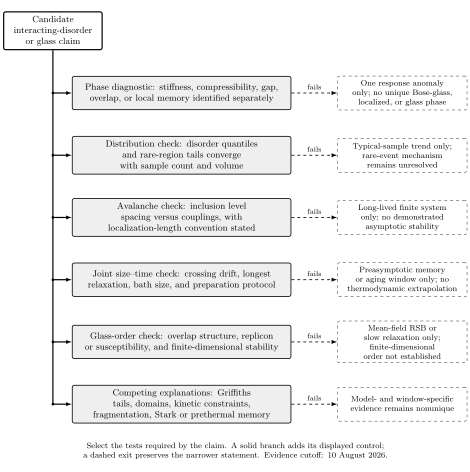
Many-body-localization evidence requires joint diagnostics and extrapolation. Finite-time memory can coexist with eventual avalanche or bath-induced thermalization; random and quasiperiodic ensembles require separate rare-region analyses. Schematic, not a phase boundary.
Dynamical and eigenstate diagnostics
Section titled “Dynamical and eigenstate diagnostics”For a charge-density-wave initial state, an imbalance
tests local memory. Thermalization predicts decay after finite-size recurrences are excluded; a nonzero plateau over the accessible interval establishes only a lower bound on relaxation time. One should also vary system size, initial state, energy density, and weak bath coupling.
Other diagnostics carry complementary failure modes:
- subdiffusive or apparently vanishing transport can arise from long crossovers;
- volume-law eigenstate entanglement can have a reduced coefficient without true localization;
- logarithmic entanglement growth is compatible with the l-bit phenomenology but not unique to it;
- a quasi-local-integral reconstruction must show operator-weight decay and stability as grows.
Pal and Huse 2010 demonstrated the early multi-diagnostic finite-size program. Modern reconstruction methods can extract quasi-local structures from entanglement, but their output remains finite-size evidence Lu et al. 2024.
Drift, avalanches, and the evidence ceiling
Section titled “Drift, avalanches, and the evidence ceiling”If an apparent critical disorder drifts strongly with , a fixed-order polynomial collapse can hide rather than resolve the drift. Fits should expose alternative Kosterlitz–Thouless-like variables, irrelevant fields, covariance, and leave-one-size-out prediction. Šuntajs et al. 2020 showed how accessible random-chain spectra can remain compatible with a long ergodic crossover.
Rare thermal inclusions provide an asymptotic negative test. Embedded-inclusion calculations find many-body resonances that spread thermalization in finite chains Morningstar et al. 2022. This does not mathematically exclude every one-dimensional localized Hamiltonian; it requires that generic random short-range claims confront inclusion growth. Quasiperiodic systems lack statistical Griffiths inclusions but still face resonances, finite-time drift, and external baths.
The durable ceiling is deliberately modest: joint finite-size and finite-time data can establish a long-lived, model-specific localized regime over a calibrated window. A thermodynamic MBL phase requires stable extrapolation against all those alternatives. Abanin et al. 2019 reviews the l-bit framework and experimental interfaces; later controversy is separated into the Research synthesis above.
The canonical disorder and glass claim test matrix records the ensemble, symmetry sector, size/time window, bath assumption, and decisive negative tests.
Exercise
Section titled “Exercise”Poisson adjacent-gap ratio. Let consecutive spacings and be independent unit-mean exponential variables. Show that .
Solution
By symmetry, integrate over and double:
Set , so :
References
Section titled “References”- Dmitry A. Abanin, Ehud Altman, Immanuel Bloch, and Maksym Serbyn, “Colloquium: Many-Body Localization, Thermalization, and Entanglement,” Reviews of Modern Physics 91 (2019) 021001. DOI
- Bohan Lu, Christian Bertoni, Steven J. Thomson, and Jens Eisert, “Measuring Out Quasi-Local Integrals of Motion from Entanglement,” Communications Physics 7 (2024) 17. DOI
- Alan Morningstar, Luis Colmenarez, Vedika Khemani, David J. Luitz, and David A. Huse, “Avalanches and Many-Body Resonances in Many-Body Localized Systems,” Physical Review B 105 (2022) 174205. DOI
- Vadim Oganesyan and David A. Huse, “Localization of Interacting Fermions at High Temperature,” Physical Review B 75 (2007) 155111. DOI
- Arijeet Pal and David A. Huse, “Many-Body Localization Phase Transition,” Physical Review B 82 (2010) 174411. DOI
- Jan Šuntajs, Janez Bonča, Tomaž Prosen, and Lev Vidmar, “Quantum Chaos Challenges Many-Body Localization,” Physical Review E 102 (2020) 062144. DOI
Original QFT.org content:CC BY 4.0, unless an item supplies different terms. Third-party material retains its own terms.