

Conformal Field Theory and Bootstrap
Conformal field theory describes quantum field theories at scale-invariant fixed points through local operators, their correlation functions, and exact consistency conditions. The conformal bootstrap turns those conditions into a nonperturbative method: specify the theory class and observable, expand the same correlator in compatible operator-product channels, add positivity or analyticity only when their hypotheses hold, and extract the strongest conclusion supported by a proof, controlled approximation, or checked certificate. A systematic account of this data-and-consistency formulation is given by Poland, Rychkov, and Vichi 2019, §§2–4.
Helpful background. The Wilson OPE supplies the short-distance expansion specialized here to conformal families. Reflection Positivity supplies the Hilbert-space sign conditions. Linearized RG Flow explains fixed points and deformations. Multiplets and Selection Rules supplies symmetry-sector language.
Choose an entry route
Section titled “Choose an entry route”The volume has four connected layers.
Symmetry, states, and conformal data
Section titled “Symmetry, states, and conformal data”| Chapter | Use it to… |
|---|---|
| Conformal Symmetry and Representations | derive the global algebra, primary modules, unitarity bounds, currents, and characters |
| Radial Quantization and State–Operator Correspondence | turn insertions into states, adjoints, Gram matrices, and completeness relations |
| Correlators, OPE, and Conformal Blocks | build normalized tensor structures, convergent OPEs, blocks, crossing, and positivity |
Dimensions, models, defects, and deformations
Section titled “Dimensions, models, defects, and deformations”| Chapter | Use it to… |
|---|---|
| CFT in One Dimension | control ordering sectors, exact blocks, functionals, and generalized-free data |
| Two-Dimensional CFT | use Virasoro and affine symmetry, rational models, sewing, and modular consistency |
| Nonunitary, Logarithmic, and Noncompact 2D CFT | replace positivity or discrete sums with indefinite pairings, Jordan modules, and continuous measures |
| Higher-Dimensional CFT and Controlled Regimes | organize spinning data, free anchors, , , large charge, and higher-spin breaking |
| Boundaries, Defects, and Interfaces | formulate bulk/defect channels, displacement identities, interfaces, and defect flows |
| Weyl Anomalies, Deformations, and Flow Constraints | separate universal curvature response, contact terms, conformal perturbation, manifolds, and monotonicity |
Numerical, Lorentzian, detector, and thermal methods
Section titled “Numerical, Lorentzian, detector, and thermal methods”| Chapter | Use it to… |
|---|---|
| Numerical Bootstrap | compile crossing into a convex problem and verify conditional bounds or reconstructed data |
| Analytic and Lorentzian Bootstrap | continue to causal sheets, invert discontinuities, control Regge arcs, and derive sum rules |
| Energy Flow and Light-Ray Operators | normalize detectors, apply ANEC and collider positivity, and bootstrap energy correlators |
| Modular and Thermal Bootstrap | distinguish torus modular crossing from local thermal KMS crossing and inversion |
Protected and large-N interfaces
Section titled “Protected and large-N interfaces”| Chapter | Use it to… |
|---|---|
| Superconformal Bootstrap Interfaces | convert versioned protected data into Ward-reduced, recombination-complete crossing |
| Large-N, Mellin, and Holographic CFT Interfaces | state CFT-side factorization, Mellin, gap, and limit criteria without assuming a bulk conclusion |
If your goal is a current numerical bound, software comparison, or active open problem, continue from the durable method chapter to the dated conformal-bootstrap research map.
The data-to-consistency map
Section titled “The data-to-consistency map”Every valid path begins by declaring the spacetime, state, operators, and conventions. It ends at a consistency equation or observable, then passes through a proof or error-controlled inference step before reaching a claim.
For Euclidean correlators, the radial-quantization argument makes the OPE an absolutely convergent expansion inside the appropriate separating sphere, rather than merely a formal short-distance series; the precise domain and quantitative tail bounds are developed by Pappadopulo et al. 2012, §§2–4.
In the diagram, begin with the declared theory class and normalized data at the center, then distinguish the exact consistency and observable branches from the dashed interface where further interpretation requires new assumptions.
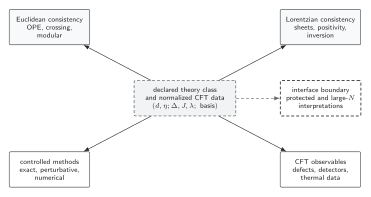
Conformal bootstrap starts with a declared theory class and normalized operator data, compares convergent or analytically continued channel representations, and adds positivity, modularity, causality, or asymptotics only under their own hypotheses. A method can exclude or constrain data without proving that a CFT exists or identifying a model. The diagram is schematic.
The full relationship remains available without the figure:
| Stage | Required input | Output | Claim boundary |
|---|---|---|---|
| Theory class | , signature, global setting, sectors, unitarity or replacement | allowed representations and correlators | no dynamics yet |
| Conformal data | spectrum, two-point metric, three-point structures, OPE normalization | channel expansion | completeness and convergence domain stated |
| Consistency | crossing, sewing, modular covariance, KMS, Ward identities | exact functional equation | equation alone does not prove existence |
| Additional structure | positivity, causality, Regge bounds, gaps, sparsity, protection | convex cone or analytic constraints | every hypothesis remains attached |
| Method | exact solution, controlled expansion, functional, inversion, or certified optimization | bound, sum rule, or reconstructed candidate | truncation and ambiguity retained |
| Interpretation | comparison with independent data | bounded model or interface statement | kink, island, or large-N pattern is not automatic identification |
A scalar crossing problem in one page
Section titled “A scalar crossing problem in one page”For identical real scalar primaries with unit two-point function in Euclidean signature,
Define
and write
In the OPE domain,
where the identity is included and in the chosen normalization. Crossing gives
The coefficients are nonnegative only because the external operator is identical and Hermitian, the theory is reflection positive, the two-point metric is positive, and the channel uses the compatible radial adjoint. Mixed, nonunitary, logarithmic, and Lorentzian systems require their own matrix, indefinite, or ordered replacements.
The representation-theoretic construction of the radial adjoint and the standard functional-separation formulation of this crossing equation are reviewed, with compatible conventions, in Rychkov 2017, §§2–3 and Simmons-Duffin 2017, §§2–4.
This simple equation already displays the volume’s recurring pattern: symmetry fixes the blocks; dynamics is the spectrum and OPE data; associativity gives crossing; positivity turns it into separation; and a functional exclusion still does not construct a theory.
Common conventions and translation checks
Section titled “Common conventions and translation checks”The table below fixes the shared starting convention. A page may override a row when its subject requires it, but must state the conversion and reproduce an invariant quantity after converting.
| Axis | Shared convention | Required translation check |
|---|---|---|
| Lorentzian signature | scalar product and prescription agree | |
| Euclidean continuation | positive with continuation path stated for Lorentzian use | same ordered boundary value is recovered |
| Conformal algebra | , , | a Casimir eigenvalue or Jacobi identity agrees |
| Radial adjoint | , , in the no- generator convention | level-one and scalar level-two Gram norms agree |
| Scalar two-point function | unit coefficient, | rescaling is inverted in every OPE coefficient |
| Degenerate operators | positive two-point matrix retained until a declared whitening | basis-invariant quadratic OPE weight agrees |
| OPE coefficient | coefficient multiplies a unit-normalized primary and its fixed descendants | a two- or three-point function round-trips |
| Cross ratios | , with channel and ordering stated | all six permutation images agree |
| Scalar block | leading -channel behavior with angular tensor declared locally | Casimir and OPE-limit checks agree |
| One-dimensional block | series, integral, and Casimir forms agree | |
| Two-dimensional stress tensor | plane–cylinder shift and character vacuum energy agree | |
| Four-dimensional stress tensor | and in the displayed anomaly convention | a free-field anchor agrees |
| Weyl anomaly in 4D | gives | |
| Fourier transform | , inverse measure | position/momentum Ward identity round-trips |
| Discontinuity | ; dDisc phases declared on the page | a frozen continuation path gives the same result |
| Modular variable | with spin structure, vacuum shift, and sector sum explicit | and actions close in the chosen sector basis |
| Numerical output | crossing basis, derivative order, precision, approximation, feasibility sign, and solver version stated | independent residual and certificate agree |
| Mellin or detector data | contour/measure/normalization and Regge or smearing domain declared locally | pole residues or total-energy sum rule agrees |
The translation procedure is short: record the source formula, write the forward transformation, write its inverse, and test an invariant such as a norm, correlator, crossing residual, anomaly response, displacement identity, or Mellin residue. An unresolved sign, phase, branch, contact term, or degeneracy remains visible in the conclusion.
Strength of conclusions
Section titled “Strength of conclusions”Use the narrowest description that fits the evidence:
| Evidence | Supported statement | Unsupported promotion |
|---|---|---|
| Algebraic identity or exact solution | equality under the stated definitions | existence of a microscopic realization unless constructed |
| Theorem | conclusion under all listed hypotheses | extension beyond dimension, positivity, or regularity assumptions |
| Controlled expansion | coefficient and remainder in a declared regime | extrapolation outside that regime |
| Certified numerical exclusion | no solution inside the specified ansatz and assumptions | existence at an allowed point |
| Convergent numerical pattern | evidence with precision and truncation study | theorem or exact endpoint |
| Kink, island, or reconstructed spectrum | candidate boundary structure | unique model identification |
| Large-N, protected, or holographic interface | conditional CFT statement | bulk dynamics, locality, or duality without its separate construction |
Current benchmark values, software versions, and open-problem status belong in dated resources. Durable pages retain the equations, assumptions, verification workflow, and claim boundary.
Review your starting point
Section titled “Review your starting point”Build a crossing vector
Section titled “Build a crossing vector”Using the scalar conventions above, define a crossing vector whose positive sum vanishes.
Solution
For each exchanged primary define . Crossing is . Positivity of the weights requires the identical-Hermitian reflection-positive hypotheses stated above.
Diagnose a model claim
Section titled “Diagnose a model claim”A finite numerical search finds a small allowed island near known CFT data. What is established?
Solution
The search conditionally excludes data outside the island at its stated derivative order, approximations, precision, spectrum assumptions, and symmetry sectors. Agreement with a known model is evidence for an interpretation, not proof of existence, uniqueness, or identification. Those require convergence and independent CFT data.
References
Section titled “References”- Pappadopulo, D., Rychkov, S., Espin, J., and Rattazzi, R. “OPE Convergence in Conformal Field Theory.” Physical Review D 86, 105043 (2012). arXiv. DOI.
- Poland, D., Rychkov, S., and Vichi, A. “The Conformal Bootstrap: Theory, Numerical Techniques, and Applications.” Reviews of Modern Physics 91, 015002 (2019). arXiv. DOI.
- Rychkov, S. EPFL Lectures on Conformal Field Theory in Dimensions. SpringerBriefs in Physics. Springer, 2017. arXiv. DOI.
- Simmons-Duffin, D. “TASI Lectures on the Conformal Bootstrap.” In New Frontiers in Fields and Strings, 1–74. World Scientific, 2017. arXiv. DOI.
Original QFT.org content:CC BY 4.0, unless an item supplies different terms. Third-party material retains its own terms.