

Protected Data as Bootstrap Input
Protected supersymmetric information becomes conformal-bootstrap input only after it has been translated into ordinary CFT data: operator dimensions and representations, two- and three-point normalizations, OPE coefficients or linear combinations, and their uncertainties. A shortening label, index coefficient, or localization observable is not yet a crossing coefficient. The conversion must preserve its upstream convention, mixing and recombination status, and exactness claim. A concrete example of a protected subsector together with its nontrivial map back to higher-dimensional CFT data is Beem et al. 2015, §§2–4.
Required background. Mixed Correlators and Symmetry Sectors supplies matrix-valued crossing. Characters and Multiplet Counting supplies conformal-primary decomposition.
Concrete upstream source. The N=1 protected-data export specializes the generic Volume 10 versioned-export contract and supplies the bounded SQCD record used below.
Which protected statements can enter crossing?
Section titled “Which protected statements can enter crossing?”Useful inputs include:
- a scaling dimension fixed by a declared shortening condition;
- an exactly normalized stress-tensor or flavor-current coefficient;
- a protected OPE coefficient, or a known linear combination of coefficients;
- the absence or multiplicity of a protected multiplet after recombination is resolved;
- a cohomological or chiral-algebra correlator together with its map to a restricted higher-dimensional OPE;
- an integrated correlator from localization together with its kernel and contact subtraction.
The available short multiplets, their null states, and their recombination patterns depend on the spacetime dimension and superconformal algebra Córdova, Dumitrescu, and Intriligator 2019, abstract and §§2–4. Each statement has a different claim ceiling. Protection of does not protect . An index can constrain a signed combination of short multiplets but usually cannot distinguish multiplets that share the same index class. A topological subsector determines only the OPE projection visible in its cohomology. In supersymmetric bootstrap systems, only the identified protected pieces are fixed; the remaining dimensions and OPE data stay as crossing variables Poland, Rychkov, and Vichi 2019, §8.
The supersymmetry algebra, shortening theorem, and protected calculation remain with the superconformal handoff, protection and mixing analysis, or another exact Volume 10 source. This page begins at their exported CFT datum.
What a usable protected input contains
Section titled “What a usable protected input contains”A complete record specifies:
| Field | Why crossing needs it |
|---|---|
| Theory and superconformal algebra | fixes dimension, R-symmetry, and allowed multiplets |
| Operator identity | names the superconformal primary, conformal component, charges, and representation |
| Protection statement | says exactly which dimension, multiplicity, or coefficient is fixed and why |
| Recombination status | prevents a short multiplet at threshold from being counted twice |
| Mixing basis | distinguishes a protected vector space from a preferred operator |
| Two-point convention | fixes what a quoted OPE coefficient means |
| Source version and content hash | freezes the upstream calculation used |
| Exact or numerical status | carries precision, uncertainty, and correlation information |
| Convention map and inverse | converts to this volume and verifies a round trip |
| Allowed conclusion | states which crossing equation or coefficient receives the datum |
If any of these fields is missing, the input may still motivate an example, but it cannot support a substantive protected-sector bound or reconstruction.
Convention conversion
Section titled “Convention conversion”Suppose an upstream source normalizes operators by
while crossing uses unit two-point functions. Define
A three-point coefficient transforms as
For a degenerate protected subspace, is replaced by a positive matrix . Whitening it requires a declared factorization and maps coefficient vectors by . A change of basis within the degenerate space changes individual components but not basis-invariant quadratic combinations.
A valid round trip applies the inverse transformation and recovers the source datum, including exact algebraic numbers or the full numerical covariance, within its stated tolerance. Agreement of a single decimal value is not enough.
Stop before crossing if the record is stale
Section titled “Stop before crossing if the record is stale”The flow below contains an explicit stop: a missing version, normalization, mixing map, or inverse conversion prevents the protected datum from reaching Ward identities or superblocks.
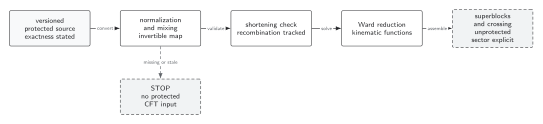
Protected data enter ordinary conformal crossing only after source identity, exactness, normalization, mixing, recombination, and an invertible convention transformation have been verified. A failed or stale check stops the path; the diagram is schematic.
The same logic in structured form is:
| Stage | Pass condition | Failure response |
|---|---|---|
| Source | canonical route, version, date, and hash exist | do not import |
| Multiplet | algebra, shortening, and recombination are identified | keep datum unassigned |
| Normalization | two-point and generator conventions are explicit | do not quote an OPE coefficient |
| Mixing | basis or invariant combination is supplied | retain only the unresolved subspace |
| Conversion | forward and inverse maps agree | reject transformed value |
| Crossing | protected contribution is isolated from unprotected unknowns | do not claim a complete solution |
Physics output requires a frozen upstream record and its supporting evidence. A synthetic schema can test file parsing, but it must not be presented as protected-data physics.
Current evidence boundary
Section titled “Current evidence boundary”This interface was checked against the cited literature and repository inputs through 24 August 2026. The designated upstream object is N=1 , protected data v1.0.0, validated against QFT.org protected-SCFT export schema v1.0.0. Its frozen import tuple is
The object becomes an accepted record only when it validates against the named schema, its RFC 8785 canonical-JSON digest equals the third tuple entry, and every declared forward/inverse convention map passes. A nonhexadecimal third entry is an automatic rejection; the hexadecimal digest above is generator output rather than a human-supplied value. This edition passes those generator gates. Its convention hash is 81124c40cb39131147e94235022cbcea42222795e2a4e4c4842936fc212bfd95, and its evidence cutoff is 24 August 2026.
The accepted record can supply exact R-charges and dimensions for selected chiral primaries, anomaly traces, , flavor-current coefficients, CDI label conventions, and the stated free-factor and evidence status. It supplies no unit-normalized non-Ward OPE coefficient, unique index multiplicity, external-correlator definition, long-multiplet gap, or crossing vector. Accordingly, accepting the record changes the protected-input inventory but still supports no dependent numerical superconformal bound. The record version, content hash, and evidence cutoff—not this page date alone—control reuse.
Common pitfalls
Section titled “Common pitfalls”Treating a protected dimension as a protected OPE coefficient. Shortening can fix one without fixing the other. Import only the quantity actually established upstream.
Whitening a mixed sector without retaining the matrix. The square root of a two-point matrix is part of the convention transform. Dropping it makes the conversion impossible to reverse.
Using an index coefficient as a multiplicity. Bosonic and fermionic short multiplets can cancel or recombine in an index. Inversion requires extra assumptions or fugacity information.
Exercises
Section titled “Exercises”An upstream operator has and , with already unit normalized. Find the crossing coefficient.
Solution
The unit-normalized operator is , so . For identical Hermitian , its scalar crossing weight is .
References
Section titled “References”- Beem, C., Lemos, M., Liendo, P., Peelaers, W., Rastelli, L., and van Rees, B. C. “Infinite Chiral Symmetry in Four Dimensions.” Communications in Mathematical Physics 336 (2015): 1359–1433. arXiv. DOI.
- Córdova, C., Dumitrescu, T. T., and Intriligator, K. “Multiplets of Superconformal Symmetry in Diverse Dimensions.” Journal of High Energy Physics 2019, 163 (2019). arXiv. DOI.
- Poland, D., Rychkov, S., and Vichi, A. “The Conformal Bootstrap: Theory, Numerical Techniques, and Applications.” Reviews of Modern Physics 91, 015002 (2019), §8. arXiv. DOI.
Original QFT.org content:CC BY 4.0, unless an item supplies different terms. Third-party material retains its own terms.