

From the Local OPE to Conformal Data
The Wilson OPE is a local short-distance expansion. At a conformal fixed point, conformal representations organize that expansion so strongly that descendants introduce no independent coefficients: after a basis and normalization are chosen, the independent data are primary dimensions and representations together with two- and three-point tensors. This page makes that reduction explicit without redefining the general OPE or assuming convergence outside a stated radial domain.
Required background. Free-Field OPE Preview supplies the local Wilson-expansion concept and its scope. Scalar Two- and Three-Point Functions fixes the two-point metric and scalar three-point convention. Helpful background. Completeness and the Operator Basis states the resolution of the identity used to insert conformal families.
The conformal-data package
Section titled “The conformal-data package”For each primary label , record
Degeneracy labels are part of ; two operators with the same and representations need not be the same state. The remaining independent tensors are:
- the two-point metric between conjugate sectors;
- one coefficient for every independent three-point spacetime structure and internal invariant tensor; and
- discrete information such as statistics, chirality, reality, and quotienting by null submodules.
In a reflection-positive Hermitian sector may be orthonormalized, but retaining makes basis covariance transparent. Under , the metric and three-point tensors transform on every index. A four-point coefficient is a contraction such as
or its spinning matrix analogue. Individual components are not invariant data.
This package is deliberately narrower than “a CFT exists.” It must also satisfy OPE convergence, associativity, reflection positivity when claimed, Ward identities, and any global or modular consistency conditions appropriate to the theory. The standard data model is summarized in Poland, Rychkov, and Vichi 2019, §§ III.B–III.C.
Descendant coefficients from symmetry
Section titled “Descendant coefficients from symmetry”Consider scalar primaries and an exchanged scalar of dimension . In the domain , write
The exact three-point function with contains
Expanding for small gives a term
Meanwhile,
in the unit two-point convention. Matching the two expansions yields
For identical external scalars, . Higher coefficients follow recursively from the conformal algebra, equivalently from descendant Gram matrices and three-point matrix elements Simmons-Duffin 2017, §§ 5–6. If a descendant is null, its whole submodule is removed before the family contributes. A zero Gram eigenvalue must never be inverted; one works directly in the irreducible quotient.
For spinning exchange, each independent left three-point structure and right three-point structure labels a block matrix. Symmetry still fixes descendants, but it does not collapse the independent primary tensor structures into one coefficient.
From data to a channel decomposition
Section titled “From data to a channel decomposition”The flow from local products to crossing has distinct logical stages. Inspect where representation theory ends and positivity begins.
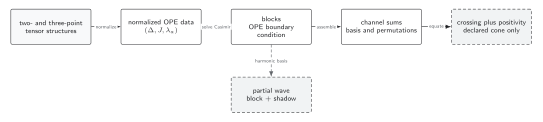
Primary dimensions, representations, the two-point metric, and three-point tensors are the independent conformal data. Descendants are summed into blocks in a declared OPE channel. A partial wave additionally contains the shadow solution. Channel equality gives crossing on an overlap and then by declared continuation; nonnegative weights require reflection positivity and a suitable Hermitian external ordering. The diagram is schematic and does not assert existence or completeness from kinematics alone.
The same distinctions are encoded semantically:
| Stage | Object | Independent input | Domain or hypothesis | Output |
|---|---|---|---|---|
| Local expansion | Wilson OPE coefficients in a renormalized operator basis | Theory and renormalization prescription | Short-distance insertion domain | Sum of local operators |
| Conformal reduction | Primaries plus fixed descendants | , , primary three-point tensors | Exact conformal symmetry and null quotient | Conformal families |
| Family sum | Block | External data and a block normalization | One chosen channel and OPE asymptotic | Contribution of one irreducible family |
| Harmonic construction | Partial wave | Pairings and shadow normalization | Euclidean harmonic-analysis contour | Block plus shadow |
| Correlator reconstruction | Channel sum | Spectrum and contracted OPE tensors | Completeness and OPE convergence | Reduced correlator in that domain |
| Consistency | Crossing equation | Same correlator in overlapping channels | Associativity and declared continuation | Functional equality |
| Positive bootstrap | Positive scalar or matrix measure | Hermiticity and two-point metric | Reflection positivity or unitary radial Hilbert space | Positivity cone for bounds |
Selection rules and degeneracy
Section titled “Selection rules and degeneracy”An exchanged primary can occur only if its Spin and internal representations appear in the product of the external representations. For identical bosonic scalars, spacetime exchange selects even spin in the symmetric internal channel and odd spin in an antisymmetric internal channel. For fermions, the sign includes both the permutation of fields and the action on spinor structures.
If several primaries share the same , the conformal block is the same but their OPE tensors remain independent. In an orthonormal degenerate basis the identical-scalar coefficient is a sum of squares,
which is invariant under orthogonal rotations of that basis. A claimed individual is not basis invariant unless an additional commuting observable resolves the degeneracy.
Continuous spectra replace the sum over by a measure. Logarithmic theories may require generalized eigenvectors and derivatives of blocks. Neither case fits an unqualified discrete table of .
Convergence is not part of the definition
Section titled “Convergence is not part of the definition”The formal organization into conformal families does not by itself prove that a channel sum converges at a chosen configuration. In a reflection-positive Euclidean CFT, radial quantization supplies strong convergence results when a sphere separates the fused insertions from the others. The precise geometry and remainder are developed on OPE Convergence, Associativity, and Domain Control.
The theorem-level factorization-algebra treatment of special holomorphic, topological, and mixed settings is a separate continuation at Holomorphic, Topological, and Mixed Factorization Theories. It does not become a prerequisite for the physical conformal-family calculation above.
Common pitfalls
Section titled “Common pitfalls”The spectrum alone is the CFT data. Three-point tensors and the two-point pairing are also required. Their contractions, not isolated basis components, enter correlators.
Descendants carry new OPE coefficients. Conformal symmetry fixes them once the primary structure is specified. Null descendants must be quotiented rather than assigned arbitrary coefficients.
A formal family expansion converges everywhere. Convergence depends on insertion geometry and channel. Other regions require a justified continuation.
Exercises
Section titled “Exercises”Derive the first descendant coefficient for identical external scalars.
Solution
Set in
Then , independently of the exchanged scalar dimension. This assumes ; the identity family has no nonzero translation descendants and is treated separately.
References
Section titled “References”- Poland, David, Slava Rychkov, and Alessandro Vichi. “The Conformal Bootstrap: Theory, Numerical Techniques, and Applications.” Reviews of Modern Physics 91 (2019): 015002. DOI; Open PDF
- Simmons-Duffin, David. “TASI Lectures on the Conformal Bootstrap.” In New Frontiers in Fields and Strings, 1–74. Singapore: World Scientific, 2017. DOI; Open PDF
Original QFT.org content:CC BY 4.0, unless an item supplies different terms. Third-party material retains its own terms.