

Crossing Equations and Positivity
Crossing and positivity do different jobs. Crossing says that two convergent OPE decompositions reconstruct the same four-point function. Reflection positivity says that, for a suitable Hermitian pairing, the accompanying OPE data are nonnegative numbers or positive-semidefinite (PSD) matrices. Together they turn consistency of a unitary Euclidean CFT into a convex problem: a linear functional can rule out a proposal when it separates the negative identity crossing vector from the cone generated by every allowed nonidentity contribution.
Required background. OPE Convergence, Associativity, and Domain Control justifies equality of channel sums and the action of suitable functionals on them. Conformal Blocks and Casimir Equations fixes the block normalization. Conjugation and Reflection Positivity supplies the positive radial form. Helpful background. Hilbert Space, Positivity, and Unitary Evolution supplies the general positivity framework.
Identical-scalar crossing as a positive sum rule
Section titled “Identical-scalar crossing as a positive sum rule”Work in a reflection-positive Euclidean CFT on with , and assume a unique normalized vacuum and identity operator. Let be a nonidentity Hermitian scalar primary, so , normalized by
For four distinct points, write and define
and remove the two-point prefactor:
The points are separated and the kinematics are Euclidean, so no coincident-point contact term or Lorentzian branch choice enters this equation. Either one must be restored before the same notation is used for distributions or continued orderings.
In an orthonormal basis of normalizable exchanged primaries, the convergent decomposition is
The descendants of one primary are already included in its block. The notation displays a discrete primary spectrum; a continuous component is represented by the corresponding positive spectral integral. The identity block is , and locality of two identical bosons permits only even spin in . Exchanging and swaps and but also changes the prefactor, so
With the crossing vectors
the identity vector is
Crossing therefore has the homogeneous positive-sum form
or, equivalently,
This derivation fixes the signs. Defining with the opposite order is harmless only if the identity term is also reversed. Some sources divide the nonidentity vector by and write the right-hand side as the constant one; here the vector is deliberately left undivided.
For a proposed set of allowed nonidentity data, take all positive linear combinations of its crossing vectors. These combinations form a convex cone, and crossing requires to lie in that cone—or in the appropriate closure when infinitely many operators or a continuous spectrum contribute. This is the geometric statement anticipated in the lead. The identical-scalar decomposition, crossing relation, and cone interpretation appear in Rattazzi et al. 2008, §3.4, §4, §§5.2 and 5.5 and Simmons-Duffin 2017, §§10.2–10.6, eqs. (188), (191)–(193).
Why the weights—not the blocks—are positive
Section titled “Why the weights—not the blocks—are positive”Choose a sphere that separates the pair from the reflected pair . The inner insertions create a radial state. Expanding that state in an orthonormal basis of primary-descendant states and pairing it with its reflected conjugate produces norms. For a nondegenerate Hermitian primary,
The positivity belongs to the spectral coefficient. It does not say that or is pointwise nonnegative in arbitrary kinematics. Indeed, a crossing vector must change sign under .
Every qualifier matters. A generic four-point coefficient is and can have either sign. For a complex external operator, the positive configuration pairs an operator product with its reflected Hermitian conjugate. Gauge-fixed fields, negative-norm sectors, logarithmic modules, and nonunitary theories do not inherit this cone without a separate replacement for reflection positivity.
An exact normalization check
Section titled “An exact normalization check”A generalized-free scalar gives a quick check of every prefactor and sign above. Its reduced four-point function is
Direct substitution gives
The first term in is the direct-channel identity; the two crossed Wick contractions supply the remaining terms. This is an exact correlator-level crossing check. It is not, by itself, a derivation of every block coefficient or proof that a generic generalized-free solution has a local stress tensor. Free and Generalized-Free CFT Data gives those spectrum, positivity, shortening, and locality qualifications.
Degeneracies and positive-semidefinite matrices
Section titled “Degeneracies and positive-semidefinite matrices”Degeneracy makes basis invariance visible. Let share the same dimension, spin, and internal quantum numbers, quotient any null states, and let
be their positive-definite Hermitian Gram matrix. If labels an external-operator pair and denotes the corresponding covariant three-point overlaps in this basis, the basis-independent exchanged weight is
For every complex vector ,
so . In an orthonormal exchanged basis, and is a sum of outer products. In a real Hermitian sector, the conjugation becomes a transpose. With only the identical pair , this reduces to the scalar weight . With several external pairs, it is genuinely matrix-valued.
For example, one exchanged primary with OPE vector contributes
The negative off-diagonal entry is harmless: the eigenvalues are and , and, for real , . Thus PSD does not mean entrywise nonnegative. A unitary rotation among degenerate primaries—orthogonal in a real sector—leaves unchanged; a change of external-pair coordinates acts by congruence and preserves PSD while changing individual entries.
Schematically, a closed mixed system has the componentwise form
where labels an internal-symmetry sector and every matrix entry of is a vector of crossing functions. The trace is the Hermitian matrix pairing in each crossing-equation component. A functional acts componentwise and must produce a PSD matrix in every allowed sector, not merely positive diagonal entries. Mixed Correlators and Global-Symmetry Sectors derives the full coupled system. The scalar-to-matrix transition and the rank-one restriction for one isolated exchanged primary are explicit in Kos, Poland, and Simmons-Duffin 2014, §§2.1–2.2 and §3.4, eqs. (2.7)–(2.10) and (3.24)–(3.25).
Linear functionals turn hypotheses into exclusions
Section titled “Linear functionals turn hypotheses into exclusions”Suppose a hypothesis specifies the allowed nonidentity dimensions, spins, symmetry sectors, and gaps. A real linear functional excludes that hypothesis if it is valid on the convergent crossing sum and satisfies
Applying it to the homogeneous sum rule would give
which is impossible because the left-hand side is at least one. The conclusion is precise: no CFT satisfying all the stated axioms and spectral hypotheses can realize that spectrum. The argument does not construct a theory on the nonexcluded side, and no converse separation claim is being made for an infinite cone without the needed topology and closure hypotheses.
Practical searches often use derivatives at the crossing-symmetric point. Because every identical-scalar crossing vector is exchange-odd, plain evaluation there vanishes; one needs exchange-odd derivatives, integrals, or another nontrivial functional. A proposed finite coefficient vector is not yet a certificate: its sign must hold over every continuous allowed dimension interval and all spins, its large-dimension tail must be controlled, and its action must commute with the infinite OPE sum. The convergence and tail estimates of Pappadopulo et al. 2012, §2 and §5.2, especially eqs. (5.9)–(5.10) are part of that justification; for derivatives one must additionally establish uniform analyticity on the chosen compact domain and apply Cauchy estimates. The distinction between a sampled search and a proof is reviewed in Poland, Rychkov, and Vichi 2019, §§IV.A–IV.B.
Crossing and Positivity in One Dimension gives an exact low-order certificate. Its kinematics are one-dimensional, outside the setup used above, but the same separation argument applies once its own crossing vectors and positivity domain have been established.
From conformal data to a justified claim
Section titled “From conformal data to a justified claim”The flow diagram shows where crossing and positivity enter. Inspect the two independent paths into the final cone: associativity equates assembled channel sums, while reflection positivity separately restricts the OPE data that may weight them.
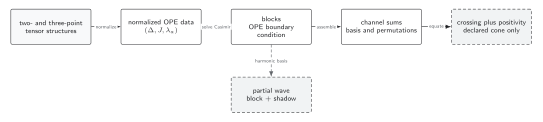
Kinematic structures and block functions do not carry positivity by themselves. A convergent OPE sum reconstructs one channel; associativity supplies the convention-fixed equation ; a positive radial inner product and reflected Hermitian-conjugate ordering independently supply nonnegative scalar weights or PSD matrices. The dashed detour records that a conformal partial wave combines physical-block and shadow solutions with convention-dependent coefficients. The figure is schematic and does not turn a gap assumption, truncated equation, or nonexcluded point into an existence proof.
The same logic can be checked without the image:
| Step | Required input | Strongest justified conclusion | Failure to avoid |
|---|---|---|---|
| Block construction | , , external dimensions, tensor basis, and block normalization | One normalized physical block; a conformal partial wave is a convention-dependent combination of physical-block and shadow solutions | Treating a partial wave as the physical block alone |
| Channel reconstruction | Complete OPE data and a convergence domain | One representation of the correlator | Truncating without a tail bound |
| Associativity | Two convergent channel sums on an overlap, or a justified continuation | An exact crossing equation | Rearranging formal series outside their domains |
| Scalar positivity | Identical Hermitian pair, reflected ordering, and positive two-point metric | Treating a generic OPE product as a square | |
| Matrix positivity | Complete OPE vectors and a positive-definite exchanged Gram matrix after quotienting nulls | Checking only entries or diagonals | |
| Spectral hypothesis | Explicit sectors, gaps, and spin ranges | A declared candidate cone | Hiding an assumption inside the solver input |
| Functional certificate | Valid swapping and proved scalar or matrix signs on the full domain | Exclusion of that candidate cone | Interpreting failure to exclude as existence |
Common pitfalls
Section titled “Common pitfalls”Crossing implies positivity. Crossing follows from associativity of channel decompositions. Positivity additionally uses Hermiticity, conjugate ordering, and a positive radial inner product.
Positive OPE weights make every block positive. The weights are nonnegative in the reflected identical-pair problem. Crossing vectors are exchange-odd functions and are not pointwise positive.
The crossing-symmetric value is already a bound. Every antisymmetric crossing vector vanishes at . Derivatives, integrals, or other nontrivial functionals carry the separating information.
Positive diagonals make a matrix PSD. A Hermitian matrix can have positive diagonal entries and a negative eigenvalue. Positivity must hold for its quadratic form in every OPE-vector direction.
Separated-point crossing settles contact terms and branches. It does not. Coincident distributions, momentum-space contact terms, and Lorentzian orderings require their own prescriptions before channel equations can be compared.
Not excluded means realized. A finite functional search supplies exclusions only. A surviving point, truncated solution, kink, or island needs additional completeness, convergence, and model-identification evidence.
Exercises
Section titled “Exercises”1. Debug a crossing convention. A student writes the nonidentity part of the homogeneous equation as , where the spectral weights obey , and defines but leaves the identity vector equal to . Diagnose the resulting equation and repair it.
Solution
The correct equation says
Replacing only the nonidentity vectors gives the inconsistent residual
which is nonzero away from . The repair is to reverse the identity vector too: , so the entire homogeneous equation is multiplied by . Equivalently, keep the original sign for every vector. Substitution of the generalized-free correlator provides an immediate prefactor-and-sign check.
2. Remove a basis choice. Let be a positive-definite Gram matrix and collect the covariant overlaps into a matrix whose rows carry the exchanged-state index. Under a nonsingular basis change suppose and . Show that the exchanged matrix is basis independent.
Solution
The inverse Gram matrix transforms as
Therefore
The Gram inverse is what removes the arbitrary choice and normalization of the nonorthonormal exchanged basis. Positivity then follows from .
3. Certify a projected cone. Suppose a two-coordinate projection of , with , sends the identity to and every vector allowed by a proposed gap to with . Construct an excluding functional. Why would checking the inequality at finitely many sampled dimensions be insufficient?
Solution
Take . Its action on the identity is , while its action on every allowed nonidentity vector is nonnegative. Applying it to a positive sum that is required to vanish gives a strictly positive result, so the proposed gap is impossible.
A finite sample does not cover the continuous dimension domain. An allowed vector could have between sample points or in the large-dimension tail, destroying the certificate. The sign must be proved on every allowed interval and asymptotic sector.
Continue
Section titled “Continue”Mixed Correlators and Global-Symmetry Sectors derives closed coupled systems and their matrix-valued kernels. Crossing and Positivity in One Dimension provides an exact low-order functional certificate in the simplest kinematics. From Crossing Equations to Convex Optimization develops the general finite-dimensional search and its claim ceiling.
References
Section titled “References”- Kos, Filip, David Poland, and David Simmons-Duffin. “Bootstrapping Mixed Correlators in the 3D Ising Model.” Journal of High Energy Physics 2014, no. 11 (2014): 109. DOI; Open PDF
- Pappadopulo, Duccio, Slava Rychkov, Johnny Espin, and Riccardo Rattazzi. “OPE Convergence in Conformal Field Theory.” Physical Review D 86 (2012): 105043. DOI; Open PDF
- Poland, David, Slava Rychkov, and Alessandro Vichi. “The Conformal Bootstrap: Theory, Numerical Techniques, and Applications.” Reviews of Modern Physics 91 (2019): 015002. DOI; Open PDF
- Rattazzi, Riccardo, Vyacheslav S. Rychkov, Erik Tonni, and Alessandro Vichi. “Bounding Scalar Operator Dimensions in 4D CFT.” Journal of High Energy Physics 2008, no. 12 (2008): 031. DOI; Open PDF
- Simmons-Duffin, David. “The Conformal Bootstrap.” In New Frontiers in Fields and Strings, 1–74. World Scientific, 2017. DOI; Open PDF
Original QFT.org content:CC BY 4.0, unless an item supplies different terms. Third-party material retains its own terms.