

Unitarity Bounds and Null States
Unitarity bounds are positivity theorems for conformal representations, not dimensional estimates. In a reflection-positive Euclidean CFT, radial conjugation makes translations adjoint to special conformal transformations. Descendant norms can then be reduced to the conformal algebra. For a symmetric traceless primary of spin , level-one positivity gives ; a scalar requires a separate level-two calculation and obeys unless it is the identity. Saturation creates a null descendant and hence a short module.
Required background. Primaries, Descendants, and Conformal Multiplets supplies descendant levels and quotient modules. Hilbert Space, Positivity, and Unitary Evolution supplies positive inner products and adjoints. Helpful background. Forms, Adjoints, and Isometries supplies Gram matrices and positive-semidefinite quotients.
Hypotheses behind the bounds
Section titled “Hypotheses behind the bounds”The derivation on this page assumes:
- a local Euclidean CFT in satisfying reflection positivity;
- radial quantization and the state–operator correspondence;
- a positive-energy spectrum of with finite-dimensional rotation eigenspaces;
- a primary state in an irreducible finite-dimensional representation of or ;
- the radial adjoint , , and ; and
- quotienting of zero-norm states so that the physical inner product is positive definite.
After Osterwalder–Schrader continuation these conditions correspond to a unitary positive-energy Lorentzian theory, but that continuation is an additional theorem-level step. Nonunitary, logarithmic, gauge-fixed, defect, or nonlocal sectors can violate one or more assumptions. The standard derivation and its CFT interpretation are given in Simmons-Duffin 2017, §§ 7.1–7.3 and Poland, Rychkov, and Vichi 2019, § III.E.
Level-one positivity for spinning primaries
Section titled “Level-one positivity for spinning primaries”Let be a primary of dimension in a rotation irrep . Choose an orthonormal basis, . The level-one Gram matrix is
Decompose into irreducible rotation representations . With the anti-Hermitian rotation matrices used here, define the positive quadratic Casimir by
The spin term is diagonal on each component, and its eigenvalue gives
Every must be nonnegative. For a symmetric traceless rank- representation, and
in generic . The component is the divergence. Its eigenvalue is
so positivity implies
The other level-one channels give weaker inequalities once this bound holds. At saturation, the projected descendant has zero norm. Positivity then makes it orthogonal to the whole physical space, and the quotient imposes
For , this gives a conserved current with ; for , a conserved symmetric traceless stress tensor has . The level-one calculation supplies the inequality. The classification theorem for positive-energy conformal representations ensures that no higher descendant imposes a stronger bound on these symmetric traceless modules; it is not enough merely to inspect the first level and assume the rest.
The scalar bound is a level-two result
Section titled “The scalar bound is a level-two result”For a scalar primary, level one gives only
and hence . The sharper bound comes from the scalar trace at level two. Using the algebra and ,
Applying once more gives the exact norm
Together with , positivity allows or
In an irreducible CFT with a unique invariant vacuum, a scalar primary at is the identity. At the nontrivial saturation value, is null and
This is the free massless scalar equation. The resulting CFT sector has additional consequences—for example, Wick-like structures under standard locality assumptions—but those do not follow from the norm polynomial alone.
Shortening as a quotient
Section titled “Shortening as a quotient”The figure separates the positivity step from the local equation. Inspect the branch at which a descendant becomes both singular and zero norm.
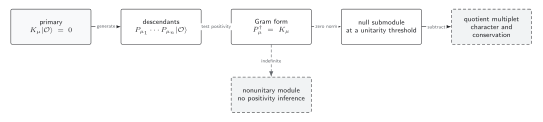
For a symmetric traceless spin- primary, the level-one divergence becomes null at and yields conservation. For a scalar, the level-two trace becomes null at and yields the free equation. The diagram is schematic; nullness requires the positive radial form and is stronger than algebraic reducibility alone.
| Step | Symmetric traceless spin | Scalar | Logical input |
|---|---|---|---|
| Candidate descendant | Level-one divergence | Level-two trace | Rotation decomposition |
| Norm factor controlling the threshold | Conformal commutators and | ||
| Positivity conclusion | or | Positive radial inner product | |
| Saturation equation | Null quotient plus state–operator correspondence | ||
| Entire submodule removed | Descendants of the divergence | Descendants of | Irreducible short-module quotient |
Bounds and equations by representation
Section titled “Bounds and equations by representation”The following table is designed for use before interpreting a measured or computed scaling dimension. Its representation labels are irreducible or rotation labels in reflection-positive Euclidean radial quantization; Lorentzian finite-dimensional field labels require continuation to the corresponding real form. Its entries are representation-theoretic constraints; they do not prove that a local CFT realizing the representation exists.
| Primary in a reflection-positive CFT | Bound or saturation value | First null component | Local conclusion at saturation | Necessary qualifications and failure mode | Proof status and source |
|---|---|---|---|---|---|
| Identity-sector scalar | Constant identity operator | Identifying every dimension-zero scalar with the identity also uses irreducibility and a unique invariant vacuum | Positive-energy representation result under the page hypotheses: Simmons-Duffin 2017, § 7.3 | ||
| Nonidentity scalar | at equality | The level-one test gives only ; nonunitary scalars may lie below the bound | Level-two Gram theorem plus representation classification: Poland, Rychkov, and Vichi 2019, § III.E | ||
| Fundamental spinor | Gamma-trace at equality | Massless Dirac equation | Chirality and reality depend on dimension and signature; the statement is for the appropriate Spin irrep | Positive-energy representation bound: Minwalla 1998, § 2, pp. 792–794 | |
| Symmetric traceless rank | Divergence at equality | Generalized conservation; ordinary current for , stress-tensor form for | Conservation follows only after the zero-norm quotient; a generic operator at the same dimension in a nonunitary theory need not be conserved | Level-one Gram theorem plus sufficiency classification: Simmons-Duffin 2017, § 7.3 | |
| Mixed-symmetry highest weight with | Representation-specific generalized divergence | Mixed-symmetry conservation equation | Highest-weight conventions and low-dimensional dualities must be translated before applying the formula | Positive-energy representation bound in the stated highest-weight convention: Dolan 2006, §§ 2–3 | |
| Any representation below its applicable bound | Forbidden in a positive-energy unitary module | Negative-norm descendant before quotient | No unitary CFT operator with those labels | It may occur in a nonunitary or gauge-dependent space, where the positive-form hypothesis is absent | Direct consequence of a negative Gram eigenvalue: Dolan 2006, Appendix C |
The table deliberately separates “allowed representation” from “realized CFT.” Crossing symmetry, OPE associativity, locality, and the existence of a stress tensor impose additional conditions that a single conformal module does not see.
Counterexamples to careless use
Section titled “Counterexamples to careless use”Nonunitary fixed points. The Lee–Yang CFT has operators below unitary bounds because reflection positivity is absent Poland, Rychkov, and Vichi 2019, § VIII. This does not contradict the inequalities; it violates their first hypothesis.
Gauge-fixed fields. A gauge potential or ghost may live in an indefinite auxiliary state space. Apply positivity only to gauge-invariant physical operators after the relevant quotient, not to every gauge-fixed field component.
Logarithmic modules. If has Jordan blocks, the inner product and module decomposition need not be diagonalizable in the form assumed above. A zero norm does not automatically define a decoupled direct summand.
Dimension alone. A spin-one operator with is conserved in the positive irreducible conformal module described above. Without conformal symmetry, radial positivity, and the null quotient, the numerical equality alone is not a conservation proof.
Handoff to radial Gram matrices
Section titled “Handoff to radial Gram matrices”This page derives analytic representation bounds. Descendant Gram Matrices constructs the radial inner product in detail, tracks basis and normalization, and checks the scalar and spinning matrices level by level. That page owns the explicit reflection-positive Gram construction; the present result supplies the target eigenvalues and null channels. Conserved Currents and the Stress Tensor then adds Ward identities and normalization data that representation theory alone cannot fix.
Exercises
Section titled “Exercises”Derive the scalar level-two norm from the two intermediate identities
Solution
Using and applying the first identity followed by the second,
Explain why the current bound follows from the channel rather than the channel.
Solution
For , the Casimir shift in the channel is , so its Gram eigenvalue is . The shift is , giving , which is already positive for positive . The divergence channel therefore reaches zero first.
References
Section titled “References”- Dolan, F. A. “Character Formulae and Partition Functions in Higher Dimensional Conformal Field Theory.” Journal of Mathematical Physics 47 (2006): 062303. DOI; Open PDF
- Minwalla, Shiraz. “Restrictions Imposed by Superconformal Invariance on Quantum Field Theories.” Advances in Theoretical and Mathematical Physics 2 (1998): 783–851. DOI; Open PDF
- Poland, David, Slava Rychkov, and Alessandro Vichi. “The Conformal Bootstrap: Theory, Numerical Techniques, and Applications.” Reviews of Modern Physics 91 (2019): 015002. DOI; Open PDF
- Simmons-Duffin, David. “TASI Lectures on the Conformal Bootstrap.” In New Frontiers in Fields and Strings, 1–74. Singapore: World Scientific, 2017. DOI; Open PDF
Original QFT.org content:CC BY 4.0, unless an item supplies different terms. Third-party material retains its own terms.