

Numerical Boundary and Defect Bootstrap
Boundary and defect bootstrap computations inherit every certification requirement of the ordinary numerical bootstrap and add channel-specific hazards: bulk-channel coefficients can have indefinite sign, defect blocks carry codimension and transverse-spin data, and displacement normalization depends on a localized Ward convention. A valid numerical exclusion must identify exactly which channel supplies positivity.
Required background. Boundary and Defect Bootstrap fixes the two channel expansions and positivity limits. Solver Certificates and Independent Verification fixes the finite-certificate standard.
Evidence cutoff: 2026-08-09. Boundary and defect bounds, software, and certificate practices are mutable. This page gives a durable formulation and a synthetic free-field acceptance target; it does not report a current phenomenological bound.
Channel data and signs
Section titled “Channel data and signs”For a scalar bulk two-point function in a boundary CFT, write schematically
For a Hermitian in a reflection-positive boundary setup and unit-normalized boundary primaries, . The bulk coefficient is a product of an OPE coefficient and a one-point coefficient and has no general fixed sign Liendo, Rastelli, and van Rees 2013, §§2.1–2.2. A boundary-channel functional can exploit positivity; a bulk-channel treatment must retain signed variables or find a separately justified matrix-positive organization. Moving a term across the equation changes the functional sign convention but not this physics.
For codimension , defect blocks also depend on transverse spin and generally on two cross-ratios. The serialized sector key must contain , parallel representation, transverse representation, orientation or parity data, spin selection, and block normalization. A boundary block table is not a codimension-two table with an angular variable set to zero.
Free planar scalar fixture
Section titled “Free planar scalar fixture”Take a canonically normalized free scalar in on ,
with for Neumann and for Dirichlet. Use nonsingular bulk configurations and boundary limits. The Neumann boundary primary is the boundary value of with dimension ; the Dirichlet primary is the normalized normal derivative with dimension . The two signs must never share one fixture row without an explicit boundary-condition label.
The displacement convention is inherited from The Displacement Operator and Defect Ward Identities. Its value is an independently derived datum that can test a boundary solution only after stress-tensor and operator normalizations match.
Certified numerical formulation
Section titled “Certified numerical formulation”The conversion from a crossing system to a finite numerical problem uses the block software, frameworks, and finite SDP workflow reviewed in Rychkov and Su 2024, §§2–3, pp. 2–13, with the defect-specific additions below.
- Freeze the exact bulk and defect crossing vectors at declared and external dimensions.
- Identify PSD sectors and retain signed sectors separately.
- Specify derivative basis, block approximation, transverse-spin and parallel-spin coverage, precision, and tails.
- Export the full conic input and certificate with canonical sector order.
- Independently evaluate crossing residuals, functional normalization, PSD eigenvalue bounds, and every spin/dimension tail.
- Repeat at multiple derivative orders, block orders, spin cutoffs, and precisions.
A successful finite certificate excludes the stated spectral hypothesis in the represented problem. It does not establish a boundary condition, prove existence of the remaining solutions, or identify a defect CFT.
The figure below shows how displacement data can enter a certified defect computation without becoming an automatic numerical or inversion result. Inspect the distinct hypothesis checks at each continuation.
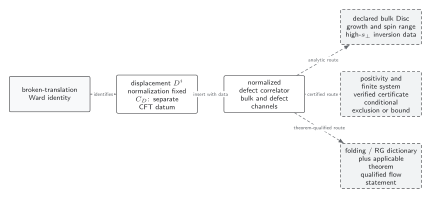
Schematic evidence path from a displacement Ward identity and defect crossing system to a numerical exclusion. The route requires codimension, channel signs, block normalization, truncations, precision, and a verified certificate; reconstruction or Lorentzian inversion remains a separate conditional continuation.
The structured equivalent is:
| Input | Required convention | Numerical use | Independent check | Claim limit |
|---|---|---|---|---|
| Defect crossing | , cross-ratios, channel prefactors | Exact vector equation | direct free-field crossing | system only |
| Boundary OPE data | unit two-point basis | nonnegative sector | reflection and Gram signs | conditional positivity |
| Bulk OPE/one-point data | signed products | signed constraints | term-by-term convention check | no scalar cone without more input |
| Displacement | localized Ward sign and normalization | gap or OPE datum | integrated shape variation | normalized constraint only |
| Finite certificate | basis, blocks, cutoffs, precision | exclusion | separate residual and tail evaluator | represented problem only |
A reproducible numerical test should follow the analytic Dirichlet/Neumann benchmark and retain the resulting certificate, precision, and tolerance data.
Failure tests
Section titled “Failure tests”Channel-sign test. Force every bulk coefficient to be nonnegative. The verifier must reject the unjustified cone.
Image test. Pair Dirichlet block data with the Neumann image sign. The boundary limit must fail.
Codimension test. Reuse a boundary block file for . Missing transverse-spin and angular dependence must be detected.
References
Section titled “References”- Liendo, Pedro, Leonardo Rastelli, and Balt C. van Rees. “The Bootstrap Program for Boundary CFT.” Journal of High Energy Physics 07 (2013): 113. DOI. Open PDF
- Rychkov, Slava, and Ning Su. “New Developments in the Numerical Conformal Bootstrap.” Reviews of Modern Physics 96 (2024): 045004. DOI. Open PDF
Original QFT.org content:CC BY 4.0, unless an item supplies different terms. Third-party material retains its own terms.