

Characters and Conformal Multiplet Counting
A conformal character records the scaling dimensions and rotation weights of every state in a module. For a long multiplet it is the primary character times the generating function for commuting translations. For a short multiplet, one must subtract the entire module generated by each null primary—not just the first null state—and restore intersections when several null modules overlap. Characters make this bookkeeping exact and expose recombination at a unitarity threshold. The primary, descendant, and unitary-shortening inputs used below are reviewed in Simmons-Duffin 2017, §§ 4.3 and 7.3 and Poland, Rychkov, and Vichi 2019, §§ III.B and III.E.
Required background. Primaries, Descendants, and Conformal Multiplets supplies the translation-generated module and null quotient. Representations, Intertwiners, and Invariants supplies highest weights and rotation characters. Helpful background. Unitarity Bounds and Null States supplies the shortening values and null representations.
Character of a long conformal module
Section titled “Character of a long conformal module”Let be the rank of , let be Cartan generators, and let . For a positive-energy module , define
The coefficient of is the character of level . If the primary has dimension and rotation irrep , commuting translations generate , so the induced long-module character is
where
For and this is, respectively,
Setting every gives the unrefined descendant factor
This counts raw translation monomials. It does not by itself decompose their tensor products into irreducible rotations or remove null states. Dolan derives the higher-dimensional character formulas and shortening subtractions in Dolan 2006, §§ 2–4.
Low-level checks
Section titled “Low-level checks”For a scalar primary, expand
Since for generic , the first levels are
| Level | Character coefficient | Operators counted |
|---|---|---|
| 0 | ||
| 1 | ||
| 2 | Symmetric traceless and trace |
The unrefined coefficients agree with the number of degree- monomials in commuting translations. This is a useful implementation test: using or would incorrectly count translations as fermionic or noncommuting.
For a primary in , the same expansion gives
Each product must be reduced using the actual dimension- representation ring. Hodge identities, absent Young diagrams, and chirality can change the result in low dimensions.
Subtracting a null module
Section titled “Subtracting a null module”Suppose a descendant at level is itself primary, has rotation representation , and generates a long submodule. Then
If the null submodule is itself short, this simple subtraction removes too much; its own null submodules must be added back by inclusion–exclusion. Weyl character formulas or BGG-type resolutions organize the general alternating sum. A negative coefficient after complete decomposition signals either an incorrect resolution or a specialization of fugacities that concealed cancellations.
For a conserved symmetric traceless primary of spin and , the null primary is its level-one divergence of spin . Therefore
For a free scalar at , the level-two null is another scalar, so
These formulas assume generic and the ordinary irreducible quotient. Special dimensions and additional simultaneous nulls require their specialized resolutions.
The subtraction has a direct module interpretation. Inspect that the descendant cone of the null primary, rather than one isolated state, is removed.
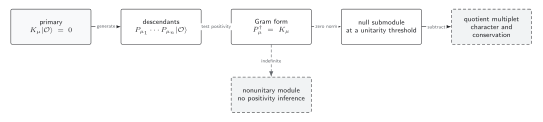
A long character counts the full descendant cone. At a shortening threshold, the first null descendant generates a second cone inside it. The short character is the full cone minus the null cone, with inclusion–exclusion if null cones intersect or contain further nulls. For currents the first removed state is the divergence; for a free scalar it is . The diagram is schematic.
| Module feature | Character operation | Conserved spin example | Free-scalar example |
|---|---|---|---|
| Primary | Multiply by | ||
| Translation descendants | Multiply by | Symmetric products of | Symmetric products of |
| First null primary | Identify its level and irrep | Level one, | Level two, scalar |
| Null submodule | Subtract its full character | ||
| Low-level check | Compare coefficients with tensor decomposition | Divergence absent at level one | Trace absent at level two |
Worked current count in three dimensions
Section titled “Worked current count in three dimensions”In , spin has unrefined dimension , and . A conserved spin-one current has , so
Before quotienting, the induced module would give
The difference is
exactly the scalar divergence at level one and all of its descendants. At level one, has nine raw components; conservation removes one scalar, leaving eight. At level two, subtraction removes the three vector descendants of that scalar, reducing eighteen to fifteen. Deleting only the first divergence would incorrectly give seventeen at the next level.
Recombination at a threshold
Section titled “Recombination at a threshold”Approach a spinning unitarity bound from a long representation, . At the threshold the induced character separates as
The second term is the module that becomes null in the short quotient. Moving above threshold joins the two pieces into one irreducible long multiplet. Conversely, a continuously varying family cannot lose states at the threshold; the short module must be accompanied by the recombination partner. The same logic for a scalar gives a free-scalar short module plus the scalar module generated by the level-two null.
Recombination is especially useful in supersymmetric or parameter-dependent theories, but the statement here is purely conformal. It assumes the spectrum changes continuously and that no additional coincident null conditions alter the resolution.
Characters versus operator-counting partition functions
Section titled “Characters versus operator-counting partition functions”A character counts states in one conformal module. A plethystic exponential instead builds multi-operator products from a chosen single-particle or single-trace input. For a bosonic generating function ,
whereas fermionic statistics insert in the sum. Before interpreting such a function as a local-operator count, one must also impose gauge singlets, integration-by-parts relations, equations of motion, finite- relations, and any shortening constraints. A conformal character already handles descendants and its declared null quotient; it does not automatically handle those separate operator-basis relations.
From the Local OPE to Conformal Data uses irreducible conformal families rather than raw Verma modules, so these null subtractions determine which descendants may propagate in a block. Multi-trace and gauge-invariant operator-basis enumeration is a separate counting problem and should not be inferred from a single-module character.
Common pitfalls
Section titled “Common pitfalls”Subtracting one null state. A null primary removes its entire descendant module. The three-dimensional current example shows the error one level later.
Setting fugacities to one too early. Distinct irreducible representations can have the same dimension. Keep rotation characters until after tensor-product decomposition and null subtraction.
Using a generic- Young diagram in low dimension. Hodge duality and vanishing long columns change both primary and descendant characters.
Calling a plethystic count a conformal character. The former builds products; the latter traces one representation. They solve different counting problems.
Exercises
Section titled “Exercises”Expand the free-scalar character through level three and identify the removed states.
Solution
Write . Multiplication by leaves the level-zero scalar and level-one vector unchanged. At level two it subtracts one scalar, removing the trace . At level three it subtracts one vector, removing . Thus the whole descendant module of the equation of motion is absent.
Verify the first four coefficients of the unrefined three-dimensional current character.
Solution
Since ,
Multiplying by gives .
References
Section titled “References”- Dolan, F. A. “Character Formulae and Partition Functions in Higher Dimensional Conformal Field Theory.” Journal of Mathematical Physics 47 (2006): 062303. DOI; Open PDF
- Poland, David, Slava Rychkov, and Alessandro Vichi. “The Conformal Bootstrap: Theory, Numerical Techniques, and Applications.” Reviews of Modern Physics 91 (2019): 015002. DOI; Open PDF
- Simmons-Duffin, David. “TASI Lectures on the Conformal Bootstrap.” In New Frontiers in Fields and Strings, 1–74. Singapore: World Scientific, 2017. DOI; Open PDF
Original QFT.org content:CC BY 4.0, unless an item supplies different terms. Third-party material retains its own terms.