

Detector Operators and Energy Flow at Null Infinity
An energy detector is a null-integrated stress-tensor observable, not a local energy density. It records the energy crossing one angle at future null infinity and is normalized so that integration over the celestial sphere returns the total four-momentum. The order of the null limit, retarded-time integration, state preparation, and removal of regulators is part of its definition.
Required background. Currents and the stress tensor supplies conservation laws and Ward normalizations. Lorentzian correlators and causal orderings supplies the Wightman ordering and data needed for detector matrix elements.
Helpful background. Lorentzian boundary prescriptions explains how the state and operator ordering determine boundary values of correlation functions.
Energy flux at future null infinity
Section titled “Energy flux at future null infinity”Let , introduce retarded coordinates
and take at fixed and fixed . With the chapter normalization, the energy detector is the operator-valued distribution
This form makes the outgoing-null limit manifest. In four-dimensional Cartesian coordinates it is equivalent, on states with no incoming flux through past null infinity, to
where denotes the Euclidean components of the outward unit vector, so is positive for an outward positive-energy null ray in the convention. Hofman and Maldacena use the corresponding flux definition to construct calorimeter correlators Hofman and Maldacena 2008, eqs. (1.1)–(1.2) and §2.1.
The un-smeared symbol is shorthand. A safe definition first pairs with smooth test functions and :
One takes in a matrix element of normalizable states, then removes the retarded-time cutoff by a controlled sequence . Swapping those operations can retain incoming flux, boundary terms, or a regulator-dependent contact contribution. A point detector is obtained only after the angular distribution has been defined.
State preparation and Wightman ordering
Section titled “State preparation and Wightman ordering”A useful collider state is a wave packet created by a local operator :
where is future timelike, is smooth and rapidly decreasing, and is the norm. The packet must be localized enough that there is no flux already present at past null infinity. The formal momentum eigenstate is distributionally normalized; it is suitable only after common delta functions cancel in a normalized ratio. A Gaussian implementation and its localization condition are given in Hofman and Maldacena 2008, eq. (2.28).
The detector expectation value is a Wightman matrix element,
not a time-ordered correlator. Distinct detector angles are spacelike separated on the null boundary under the usual Regge-boundedness conditions and commute; coincident angles are distributional and may contain contact terms Koloğlu et al. 2021, §§2.4, 4, and 6.
Four-momentum normalization
Section titled “Four-momentum normalization”Stress-tensor conservation and the flux through a large sphere give
The second identity uses that asymptotic CFT radiation is null: energy crossing angle carries momentum times that energy. These sum rules determine the detector normalization independently of any light-transform convention Hofman and Maldacena 2008, eq. (2.9).
For a normalized scalar state with sharp , rotations leave no angular invariant, so
In , this becomes . This is both a Ward-identity result and a direct check of the stress-tensor three-point function. For a narrow wave packet, is replaced by up to the packet’s controlled momentum spread.
Relation to the light transform
Section titled “Relation to the light transform”The detector is a light transform of the stress tensor placed at null infinity. If a symmetric-traceless primary has quantum numbers , the light transform carries
For , . In the convention of Koloğlu and collaborators, the physical energy detector is ; other sources absorb this factor into . The invariant check is always , not the name assigned to the transform Koloğlu et al. 2021, eqs. (2.12)–(2.17) and §2.4.
The following diagram should be read from a normalized local state through the null-infinity limit to positivity and collider observables. Inspect especially where a conformal transformation or an extra hypothesis is required.
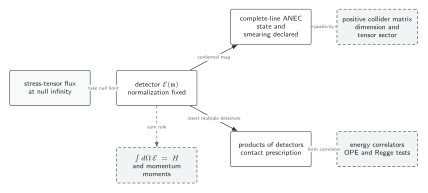
Detector, light-ray, and collider relations. The diagram is schematic and not to scale: detector normalization is fixed by the total-energy sum rule; ANEC positivity applies to a declared state and smearing domain; collider and event-shape conclusions retain their dimension, tensor-sector, contact, and Regge assumptions.
The same content in structured form is:
| Stage | Defined object or conclusion | Necessary qualification | What does not follow automatically |
|---|---|---|---|
| State | Smeared local-operator packet | Positive norm, future-timelike central momentum, no incoming flux | A plane wave is not a normalizable localized state. |
| Detector | at future null infinity | Fixed- large-radius limit, Wightman ordering, angular distribution, | Pointwise positivity of the local stress tensor |
| Light transform | Null integral of in a conformal frame | Jacobian, affine null normalization, transform convention | Equality of two regulated expressions before limits |
| ANEC | Positive complete-null-line average on its state domain | Unitarity, smearing, boundary control, regulator removal | A dimension-independent collider inequality |
| Collider/event shape | One or more detector insertions in a prepared state | Polarization sector, dimension, contacts, angular measure; Regge control for commutativity arguments | A jet definition, a large higher-spin gap, or a dispersion relation |
Charge-flow detectors
Section titled “Charge-flow detectors”For a conserved current , define analogously
Charge flow is not positive: particles and antiparticles contribute with opposite signs. For a non-Abelian current, the coincident-angle commutator contains the current-algebra contact term even though separated detectors commute Koloğlu et al. 2021, §6.1. Energy positivity therefore cannot be transferred to by analogy.
Failure modes
Section titled “Failure modes”Taking the wrong limit. Sending at fixed reaches spatial rather than future null infinity. Hold fixed and state the order in which time and angular regulators are removed.
Normalizing the correlator but not the state. Dividing by a guessed power of does not replace . Compute the state norm and verify the one-detector sum rule.
Dropping coincident-angle terms. Separated-angle formulas do not determine distributions supported at . Preserve contact terms until after integrated sum rules are checked.
Assuming infrared safety from conformal symmetry. The intrinsic CFT distribution is well defined under the hypotheses above. Its translation into a scattering observable requires a separately specified inclusive, infrared-safe measurement.
Exercises
Section titled “Exercises”1. Scalar-state distribution. In dimensions, derive the energy distribution of a zero-momentum scalar state.
Solution
Rotations force . The sum rule gives , hence . The momentum sum rule vanishes because .
2. A normalization diagnostic. Suppose a four-dimensional calculation gives for a scalar state. Identify the inconsistency.
Solution
Integration over gives , contradicting . The likely cause is a factor-of-two mismatch between the chosen light transform and the physical detector.
References
Section titled “References”- Hofman, Diego M., and Juan Maldacena. “Conformal Collider Physics: Energy and Charge Correlations.” Journal of High Energy Physics 2008, no. 05 (2008): 012. doi:10.1088/1126-6708/2008/05/012.
- Koloğlu, Murat, Petr Kravchuk, David Simmons-Duffin, and Alexander Zhiboedov. “The Light-Ray OPE and Conformal Colliders.” Journal of High Energy Physics 2021, no. 01 (2021): 128. doi:10.1007/JHEP01(2021)128.
Original QFT.org content:CC BY 4.0, unless an item supplies different terms. Third-party material retains its own terms.