

Mixed-Correlator Islands
Mixed correlators replace scalar nonnegative coefficients by positive-semidefinite quadratic forms and can exclude regions that one correlator leaves open. An isolated allowed region is always conditional on the chosen correlator set, shared-operator identifications, gaps, uniqueness assumptions, numerical approximation, and scan procedure.
Required background. Single-Correlator Bounds fix exclusion and bound language. Mixed correlators and symmetry sectors fix the exact coupled equations. Helpful background. Automated Crossing-System Generation supplies canonical matrix and sector serialization.
Evidence cutoff: 2026-08-09. Published islands and their numerical boundaries are mutable evidence. This page explains their logic without asserting a current island coordinate or a completed model reproduction.
OPE-vector geometry
Section titled “OPE-vector geometry”Suppose two external scalars couple to a shared exchanged scalar . Its contribution is controlled by
The crossing equation is a sum of matrix-valued block vectors contracted with these rank-one PSD matrices. Relaxing rank one to an arbitrary PSD matrix gives a convex outer approximation; imposing that a unique operator is shared across correlators can restore additional information through OPE-angle scans or equivalent formulations. State which version is solved.
An island arises when certified exclusions surround a connected allowed component in a parameter space such as , possibly augmented by OPE ratios. A mesh of feasible solver statuses does not define its topology. Boundary points require certificates; unsolved holes, disconnected components, and interpolation uncertainty must be represented explicitly. Modern island searches and continuous navigator alternatives are compared in Rychkov and Su 2024, §§III.B–III.C.
Assumption-removal study
Section titled “Assumption-removal study”For each boundary, rerun after removing one input:
- a gap in one representation;
- uniqueness of a leading scalar;
- equality of an operator appearing in two OPEs;
- a fixed OPE-coefficient ratio;
- one correlator or tensor structure; or
- a Ward-identity normalization.
The resulting expansion or disappearance of the component measures the inferential force of that assumption. Precision islands in the Ising and systems demonstrate how shared-operator information and mixed correlators can sharply reduce allowed regions Kos et al. 2016, §§2–4, but their numerical coordinates are not imported here as an undated benchmark.
Scanning and topology
Section titled “Scanning and topology”Bracket every solved ray or line with certified excluded points and points for which exclusion was not found. Refine near curvature, narrow necks, and apparent disconnections. Record the triangulation or cell complex, evaluation hashes, and deterministic tie rules. A navigator can search continuously, but its objective and sign convention are extra inputs; a negative navigator value is not synonymous with existence.
The shared figure classifies each numerical object by its strongest supported claim. Focus on the scan-delimited-island column, then compare its claim limit with pointwise exclusions and the other numerical evidence classes.
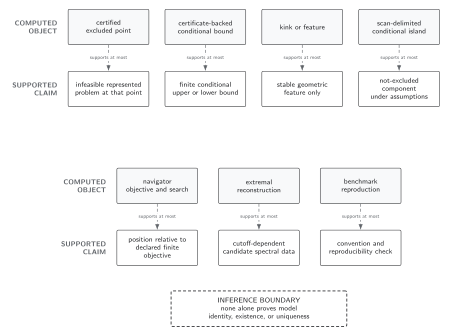
Schematic evidence classification for mixed-correlator islands. Certified excluded points and topology-aware brackets can support a conditional not-excluded component. The shared diagram also separates bounds, kinks, navigator searches, extremal reconstructions, and benchmark reproductions; none proves that every interior point or one unique CFT is realized.
The seven visible columns have this semantic mapping:
| Computed or reproduced object | Strongest supported claim | Not established by that object alone |
|---|---|---|
| Certified excluded point | The represented problem is infeasible at that point under the stated assumptions | Nonexistence of an exact CFT outside the controlled representation |
| Certificate-backed conditional bound | A finite upper or lower boundary in the declared represented problem | Realization of a CFT at the boundary |
| Kink or feature | A stable geometric feature after the stated refinements | Identification with a particular theory |
| Scan-delimited conditional island | A not-excluded component bounded by tested certificates and brackets | Realization of every interior point or uniqueness |
| Navigator objective and search | Position relative to the declared finite deformed objective in the searched domain | A physical distance to theory space or a unique model |
| Extremal reconstruction | Cutoff-dependent candidate dimensions and OPE data | An exact full spectrum or model identity |
| Benchmark reproduction | A frozen observable or certificate is reproduced within the declared tolerance | Correctness of every method or identification of a theory |
The structured equivalent is:
| Stage | Input | Verified or observed output | Required check | Claim limit |
|---|---|---|---|---|
| PSD crossing | correlator closure and OPE-vector order | finite feasibility problem | matrix signs and rank relaxation | declared system only |
| Point solve | parameter coordinate and certificate | excluded or not excluded | independent residual and positivity | no topology yet |
| Boundary bracket | neighboring point solves | finite interval containing boundary | mesh and precision refinement | tested approximation |
| Island topology | cell complex and all brackets | conditional connected component | holes and disconnected pieces | no realization claim |
| Model comparison | external spectrum and symmetry dictionary | compatibility | convention conversion and independent data | no uniqueness without more evidence |
Failure tests
Section titled “Failure tests”Shared-operator test. Split one assumed common operator into independent copies. The allowed region must not be silently reported as unchanged.
Topology test. Hide unsolved cells. A closed-looking polygon with missing evaluations is not a certified island.
Rank test. Confuse a PSD relaxation with a rank-one OPE outer product. State the relaxation explicitly.
Continue to Global Symmetry and Spinning Bootstrap Systems or Extremal Functionals, Navigators, and Spectrum Reconstruction.
References
Section titled “References”- Kos, Filip, David Poland, David Simmons-Duffin, and Alessandro Vichi. “Precision Islands in the Ising and Models.” Journal of High Energy Physics 08 (2016): 036. DOI. Open PDF
- Rychkov, Slava, and Ning Su. “New Developments in the Numerical Conformal Bootstrap.” Reviews of Modern Physics 96 (2024): 045004. DOI. Open PDF
Original QFT.org content:CC BY 4.0, unless an item supplies different terms. Third-party material retains its own terms.