

Torus Partition Functions as Bootstrap Data
The torus partition function turns a two-dimensional CFT spectrum into a function of one complex modulus. Its exponents retain dimensions, spins, and Casimir shifts; its transformation under changes of torus cycles tests whether the Hilbert-space sectors have been assembled consistently. The answer may be invariant, covariant by a phase, or vector-valued—those cases must not be collapsed into one another.
Required background. Use chiral blocks, sewing, and modularity for the character decomposition and the cylinder map and Hamiltonian for the plane-to-cylinder energy shift. Helpful background. Nonrational modular spectral densities explains when a character sum becomes a measure-valued integral.
The torus trace and its vacuum shifts
Section titled “The torus trace and its vacuum shifts”Write the Euclidean torus as
and define
For left and right central charges , the Hilbert-space trace is
The shifts by and are not optional conventions: they are the cylinder Casimir energies produced by the exponential map. With spatial circumference ,
Consequently,
For a state of weights , its plane scaling dimension and spin are
This distinguishes two related quantities: is the local operator spin, whereas also contains the possible gravitational-anomaly shift. In a nonanomalous bosonic theory with , and locality normally gives integral spin. The standard derivation of the trace and its modular action is given in Di Francesco, Mathieu, and Sénéchal 1997, § 10.1, pp. 336–340.
If the spectrum is discrete, the state decomposition is
for a unitary compact theory. In a noncompact or continuous-spectrum theory, the honest replacement is
possibly after separating a distributional volume factor or a discrete vacuum. Positivity of follows only in a positive-norm Hilbert-space trace. Convergence is required for ; a formal -series with uncontrolled growth is not yet a partition function.
Characters and modular generators
Section titled “Characters and modular generators”When the Hilbert space decomposes into left and right chiral modules,
define the characters
Then
For a finite character basis, the modular generators act as
If the same basis is used on both chiral sides, invariance of the sesquilinear form requires
In a continuum theory, is generally an integral kernel and these become kernel identities with the correct measure. A finite matrix borrowed from a rational model cannot be applied to a continuum spectrum without proving that it acts on the chosen function space.
The transformation exposes spin and anomaly information directly. One state contributes the phase
Thus an ordinary nonanomalous bosonic partition function can be invariant when spins are integral. A gravitational anomaly can leave an overall multiplier. A fermionic theory generally has four spin structures, and or can mix them instead of preserving one component. With symmetry twists or chemical potentials, modular transformations likewise act on a vector of sector functions and may include anomaly-controlled phases. These refinements are developed on Spin, Charges, and Extended Modular Sectors.
A complete Ising check
Section titled “A complete Ising check”The diagonal Ising CFT has and three Virasoro primaries, ordered as
In this basis,
and
The diagonal partition function
has . Direct multiplication gives , so both required identities hold. Notice what has actually been tested: the specified character vector, ordering, central charge, and diagonal pairing. The calculation does not by itself prove a classification of all Ising modular invariants. The matrices and minimal-model construction appear in Di Francesco, Mathieu, and Sénéchal 1997, §§ 10.6–10.7, pp. 359–376.
Two quick internal checks catch common transcription errors. The first row of has squared norm
and its inner product with the second row is
The phase of follows from , not from alone.
The following diagram places this torus calculation beside, but not inside, the local thermal construction. Inspect the two different consistency arrows: modular transformations act on global sector traces, whereas KMS acts on ordered local correlators. The thermal OPE and discontinuity branch follows the construction of Iliesiu et al. 2018, §§ 2–3.
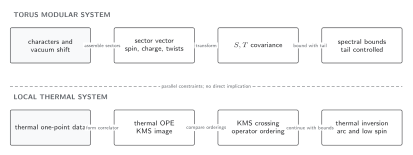
Global torus covariance and local thermal KMS consistency are parallel but distinct constraints. The torus branch must retain vacuum shifts, spin structures, charge sectors, and modular phases; the thermal branch must retain ordering, image tails, analytic continuation, and possible inversion arcs. Schematic and not to scale.
The same relationships are available without the image:
| Branch | Input object | Consistency map | Output constraint | Information that must remain explicit |
|---|---|---|---|---|
| Torus | sector or character vector | and | closure and invariant or covariant pairing | , vacuum shift, spin, multiplier, sector measure |
| Higher genus | sewn blocks and three-point data | mapping-class move | equality of decompositions | sewing coordinates, chiral pairing, degeneration channel, tail |
| Thermal KMS | ordered | move an operator around the trace | equality with the KMS image | dimension, ensemble, statistics phase, ordering, OPE domain |
| Thermal inversion | analytically continued | discontinuity integral plus arcs | poles and thermal OPE coefficients | sheet, growth exponent, spin domain, subtractions, low-spin terms |
What the torus trace can and cannot determine
Section titled “What the torus trace can and cannot determine”The unflavored genus-one trace knows the multiplicity of each pair , hence dimensions and spins. It does not know generic three-point coefficients. A flavored trace can add charge information, and a defect or twisted trace can expose more sectors, but only after the full collection and its modular action have been specified. Higher genus accesses products of three-point coefficients through sewing.
Likewise, a thermal interpretation is conditional on choosing a cycle as Euclidean time. On the rectangular slice ,
Away from that slice, is an angular potential for . This global trace is not the local KMS two-point function on discussed later in the chapter.
Common failure modes
Section titled “Common failure modes”Dropping the vacuum shift. Replacing by changes the phases and the low-temperature exponential. It invalidates both modular checks and every Cardy inference built on them.
Calling covariance invariance. A single spin structure, charged trace, or anomalous theory may transform by a phase or into another component. State the vector and multiplier before imposing an invariant scalar equation.
Treating a continuum as a finite sum. Delta-normalized states, volume factors, and modular kernels require a declared spectral measure. Coefficient-wise positivity and finite character-matrix arguments need not survive unchanged.
Forgetting the basis order. A correct matrix paired with characters in a different order fails for a mundane reason. Record the order and verify at least one row norm, one orthogonality relation, and the vacuum phase.
Exercises
Section titled “Exercises”For the Ising matrix above, show that and explain why this is compatible with charge conjugation.
Solution
Multiplying the displayed matrix by itself gives unit diagonal entries and zero off-diagonal entries. In general a rational CFT modular matrix obeys , where conjugates representations. All three Ising Virasoro primaries are self-conjugate, so .
Suppose and all plane spins are integral. Compute the phase acquired by each term under and state whether the scalar partition function is strictly invariant.
Solution
Each term acquires
The common phase is nontrivial, so the partition function is covariant with a multiplier, not strictly invariant. A consistent interpretation must retain the gravitational anomaly or add the appropriate inflow data; integer spin alone does not remove the phase.
Continue the calculation
Section titled “Continue the calculation”Modular Crossing and Spectral Bounds converts the relation into positive sum rules and keeps finite bounds separate from Cardy asymptotics.
A reproducible calculation should consume frozen Ising characters and matrices, then test derivative functionals, sector extensions, spectral tails, and a separate thermal fixture.
References
Section titled “References”- Di Francesco, Philippe, Pierre Mathieu, and David Sénéchal. Conformal Field Theory. Graduate Texts in Contemporary Physics. New York: Springer, 1997. doi:10.1007/978-1-4612-2256-9.
- Iliesiu, Luca, Murat Koloğlu, Raghu Mahajan, Eric Perlmutter, and David Simmons-Duffin. “The Conformal Bootstrap at Finite Temperature.” Journal of High Energy Physics 2018, no. 10 (2018): 070. doi:10.1007/JHEP10(2018)070. Open preprint.
Original QFT.org content:CC BY 4.0, unless an item supplies different terms. Third-party material retains its own terms.