

Mellin-Space CFT Correlators
Mellin space converts the multiplicative scaling structure of a conformal correlator into complex-variable analyticity. OPE families appear through pole sequences, spin appears through residue polynomials, and crossing acts by permuting Mellin variables. The Gamma-function measure is part of the representation: omitting it confuses universal double-trace poles with dynamical poles of the Mellin amplitude.
Required background. Conformal Partial Waves and the Shadow Formalism supplies spectral decompositions and projection contours. Mellin Transforms and Scaling Asymptotics supplies inversion and strip conditions. Helpful background. Dispersion Relations for CFT Correlators supplies the relation between growth and polynomial ambiguity.
Mellin variables and the Gamma measure
Section titled “Mellin variables and the Gamma measure”For scalar primaries of dimensions , a convention-independent starting point is
subject to
Only Mellin variables are independent. The integration lines are vertical and must separate the pole families appropriate to the chosen OPE domain. A formal expression without a nonempty fundamental strip, an analytic continuation prescription, or a distributional interpretation is not yet an inverse Mellin representation.
For four identical scalars of dimension , define
with . Factoring
gives the convention
For an initial Euclidean strip, the real parts can be chosen so that all three Gamma arguments are positive while their constrained sum is respected. Continuation beyond that strip requires moving contours and adding the residues of crossed poles. The power of and the definition of are convention choices; changing them requires transforming the entire measure, not just relabeling .
OPE poles versus kinematic poles
Section titled “OPE poles versus kinematic poles”The squared Gamma factors have poles at
and in the crossed variables. These generate the generalized-free double-trace dimensions. They are present even when is a constant.
An exchanged primary of dimension and spin contributes a dynamical sequence
where is a degree- Mack-type polynomial in the transverse Mellin variable, in a convention fixed by the conformal block normalization. Pole locations encode the primary twist and descendants; residues encode OPE coefficients and spin. This pole factorization is the central result of the Mellin representation Mack 2009, §§3–5 and Penedones 2011, §§2–3.
Three distinctions prevent common errors:
- a Gamma-measure pole is not an exchange pole of ;
- a finite list of principal poles is not a full conformal block unless its descendant sequence and residues are supplied;
- adding a crossing-symmetric polynomial changes the correlator but leaves the declared exchange-pole locations and residues unchanged.
Crossing and contact polynomials
Section titled “Crossing and contact polynomials”For identical scalars, permutation symmetry acts on with . In the present convention a fully symmetric correlator requires the correspondingly transformed Mellin integrand to agree. Its large-variable continuation must be matched to the chosen conformal Regge regime Costa, Gonçalves, and Penedones 2012, §§2–3. A contact-type solution has polynomial Mellin amplitude. The lowest examples are
and
up to lower-degree terms and convention-dependent shifts. Both are crossing symmetric. The degree controls large-variable growth and, after block decomposition, the range and asymptotics of affected double-trace data.
“Contact ambiguity” means ambiguity in reconstructing from specified pole or discontinuity data. Once the complete position-space correlator and transform convention are fixed, its Mellin amplitude is not freely ambiguous.
A declared contact-plus-pole toy
Section titled “A declared contact-plus-pole toy”For algebraic checks, take
It is symmetric under all permutations of . Its three residues equal , and shifting changes no pole or residue. This is a deliberately truncated meromorphic fixture, not a conformal exchange amplitude: a physical scalar conformal block has the full descendant sequence with fixed residues. The distinction makes the toy useful for testing pole extraction without overclaiming its spectrum.
A reproducible calculation should use a frozen constant-contact fixture and a separately declared exchange fixture. The equations above are the analytic baseline.
From data to a conditional inference
Section titled “From data to a conditional inference”The figure summarizes which information survives each transformation. Inspect the contact branch: it rejoins the CFT correlator without passing through exchange-pole data.
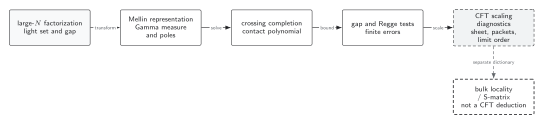
The Gamma measure, dynamical pole sequence, crossing-symmetric contact polynomial, Regge bound, and order of limits are separate parts of a Mellin analysis. Bulk terminology lies beyond the CFT-side inference boundary; the diagram is schematic.
| Mellin object | How it is identified | Position-space content | Required qualification |
|---|---|---|---|
| Gamma measure | fixed by external dimensions and convention | generalized-free double-trace poles | contour and coincident-pole prescription |
| pole of | residue of the meromorphic amplitude | exchanged primary twist and descendants | complete pole ladder and normalization |
| residue polynomial | degree and coefficients in transverse variable | spin and OPE data | Mack-polynomial convention |
| polynomial in | entire crossing-symmetric addition | contact-type double-trace corrections | degree and Regge growth |
| large- scaling | asymptotics along a stated complex direction | Lorentzian or flat-space-type diagnostic | sheet, smearing, and uniform limit |
Contour and normalization checks
Section titled “Contour and normalization checks”A reliable calculation passes four independent tests:
- Constraint: substituting the chosen reproduces every .
- Crossing: all six point permutations map the complete integrand—including powers and Gamma factors—to the appropriate channel.
- OPE closure: moving the contour in the declared direction gives the expected small- powers and logarithms.
- Inverse transform: transforming back reproduces the correlator in an overlap domain, with tail and contour errors stated.
A residue calculation performed on alone does not test the inverse transform. Conversely, fitting the full integrand without dividing out the Gamma measure does not identify the dynamical poles.
Common pitfalls
Section titled “Common pitfalls”Dropping Gamma factors. They are not a decorative normalization; they carry the universal double-trace structure. A pole classification without them is physically misidentified.
Calling every polynomial a harmless ambiguity. It is harmless only relative to the pole data used for reconstruction. It changes double-trace CFT data and may violate a declared Regge bound.
Taking a large real Mellin variable without a contour prescription. Mellin amplitudes are complex functions. The direction, fixed ratios, avoided poles, and analytic continuation all matter.
Exercises
Section titled “Exercises”Verify that is invariant under and that adding leaves all three simple-pole residues unchanged.
Solution
The three denominators are permuted by , while is unchanged. The degree-two addition is entire, so it contributes no coefficient to , , or . It therefore preserves the pole residues while changing the inverse Mellin transform.
References
Section titled “References”- Costa, M. S., Gonçalves, V., and Penedones, J. “Conformal Regge Theory.” Journal of High Energy Physics 2012, 091 (2012). arXiv. DOI.
- Mack, G. “D-Dimensional Conformal Field Theories with Anomalous Dimensions as Dual Resonance Models.” Bulgarian Journal of Physics 36 (2009): 214–226. arXiv.
- Penedones, J. “Writing CFT Correlation Functions as AdS Scattering Amplitudes.” Journal of High Energy Physics 2011, 025 (2011). arXiv. DOI.
Original QFT.org content:CC BY 4.0, unless an item supplies different terms. Third-party material retains its own terms.