

Automated Crossing-System Generation
Automating a crossing system is safe only when the generator emits more than solver input. It must also emit a canonical, human-readable specification from which representations, tensor structures, permutation signs, positive-semidefinite sectors, and every numerical table can be checked independently.
Required background. Mixed correlators and symmetry sectors supply the coupled crossing structure. Block Approximations and Semidefinite Programs supply the numerical target format. Helpful background. Spinning operators and blocks explain basis and statistics data beyond scalar systems.
Evidence cutoff: 2026-08-23. Software examples and supported formats were checked through this date against the block-software and framework survey in Rychkov and Su 2024, §§2.1–2.2, pp. 2–3. The durable requirements below are format-independent; a later generator release must be revalidated rather than assumed compatible.
A declarative crossing specification
Section titled “A declarative crossing specification”The source specification should contain, at minimum:
- spacetime dimension and Euclidean/Lorentzian convention;
- external primaries, global-symmetry representations, spins, parity, reality conditions, and two-point normalizations;
- an ordered basis of three- and four-point tensor structures;
- permutation matrices, statistics phases, and crossing orbits;
- exchanged representation sectors, spin parities, unitarity thresholds, gaps, and uniqueness assumptions;
- the order of OPE-vector components in every matrix-positive sector; and
- block normalization, evaluation coordinates, derivative basis, and approximation settings.
For scalar external operators , a generated mixed system has the form
where the vector order must be fixed globally. A permutation of external labels acts on both the tensor basis and OPE vector; transforming only one creates a crossing system that can look dimensionally correct while being false.
Algebraic checks before block evaluation
Section titled “Algebraic checks before block evaluation”- Projectors are idempotent, mutually orthogonal where appropriate, and sum to the identity on the declared product representation.
- Permutation matrices obey the group relations, including fermionic signs.
- Applying the crossing map around a closed permutation cycle returns the original basis.
- Bose or Fermi symmetry removes exactly the expected structures and spins.
- Conserved structures have the rank predicted after Ward identities and dimension-specific identities.
- Every scalar or PSD contribution has the sign implied by reflection positivity in the chosen two-point basis.
The autoboot construction demonstrates how global-symmetry representations can generate mixed-scalar equations, but any concrete output remains tied to its supported input class and release Go and Tachikawa 2019, §§2–4. A generator does not remove the need for an independent small-system derivation.
Canonical serialization and hashes
Section titled “Canonical serialization and hashes”Canonical output sorts sectors by a declared stable key, writes exact rational or symbolic group-theory coefficients without locale-dependent formatting, fixes matrix row and column order, and records the generator version plus source revision. Compute hashes separately for:
- the human-readable physical specification;
- symbolic projectors and crossing maps;
- block-generation inputs;
- numerical block tables;
- conic solver input; and
- any certificate or reconstructed spectrum.
A hash identifies bytes, not correctness. It becomes useful only after the hashed object has passed the relevant mathematical checks. Generated timestamps, absolute paths, and nondeterministic map ordering should not enter canonical scientific content.
The figure below shows how exact symbolic data and numerical approximations join. Inspect the independent-verification gate: it reads frozen artifacts rather than mutable in-memory generator objects, can reject a solver output, and preserves the distinction between a dual exclusion and finite primal feasibility.
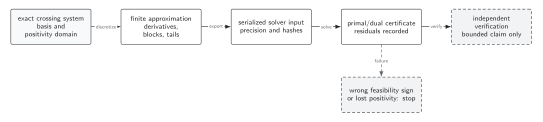
Schematic route from representation and tensor-basis input to exact crossing, finite block data, a conic problem, and candidate solver variables. Canonical ordering, versions, hashes, precision, and truncations accompany each edge. Independent identity, residual, cone, normalization, interval, and tail checks can reject the candidate; passing dual and primal records reach different bounded conclusions. The diagram is schematic and not to scale.
The same route in structured form is:
| Generated object | Canonical content | Independent identity | Passing output | Failure signal |
|---|---|---|---|---|
| Representation file | irreps, product rules, projectors | projector completeness and character count | complete sectors | missing or duplicated sector |
| Tensor-basis file | ordered structures and parity | rank and permutation closure | invertible declared basis | singular or incomplete basis |
| Crossing file | exact matrices and statistics signs | closed-cycle permutation test | exact crossing system | wrong sign after a cycle |
| Positivity file | OPE-vector order and PSD blocks | reflection-positive quadratic form | declared cone | signed term placed in a PSD block |
| Block input | convention, coordinates, derivatives, poles | direct block comparison and remainder check | finite representation | normalization or approximation drift |
| Solver input | scaled matrices, objective, precision, hashes | regeneration and inverse scaling | one canonical finite problem | nondeterministic bytes or sector order |
| Solver output | candidate primal or dual variables | no identity supplied by status alone | candidate record | missing variables or convention |
| Verification record | unscaled residuals, cone bounds, functional intervals and tails | separate evaluator from frozen inputs | verified dual or primal record | any hash, equality, PSD, interval, or tail failure |
| Interpreted result | assumptions and approximation scope | compare branch type and claim ceiling | conditional exclusion or finite feasibility | CFT existence inferred from a primal point |
Failure tests
Section titled “Failure tests”Closure test. Remove one correlator from a permutation orbit. The generated equations must report that the system is not closed.
Serialization test. Randomize dictionary insertion order. Canonical output and hashes must remain unchanged.
Sign test. Exchange two identical fermions. A generator that omits the statistics phase must fail an exact cycle check.
Continue to Precision, Convergence, and Numerical Error Budgets and Solver Certificates and Independent Verification.
References
Section titled “References”- Go, Mocho, and Yuji Tachikawa. “autoboot: A Generator of Bootstrap Equations with Global Symmetry.” Journal of High Energy Physics 06 (2019): 084. DOI. Open PDF
- Rychkov, Slava, and Ning Su. “New Developments in the Numerical Conformal Bootstrap.” Reviews of Modern Physics 96 (2024): 045004. DOI. Open PDF
Original QFT.org content:CC BY 4.0, unless an item supplies different terms. Third-party material retains its own terms.