

Defect Representations, Transverse Spin, and Tensor Structures
A defect primary transforms under the conformal group along the support and under rotations of the normal bundle. Its “spin” is therefore not one label: parallel Lorentz spin, transverse spin, parity, and orientation data must all be specified. Tensor structures are invariant polynomials built from those representations and the available position vectors; their number can jump at special codimension.
Required background. Conformal boundaries and defects derive the preserved subgroup. Spin and tensor representations provide the symmetric-traceless and mixed-symmetry conventions.
Helpful background. Multiplets, invariants, and selection rules explain how invariant tensors and representation products restrict couplings.
Parallel and transverse quantum numbers
Section titled “Parallel and transverse quantum numbers”For a flat -dimensional defect of codimension , a local defect primary is labeled by
Here is its scaling dimension, is an representation inherited from the maximal compact subgroup of , and is an representation. From the intrinsic -dimensional viewpoint, is a global symmetry. Descendants are generated only by parallel translations :
Normal derivatives of a bulk field are not automatically descendants of a defect primary; after restricting to the support, they must be decomposed into defect conformal multiplets.
For symmetric-traceless representations, encode parallel indices with a null polarization and transverse indices with a null polarization :
The two-point function is fixed, after choosing unit normalization, by the parallel inversion tensor and the transverse Kronecker tensor:
with trace subtractions understood through . More general Young diagrams require one polarization per row together with Young-projector gauge relations. Lauria, Meineri, and Trevisani give a representation-independent polynomial construction in Lauria, Meineri, and Trevisani 2019, §§2–3.
Bulk scalar coupled to transverse spin
Section titled “Bulk scalar coupled to transverse spin”Let a bulk scalar approach the defect. Put
A defect primary with parallel spin cannot appear in its two-point function with a single bulk scalar and one defect insertion, because no nonzero parallel vector remains after translating the defect insertion to the origin. A parallel scalar with transverse symmetric-traceless rank can appear:
Angle brackets denote the symmetric-traceless projection. Scaling gives the power of ; inversion along the support gives the denominator; transverse covariance fixes the harmonic. The formula also displays a selection rule: the direction must furnish the same representation as the defect operator.
For codimension two, irreducible representations are one-dimensional complex charges . Writing ,
Orientation reversal sends and . If reflection is a symmetry, charged operators can be organized into parity-even and parity-odd real combinations. If it is not, identifying with discards data. For there is no continuous and no transverse-spin tower; a discrete reflection label exists only in a doubled or two-sided problem.
Constructing tensor structures
Section titled “Constructing tensor structures”For a correlator with specified external representations, a reliable construction has four steps:
- Split every position and polarization into parallel and transverse parts using projectors and .
- Form contractions invariant under , including Levi-Civita tensors only when orientation and dimension permit them.
- Impose homogeneity, transversality, tracelessness, permutation symmetry, conservation, and any internal-symmetry selection rule.
- Compute the rank of the structures at generic kinematics in the declared and ; eliminate dimension-specific identities before assigning OPE coefficients.
This last step is essential. A formal embedding-space list can become linearly dependent when an antisymmetrization uses more indices than the parallel or transverse space provides. Conversely, admits an structure that has no analogue for an unoriented boundary. A conserved current or stress tensor imposes differential relations among coefficient functions, not merely algebraic deletion of structures Billò et al. 2016, §§2–3.
For example, the bulk–defect correlator of a bulk vector with a defect transverse vector can use the transverse projection and the product . Before conservation these are independent:
where . If is conserved, differentiating at separated points relates and for generic dimensions. Contact terms must be treated separately; applying the separated-point equation through the support can remove the displacement coupling incorrectly.
The free boundary scalar as a degeneration
Section titled “The free boundary scalar as a degeneration”For the half-space scalar, , so the leading boundary operators have only parallel spin:
Both are parallel scalars. Their dimensions, and , differ because Dirichlet removes the boundary value while Neumann removes the normal derivative. Treating as a transverse vector would be misleading at a one-sided boundary: has no vector representation. Its sign changes if the chosen normal orientation is reversed, which is a convention rather than a continuous quantum number.
The figure below places these codimension-specific representation rules beside the OPE channels. Inspect the branch from to charged angular harmonics and the collapse of that branch at .
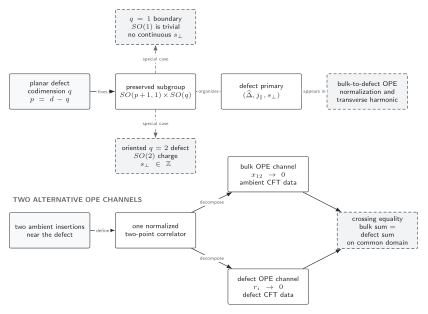
Schematic classification of defect representations and their appearance in bulk-to-defect structures and channel decompositions. The diagram is codimension-sensitive: charges use an oriented normal plane, while a boundary retains only parallel spin and any separately declared discrete reflection.
The structured equivalent records the degenerations explicitly:
| Codimension | Transverse group | Label for a symmetric-traceless sector | Basic angular structure | Required qualification |
|---|---|---|---|---|
| trivial connected group | none | constant | Normal reversal is a convention or extra discrete symmetry | |
| oriented | Reflection exchanges and | |||
| rank or a Young diagram | Traces and dimension-specific identities must be removed | |||
| Any with spinning bulk fields | data | invariant polarization polynomials | Conservation and contact terms are imposed after basis construction |
Basis and selection-rule checks
Section titled “Basis and selection-rule checks”Generic-rank test. Evaluate the proposed structures at several nonsingular generic configurations. A rank drop signals an identity or a nongeneric frame; it does not by itself prove a physical selection rule.
Parity test. Reverse the declared orientation and track every Levi-Civita tensor and charge. Parity-even and parity-odd coefficients must not be combined.
Two-point reality test. In a unitary Euclidean theory, choose Hermitian conjugation so the defect two-point matrix is positive. For complex charge, the conjugate operator carries .
Conservation test. Differentiate the complete correlator, including every structure, at separated points. Then add the separately normalized contact terms required by the Ward identity.
The tensor harmonic derived here becomes the leading term of the bulk-to-defect expansion and labels the blocks on Boundary and defect correlators and blocks.
References
Section titled “References”- Billò, Marco, Vasco Gonçalves, Edoardo Lauria, and Marco Meineri. “Defects in Conformal Field Theory.” Journal of High Energy Physics 04 (2016): 091. DOI. Open PDF
- Lauria, Edoardo, Marco Meineri, and Emilio Trevisani. “Spinning Operators and Defects in Conformal Field Theory.” Journal of High Energy Physics 08 (2019): 066. DOI. Open PDF
Original QFT.org content:CC BY 4.0, unless an item supplies different terms. Third-party material retains its own terms.