

Generalized-Free and Solvable 1D CFT Data
Generalized-free correlators are exact solutions of one-dimensional crossing whose spectra and OPE coefficients can be written in closed form. They are ideal normalization and convergence tests because Wick contractions, block decomposition, and crossing can be checked independently. They are kinematic CFT data, however—not evidence for a local microscopic action or for a unique interacting theory.
Required background. Crossing and Positivity in One Dimension supplies the positive block sum. Helpful background. Free and Generalized-Free CFT Data compares the same construction in higher dimensions.
Two exact ordered correlators
Section titled “Two exact ordered correlators”Normalize an identical primary of dimension by
In the ordering , Wick pairings give the reduced generalized-free boson correlator
Changing the sign of the crossed Wick contraction gives the generalized-free fermion solution
Both obey
in this ordered convention. The names “boson” and “fermion” refer to the Wick-contraction sign and resulting exchanged tower. A continuation to another ordering must still carry the appropriate graded sign and branch phase.
These correlators also pass the clustering check: as , , so the identity is the leading -channel contribution.
Exact spectra and OPE weights
Section titled “Exact spectra and OPE weights”The bosonic and fermionic solutions decompose into the normalized blocks
with spectra
For either tower, the nonidentity coefficient at an allowed is
It is positive for on both displayed towers. The identity has and is not obtained by substituting into this expression. These one-dimensional generalized-free decompositions and their functional duals are worked out in Mazáč and Paulos 2019, §§2–4.
For positive integer or half-integer , the fermionic spectrum is also the extremal solution that saturates the optimal unitary gap bound, with the theorem’s functional-domain assumptions kept in force Mazáč 2017, §§4–5, pp. 17–33, Open PDF.
As a quick check, set . The bosonic tower begins at with , followed by . Expanding,
while reproduces every term shown. The fermionic tower begins at with and similarly reproduces
These coefficient-level checks catch a missing Wick sign, a different block normalization, or a shift of the double-trace tower immediately.
What makes a strong benchmark
Section titled “What makes a strong benchmark”A numerical decomposition should compare more than the final crossing residual. For a truncation at , record:
- the exact input correlator and ordered interval;
- the analytic dimensions and OPE weights used;
- the block evaluator and precision;
- the maximum direct-correlator residual on a test grid;
- a bound on the omitted positive tail;
- the residual after ;
- a failure test with the Wick sign, first dimension, or block normalization deliberately changed.
The figure places this exact fixture in the same ordered crossing pipeline used by analytic and numerical functionals. Inspect the side branch: generalized-free data test the block, ordering, and normalization conventions, but they do not by themselves establish that a functional is positive on a proposed continuous spectrum.
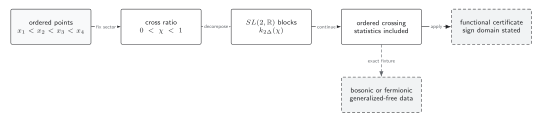
The generalized-free branch supplies exact correlators, block towers, OPE weights, and ordering signs for the one-dimensional crossing pipeline. A functional certificate adds independent domain and positivity conditions; the exact fixture does not turn a truncated search into an existence proof. The diagram is schematic and not to scale.
The figure’s relationships can be checked without the image:
| Stage | Generalized-free datum | Exact check | Failure exposed |
|---|---|---|---|
| Ordering | , hence | Wick contractions use the declared graded order | Missing permutation or statistics sign |
| Block basis | Casimir equation and OPE limit | Shadow or normalization substituted for the block | |
| Spectrum | or | First nonidentity power and every analytic coefficient | Bosonic tower paired with the fermionic sign |
| Crossing | Exact equality under | Direct correlator and block sum agree with a bounded tail | Small sampled residual mistaken for an exact sum |
| Functional use | The exact tower is a test input | Every asserted sign is checked on its stated spectral set | Benchmark agreement promoted to an optimal bound or model identity |
A reproducible calculation should use the same , block, and ordering conventions as this chapter. The equations above provide the analytic benchmark against which its outputs should be checked.
Deformations and contact ambiguities
Section titled “Deformations and contact ambiguities”One may perturb the generalized-free solution,
and solve crossing order by order. Differentiating a block produces logarithms through
Crossing alone can leave homogeneous, contact-type solutions. Their admissibility depends on endpoint and Regge bounds, and perturbative CFT data need not resum to an exact unitary theory. In the functional basis, the contact-term ambiguity is fixed in Mazáč and Paulos 2019, §3.4, pp. 21–23, Open PDF. The broader analytic classification belongs to Analytic Functionals and Polyakov Blocks, while the Mellin interpretation belongs to Large-N Crossing and Contact Ambiguities.
Comparing low-dimensional benchmarks
Section titled “Comparing low-dimensional benchmarks”The following structured comparison is the chapter’s portion of the low-dimensional model table. It keeps properties that are often conflated in separate columns.
| Benchmark | Spectrum in this channel | Dilatation action | Reflection positivity | Exact evidence | Important limitation |
|---|---|---|---|---|---|
| Generalized-free boson | Discrete | Diagonal | Yes for in the stated sector | Wick correlator, positive coefficients, exact block sum | Does not supply a local microscopic action |
| Generalized-free fermion | Discrete | Diagonal | Yes in the compatible graded ordering | Wick correlator, positive coefficients, exact block sum | Statistics signs must follow the ordering convention |
| Finite block truncation | Finite approximation | Diagonal by construction | Only if every retained weight is nonnegative | Residual and tail estimate | Is not an exact crossing solution unless the tail vanishes |
| Perturbative contact solution | Deformed double-trace data | Diagonal order by order | Must be checked order by order | Linearized crossing and endpoint bounds | May not resum to a complete CFT |
Exact rational models, nonunitary theories, logarithmic modules, and noncompact spectra occupy different rows on the two-dimensional core and nonunitary/logarithmic chapter. A label such as “solvable” never substitutes for specifying spectrum type, diagonalizability, and positivity.
Common pitfalls
Section titled “Common pitfalls”Calling generalized free data a free local field theory. The correlators solve conformal kinematics and crossing. Local equations of motion, a stress tensor, and a microscopic action are extra claims.
Using the bosonic tower with the fermionic Wick sign. The sign removes alternating low-dimension contributions and shifts the exchanged tower by one. Check the first nonidentity power before fitting coefficients.
Treating a small truncated residual as exact data. A residual has meaning only together with precision, sampling domain, and an omitted-tail bound.
Exercises
Section titled “Exercises”Verify crossing for and directly.
Solution
Multiply by . The identity and crossed terms exchange, while the middle term retains its plus sign for and its minus sign for . The result is in both cases.
Use the gamma-function formula to compute and for the bosonic solution at .
Solution
At , the formula gives . At , it gives .
References
Section titled “References”- Mazáč, D. “Analytic Bounds and Emergence of Physics from the Conformal Bootstrap.” Journal of High Energy Physics 2017, 146 (2017). arXiv. DOI.
- Mazáč, D., and Paulos, M. F. “The Analytic Functional Bootstrap I: 1D CFTs and 2D S-Matrices.” Journal of High Energy Physics 2019, 162 (2019), §§2–4. arXiv. DOI.
- Mazáč, D., and Paulos, M. F. “The Analytic Functional Bootstrap II: Natural Bases for the Crossing Equation.” Journal of High Energy Physics 2019, 163 (2019). arXiv. DOI.
Original QFT.org content:CC BY 4.0, unless an item supplies different terms. Third-party material retains its own terms.