

Superconformal Ward Identities
Superconformal Ward identities correlate spacetime dependence, R-symmetry dependence, and the contributions of different conformal components in a supermultiplet. For selected BPS four-point functions they reduce many tensor functions to a protected part plus a smaller set of unrestricted functions. The reduction is specific to the spacetime dimension, superconformal algebra, external multiplet, and polarization convention; there is no universal equation obtained by replacing “conformal” with “superconformal.” Already in four-dimensional theories, covariant two- and three-point structures and their Ward identities depend on the chosen superfields Osborn 1999, abstract.
Required background. Protected Data as Bootstrap Input supplies the multiplet and normalization record. Localized Transformations and Ward Identities supplies contact-term reasoning.
Kinematics with R-symmetry polarizations
Section titled “Kinematics with R-symmetry polarizations”For identical scalar superconformal primaries , encode a symmetric-traceless R-symmetry representation with a null polarization . A four-point function can be written schematically as
where
are spacetime cross ratios, while or an equivalent pair encode R-symmetry cross ratios. The prefactor fixes weights and a tensor-structure basis.
Crossing permutes both pairs of variables and acts by a matrix on the R-symmetry structures. Choosing correctly while leaving the -tensor basis implicit does not define a crossing system. For four-dimensional chiral primaries, the null-polarization construction reduces the R-symmetry dependence to two invariants and organizes the channels with harmonic polynomials Nirschl and Osborn 2005, abstract.
Solving the Ward constraints
Section titled “Solving the Ward constraints”Supersymmetry gives differential constraints
where differentiates spacetime and R-symmetry variables and contains contact or protected terms fixed by the chosen multiplet. The operators must be imported with the supercharge and polarization conventions that derived them.
For many half-BPS correlators, the solution can be organized as
or as a finite sum of such terms. The rational or single-variable protected piece is fixed by shortening data, while contains long-multiplet dynamics. The polynomial is not optional: it enforces the zeroes and tensor relations required by the Ward identities.
This form is a pattern, not a dimension-independent formula. Four-dimensional and half-BPS correlators provide classic realizations Dolan and Osborn 2002, §§4–6; different algebras and external representations yield different numbers of functions and protected pieces.
A reproducible reduction
Section titled “A reproducible reduction”Given an imported Ward system:
- declare the external supermultiplet and which conformal component is inserted;
- choose and normalize a complete R-symmetry tensor basis;
- strip a stated kinematic prefactor;
- write every differential Ward equation, including contact terms;
- solve the equations before imposing crossing;
- separate pieces fixed by shortening or cohomology from unrestricted functions;
- substitute back into the full correlator and verify every Ward residual;
- transform under generators of the permutation group and derive crossing for the reduced functions.
The protected-input flow appears below. The Ward step consumes an accepted multiplet convention; it does not repair missing normalization or recombination information.
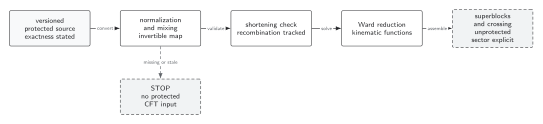
Ward reduction acts only after the external multiplet, R-symmetry tensors, and protected source conventions are fixed. Its output is a reduced set of dynamical functions plus a separately identified protected contribution. The diagram is schematic.
An equivalent table is:
| Input to the Ward step | Produced object | Independent check |
|---|---|---|
| External component and prefactor | dimensionless reduced correlator | weights at every point |
| R-symmetry representation | polynomial tensor basis | projector completeness |
| Supercharge convention | differential operators | algebra closure on the correlator |
| Protected multiplets | OPE limits and imported coefficients | |
| Ward solution | unrestricted functions | substitution residual vanishes |
| Permutation action | reduced crossing matrix | group relations and Bose/graded signs |
Contact and shortening qualifications
Section titled “Contact and shortening qualifications”Ward identities are distributional. At coincident points, variations can produce delta-function terms and mixing with descendants. A solution derived for separated points cannot be integrated through collisions without a regulator and local counterterms.
Short multiplets at an isolated point can recombine into a long multiplet when parameters change. The protected subtraction must therefore be compatible with the recombination identity used by the upstream multiplet classification. Otherwise a threshold contribution can appear once in and again in the long sector.
Common pitfalls
Section titled “Common pitfalls”Using a Ward solution from a different external representation. The R-symmetry polynomial degree and protected terms depend on the external multiplet. Similar notation does not make the systems interchangeable.
Subtracting the protected piece twice. If a superblock convention already includes a short contribution, removing it again from corrupts crossing. State where the subtraction occurs.
Ignoring contacts when integrating the identity. Separated-point Ward equations do not fix coincident-source terms. Localization or integrated-correlator uses require their own subtraction map.
Exercises
Section titled “Exercises”Why must the crossing transformation act on both and the R-symmetry variables?
Solution
A permutation moves both spacetime points and the R-symmetry polarizations attached to them. The prefactor and tensor structures therefore transform together. Acting only on spacetime variables generally mixes or misnormalizes the R-symmetry channels.
References
Section titled “References”- Dolan, F. A., and Osborn, H. “Superconformal Symmetry, Correlation Functions and the Operator Product Expansion.” Nuclear Physics B 629 (2002): 3–73. arXiv. DOI.
- Nirschl, M., and Osborn, H. “Superconformal Ward Identities and Their Solution.” Nuclear Physics B 711 (2005): 409–479. arXiv. DOI.
- Osborn, H. “N=1 Superconformal Symmetry in Four-Dimensional Quantum Field Theory.” Annals of Physics 272 (1999): 243–294. arXiv. DOI.
Original QFT.org content:CC BY 4.0, unless an item supplies different terms. Third-party material retains its own terms.