

Multipoint Correlators and Multilightcone Limits
Higher-point scalar correlators expose OPE coefficients involving several spinning operators, but they also introduce multiple channel trees, tensor structures, and inequivalent lightcone limits. A controlled multilightcone argument therefore begins by fixing the tree and a hierarchy of cross-ratios; only then may crossed-channel singularities be matched to large-spin families.
Required background. The Lorentzian inversion formula supplies the four-point projection that can be used on a declared subchannel. OPE convergence and associativity supplies the Euclidean starting domain and the equality of overlapping channel expansions.
Helpful background. Crossing kernels and conformal 6j symbols explains how local changes of OPE tree compose.
Evidence cutoff. Research-sensitive multipoint block, recoupling, and multilightcone statements below reflect primary sources available through 2026-08-09. Later inversion theorems or uniformity results require a renewed source check.
Count variables before taking limits
Section titled “Count variables before taking limits”For scalar insertions in sufficiently high dimension, conformal symmetry leaves
independent cross-ratios. Gram-determinant relations reduce this number when . Thus a generic five-point function has five invariants and a generic six-point function has nine; a two-variable four-point parametrization cannot be reused without losing data.
A binary OPE tree has internal edges. Each edge carries a conformal representation , and each trivalent vertex involving spinning internal operators carries a tensor-structure label. Euclidean use of such a tree presupposes the convergent OPE domains established in Pappadopulo et al. 2012, §§3–5. Schematically,
The superscript records the tree. For five points there are two internal edges and one topological binary-tree shape, though external labelings give different channels. For six points, the comb and snowflake are inequivalent shapes. In the snowflake channel, the three pairwise OPEs , , and meet at a central three-point function, directly probing a coefficient among three exchanged spinning operators.
Euclidean and Lorentzian reductions differ
Section titled “Euclidean and Lorentzian reductions differ”In a Euclidean OPE , contributions are ordered primarily by scaling dimension. In a Lorentzian lightcone OPE with a fixed Wightman prescription, they are ordered by twist . At higher points several null separations can be approached independently, so the expression “the lightcone limit” is incomplete.
For a six-point snowflake analysis, one useful hierarchy is
with the three remaining invariants held in a compact nonsingular domain. A further limit is a third step, not part of the first two. This hierarchy corresponds to first selecting low-twist exchanges in one set of pairwise OPEs and then forcing an infinite large-spin sum in the crossed tree. It specifies the scaling but not a universal Wightman ordering: the imaginary-time hierarchy for all six insertions must still be declared, and a different hierarchy can reach another sheet. Antunes and collaborators derive the associated five- and six-point snowflake lightcone blocks and matching equations in Antunes et al. 2022, §§2–3.
Sequential and simultaneous limits need not agree. Terms such as
distinguish a fixed-ratio simultaneous limit from or . Moreover, a subleading term of a lower-twist block may dominate the leading term of a higher-twist block. A valid truncation must therefore control remainders uniformly in every cross-ratio that is still being varied.
Matching a higher-point channel
Section titled “Matching a higher-point channel”The five-point channel with internal operators and contains coefficients
When identities or other lowest-twist operators dominate an alternative channel, the direct channel must contain large- families. Matching the power laws fixes the leading large-spin scaling of the three-point coefficient involving the two spinning operators, while logarithms encode anomalous dimensions and mixing.
The six-point snowflake similarly accesses
Here the limit can send three spins large with fixed ratios, send them large sequentially, or keep one finite. These are different asymptotic regimes. Any stated formula must declare which spins are large, which twists remain bounded, how the tensor label scales, and whether degeneracies have been diagonalized.
The diagram below shows how four-point recouplings build the changes between multipoint trees. Inspect the central six-point vertex: it carries genuine three-spinning-operator data that no single four-point scalar correlator contains.
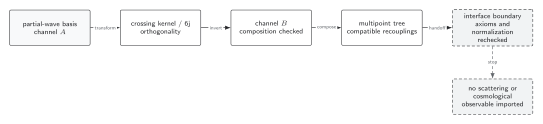
Schematic higher-point channel map. Local moves change the OPE tree, while a declared sequence of null limits determines which internal spins become large and which tensor structures are probed.
The same reasoning can be tracked in a table:
| Correlator and tree | Internal data | Controlled limit | Leading information | Principal unresolved issue |
|---|---|---|---|---|
| Four-point binary channel | One | One crossed lightcone pair | Scalar–scalar–spin- data | Low-spin completion |
| Five-point channel | Two internal representations and a structure label | Two declared null pairs, sequential or fixed-ratio | Scalar–spin–spin coefficient at large | Mixing of tensor structures |
| Six-point snowflake | Three internal representations meeting centrally | Three paired null limits followed by a crossed hierarchy | Spin–spin–spin coefficient at large | Multivariable uniformity and degeneracy |
| Six-point comb | Three consecutive internal edges | Nested consecutive OPE limits | Iterated scalar–operator couplings | Mixed-symmetry exchanges and a different block basis |
Generalized-free six-point check
Section titled “Generalized-free six-point check”For a centered generalized-free scalar, Wick’s theorem gives fifteen pairings,
In the snowflake limit, the pairing supplies the triple-identity singularity. Expanding that same term in the crossed tree requires three large-spin double-twist sums. The known generalized-free coefficients reproduce the predicted powers and provide a nontrivial check of the central three-operator coefficient asymptotics Antunes et al. 2022, §4.1 and app. C.
The five-point correlator of a centered Gaussian scalar vanishes. It therefore cannot check a nonzero five-point coefficient; one needs an interacting example or external operators with a nonvanishing odd correlator.
What four-point inversion can and cannot do
Section titled “What four-point inversion can and cannot do”A four-point Lorentzian inversion integral may be applied to one subchannel after treating the remaining positions and tensor structures as external data and proving the required Regge bound uniformly in them. Iterating this operation is useful, but it is not a universal multipoint inversion theorem. New singular loci, multiple complex spins, and noncommuting limits can obstruct a naive iteration.
Likewise, a chain of conformal kernels changes a Euclidean partial-wave basis; the local four-representation kernel is the tetrahedral overlap described in Liu et al. 2019, §3. It does not by itself choose a Wightman ordering or prove convergence of a multilightcone deformation. Harmonic recoupling and Lorentzian asymptotics are complementary checks.
Common pitfalls
Section titled “Common pitfalls”Suppressing the OPE tree. A list of exchanged dimensions without the internal edges and vertex tensor structures does not specify higher-point CFT data.
Counting cross-ratios as if were always large. Gram constraints matter in low dimension and can make a proposed coordinate set redundant or singular.
Interchanging sums and null limits. The singularity is often produced precisely because the large-spin sum is nonuniform. Take a controlled asymptotic sum before the next limit, or supply a uniform remainder estimate.
Removing disconnected terms. A connected correlator and the full correlator obey different leading crossing balances. State which one is being expanded.
Exercises
Section titled “Exercises”For six identical scalars in sufficiently high dimension, give the number of independent cross-ratios and internal edges of a binary OPE tree. In the snowflake tree, identify the OPE coefficient that is inaccessible to an identical-scalar four-point function.
Solution
There are cross-ratios and internal edges. The three exchanged operators meet at the central vertex, so the expansion contains , including its tensor-structure label. An identical-scalar four-point function contains only products of scalar–scalar– coefficients and cannot determine this general three-spinning-operator coefficient.
References
Section titled “References”- Antunes, António, Miguel S. Costa, Vasco Gonçalves, and João Vilas Boas. “Lightcone Bootstrap at Higher Points.” Journal of High Energy Physics 2022, no. 3 (2022): 139. doi:10.1007/JHEP03(2022)139.
- Liu, Junyu, Eric Perlmutter, Vladimir Rosenhaus, and David Simmons-Duffin. “d-Dimensional SYK, AdS Loops, and 6j Symbols.” Journal of High Energy Physics 2019, no. 3 (2019): 052. doi:10.1007/JHEP03(2019)052.
- Pappadopulo, Duccio, Slava Rychkov, Johnny Espin, and Riccardo Rattazzi. “OPE Convergence in Conformal Field Theory.” Physical Review D 86, no. 10 (2012): 105043. doi:10.1103/PhysRevD.86.105043.
Original QFT.org content:CC BY 4.0, unless an item supplies different terms. Third-party material retains its own terms.