

Dispersion Relations for CFT Correlators
A conformal dispersion relation reconstructs a four-point correlator from its channel discontinuities and a theory-independent kernel. Reconstruction is unique only within a declared analytic and growth class: contributions invisible to the chosen discontinuity reappear as subtraction or contact terms. The number and form of those terms are conclusions of the contour estimate, not optional decorations.
Required background. The CFT Regge limit determines the large-contour behavior. Boundary values, discontinuities, and dispersion integrals supplies the Cauchy-contour argument.
Helpful background. Subtracted scattering dispersion relations gives a one-variable comparison while keeping the distinct CFT kinematics visible.
From a cut plane to subtraction data
Section titled “From a cut plane to subtraction data”For one complex variable, let be analytic away from a cut and satisfy ) on a large circle. Subtracting at gives
where is the polynomial fixed by . Adding a polynomial of degree at most leaves the discontinuity unchanged. This elementary null space is the model for contact ambiguities in CFT, although the CFT basis is constrained by crossing and by two-variable analyticity rather than being an arbitrary polynomial.
The two-variable CFT relation
Section titled “The two-variable CFT relation”For a scalar four-point function in , the absorptive input is a crossed-channel double discontinuity. This choice is inherited from the spin-analytic inversion formula Caron-Huot 2017, §§3.1–3.4. In a convergence domain, the -channel contribution takes the schematic form
There is a corresponding -channel term with the external ordering permuted. The kernel contains a two-dimensional bulk contribution and a distributional contact contribution on the boundary of its support. Both are needed: the contact part arises from the large-dimension behavior when the inversion data are resummed. Carmi and Caron-Huot derive the kernel and a direct contour proof in Carmi and Caron-Huot 2020, §§3–4.
Why is the integral two-dimensional? Holding one cross-ratio fixed does not keep the relevant CFT analytic domain fixed while the other crosses both Euclidean and Regge regions. Integrating over both and permits the contour pieces to combine into the double discontinuity. A one-dimensional formula exists in special kinematics or with a different input, but it is not obtained by simply deleting one integral.
For identical scalars in an arbitrary unitary CFT, a useful guaranteed subtraction is to apply the dispersion theorem to
The factor improves the Euclidean and Regge endpoints. The resulting relation reconstructs from the - and -channel double discontinuities of the appropriately ordered rescaled correlators. One then multiplies by . In this scheme the identity is reconstructed from the double discontinuity of the rescaled correlator; adding a separate identity term would double count it Carmi and Caron-Huot 2020, §4.2.
Arc terms and contact ambiguities
Section titled “Arc terms and contact ambiguities”The contour sequence is:
- Declare the Euclidean starting region and the two Lorentzian boundary values.
- Deform to the - and -channel cuts without crossing other singularities.
- Estimate the Euclidean OPE endpoint, the Regge portion of the contour, and the keyhole near the crossed-channel singularity.
- If an arc does not vanish, improve the falloff by a declared subtraction.
- Retain every term in the null space of the discontinuity map that survives crossing and the growth bound.
The diagram emphasizes that subtractions are fixed before the discontinuity integral is interpreted. Inspect the split between the cut contribution and the arc contribution.
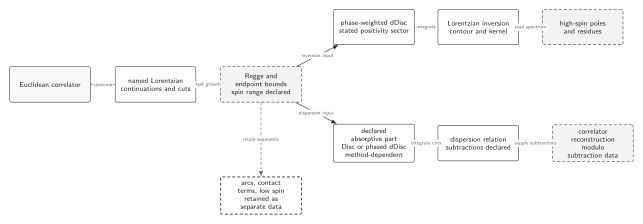
Schematic conformal dispersion branch. The declared absorptive input may be an ordinary discontinuity or a phase-weighted double discontinuity, depending on the reconstruction formula and its crossing symmetrization. Regge and endpoint estimates determine the necessary subtraction basis and any low-spin ambiguity. The parallel inversion branch specifically uses the double discontinuity to reconstruct high-spin data; it is related to dispersion but is not a prerequisite output of it.
For a general subtraction scheme, let span the crossing-compatible functions with vanishing chosen absorptive part and acceptable growth. Then
The coefficients require low-spin OPE data, a normalization condition, a Ward identity, or another physical input. Calling the “contact terms” describes their role in the representation; it does not assert a bulk effective field theory.
Hypothesis and subtraction matrix
Section titled “Hypothesis and subtraction matrix”| Reconstruction | Analytic input | Endpoint or Regge requirement | Retained terms | Strongest justified output |
|---|---|---|---|---|
| Unsubtracted two-variable relation | Specified - and -channel sheets and double discontinuities | Vanishing Euclidean, Regge, and keyhole arcs | Non-normalizable or zero-discontinuity terms allowed by the theorem | Correlator modulo the stated null space |
| -rescaled scalar relation | Same sheets applied to and its crossed ordering | Bounded unitary correlator; regulated keyhole at the crossed OPE singularity | No separately added identity in this scheme | Convergent reconstruction in an arbitrary unitary scalar CFT in |
| Generic -subtracted relation | Cut data plus conditions at a subtraction point | Polynomial growth compatible with subtractions | Finite crossing-compatible contact basis | Correlator once all constants are supplied |
| Dispersive sum rule | Difference between OPE and dispersive representation | Functional swapping and Regge convergence | Low-twist or low-spin terms isolated explicitly | Spectral sum rule with declared zeros and sign domain |
Dispersive sum rules can be derived by applying linear functionals to the difference between the OPE and a dispersion representation. Their characteristic double zeros at appropriate double-twist families follow from the double discontinuity, while subtractions can isolate a finite low-twist sector Caron-Huot et al. 2021, §§2–4.
Generalized-free reconstruction
Section titled “Generalized-free reconstruction”For the monomial test function
the -channel absorptive part is
In the unsubtracted convergence window, inserting this expression reproduces the original function. Outside that window the rescaled subtracted relation and, when necessary, the keyhole prescription recover it. The special case checks the subtle statement that the subtracted representation reconstructs the identity even though the identity’s unrescaled double discontinuity vanishes Carmi and Caron-Huot 2020, §5.1.
A reproducible calculation should perform this comparison using the chapter’s generalized-free conventions and expose the arc and low-spin terms. Such a finite comparison checks the formulas but does not establish their hypotheses.
Common pitfalls
Section titled “Common pitfalls”Counting subtractions from analogy alone. The required number follows from the actual CFT Regge and endpoint powers, including prefactors introduced by a change of reduced-correlator convention.
Dropping the distributional kernel term. A contact contribution supported on the edge of the integration region can be required even when the bulk kernel looks regular.
Adding invisible terms without a basis. Every ambiguity must satisfy crossing, the selected growth bound, and vanishing of the chosen discontinuity. An arbitrary crossing-symmetric ansatz is not automatically allowed.
Confusing dDisc positivity with coefficient uniqueness. Nonnegative absorptive data can yield useful inequalities, but it does not determine subtraction constants.
Exercises
Section titled “Exercises”Let a one-variable function satisfy ) on the large circle. Determine the minimal in the displayed subtracted relation and the corresponding ambiguity. What additional CFT conditions reduce its two-variable analogue?
Solution
The bound is compatible with , so the dispersion integral determines up to . In CFT, crossing, permutation symmetry, OPE endpoint behavior, and the declared Regge bound restrict the allowed two-variable contact basis; normalization or low-spin OPE data then fixes its remaining coefficients.
References
Section titled “References”- Carmi, Dean, and Simon Caron-Huot. “A Conformal Dispersion Relation: Correlations from Absorption.” Journal of High Energy Physics 2020, no. 9 (2020): 009. doi:10.1007/JHEP09(2020)009.
- Caron-Huot, Simon, Dalimil Mazáč, Leonardo Rastelli, and David Simmons-Duffin. “Dispersive CFT Sum Rules.” Journal of High Energy Physics 2021, no. 5 (2021): 243. doi:10.1007/JHEP05(2021)243.
- Caron-Huot, Simon. “Analyticity in Spin in Conformal Theories.” Journal of High Energy Physics 2017, no. 9 (2017): 078. doi:10.1007/JHEP09(2017)078.
Original QFT.org content:CC BY 4.0, unless an item supplies different terms. Third-party material retains its own terms.