

Conjugation and Reflection Positivity
Hermitian conjugation in radial quantization reflects cylinder time. On the plane that reflection is inversion through the quantization sphere, followed by complex conjugation and the appropriate spin transformation. When the Euclidean theory satisfies reflection positivity, this inside–outside pairing is a positive Hilbert-space inner product; it yields and . Without reflection positivity the algebraic radial pairing can still be defined, but its norms and squared OPE coefficients need not be nonnegative.
Required background. The State–Operator Correspondence supplies the ket prepared inside a sphere and the exterior path integral that defines a bra. Reflection Positivity within Osterwalder–Schrader Reconstruction owns the general reconstruction theorem and its hypotheses. Helpful background. Bilinear and Hermitian Forms, Adjoints, and Isometries reviews antilinear adjoints and positive forms.
Radial inversion defines the adjoint
Section titled “Radial inversion defines the adjoint”Use a unit quantization sphere for the moment. Its inside and outside are exchanged by
On the cylinder, where , this is simply . For a Hermitian scalar primary of dimension , radial conjugation is
The factor is forced by the primary Weyl transformation. Applying the operation twice returns the original insertion, which is the first round-trip check:
For a primary in a complex internal representation, the operator on the right lies in the conjugate representation. For a spinning primary, every vector index is acted on by the inversion matrix
and spinor indices require a lift of this orthogonal transformation to the chosen Pin or Spin structure. Fermionic products are conjugated in reverse order with their graded signs. These data cannot be recovered from the scalar prefactor alone.
The scalar bra is consequently represented by
Rychkov 2017, §§3.1.6–3.1.7, pp. 43–45, Open PDF derives the inversion rule and uses the two-point function as its normalization check.
Reflection positivity on a sphere
Section titled “Reflection positivity on a sphere”Let be a finite linear combination of products of local insertions supported strictly inside the unit sphere. Define by complex conjugating coefficients, applying radial inversion and the operator reflection to each insertion, and reversing operator order. Spherical reflection positivity is the condition
for every such , after quotienting null vectors and completing the resulting space. Through the plane–cylinder map this is ordinary reflection positivity across the cylinder slice .
Several restrictions are essential:
- insertions must lie on the prescribed side of the reflection surface before the limiting construction;
- fields must transform under the full reflection, including spin, charge, and complex conjugation;
- gauge constraints and null states must be handled before interpreting the quotient as a physical Hilbert space; and
- the inequality is a property of the specified Euclidean theory and state, not a consequence of conformal covariance alone.
The Osterwalder–Schrader framework establishes how an appropriate Euclidean reflection-positive system reconstructs a positive Lorentzian Hilbert space Osterwalder and Schrader 1973, axioms E0–E4 and theorem, pp. 83–112. The CFT specialization and the conversion from planar to spherical reflection are explained in Simmons-Duffin 2017, §§7.1–7.2, pp. 31–36, Open PDF.
Norms of primaries and descendants
Section titled “Norms of primaries and descendants”Normalize scalar primaries by
within a subspace of equal dimension and quantum numbers. Radial conjugation gives
Reflection positivity therefore requires the Hermitian matrix to be positive semidefinite. After removing null combinations it may be made the identity by a basis change. In a nonunitary theory can be indefinite, and no basis change converts an indefinite form into a positive one.
Adopt the Euclidean algebra convention
For a scalar primary with , the level-one Gram matrix is
Hence a nontrivial scalar primary in a positive theory must have ; is the identity multiplet after the usual uniqueness assumptions on the vacuum. At level two, the scalar descendant obeys
Its positivity gives the scalar unitarity bound
for a nonidentity scalar in . At saturation is null, the representation shortens, and the corresponding operator obeys a free wave equation in correlation functions away from contact terms. The full spin-dependent bounds and their exceptions belong to Unitarity Bounds and Null States; Descendant States and Gram Matrices derives the level-by-level method.
Positivity of OPE data
Section titled “Positivity of OPE data”Choose Hermitian operators and an orthonormal basis of exchanged primaries in a reflection-positive sector. Then the coefficient multiplying a conformal block in an identical-scalar four-point function is
This familiar nonnegativity has conditions: the external operators are related by the radial adjoint, the intermediate states have positive norm, and phases and degeneracies are treated consistently. For mixed correlators, the exchanged coefficients form positive-semidefinite matrices rather than independent nonnegative numbers. For charged, non-Hermitian, logarithmic, or nonunitary operators, the correct pairing can be complex, indefinite, or nondiagonal; writing an unexplained square is then wrong.
The shared geometry figure connects the reflection surface to its two plane images. Inspect in particular that the bra lies outside the sphere, that inversion reverses radial time, and that positivity is shown as an additional condition rather than as a geometric identity.
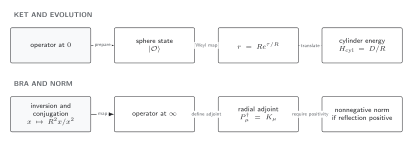
Radial conjugation and positivity. Inversion plus complex conjugation defines the adjoint; reflection positivity makes the resulting inside–outside pairing nonnegative. The figure is schematic and uses a scalar label—spin and internal indices require their own reflection matrices.
Failure tests
Section titled “Failure tests”| Proposed inference | Required check | What failure means |
|---|---|---|
| from conformal covariance | Evaluate the reflected two-point pairing | Covariance fixes the form, not the sign |
| Include inversion, Weyl weight, and generator convention | A missing factor or alternate convention changes the displayed adjoint relation | |
| Verify Hermiticity, reflection positivity, and basis phases | The coefficient may be complex or part of a matrix pairing | |
| Null descendant implies an operator equation | Quotient the null state and control contact terms | A zero determinant alone can signal reducibility without the claimed local equation in every distributional context |
| Euclidean positivity implies every Lorentzian ordering is positive | Carry out the specified analytic continuation | Reflection positivity constrains a particular reflected configuration, not arbitrary Wightman orderings |
The supported conclusion is exact but conditional: spherical reflection positivity turns radial conjugation into a positive Hilbert-space adjoint, making self-adjoint and descendant Gram matrices positive semidefinite. If the condition is absent, conformal representation theory survives but bootstrap positivity must be withdrawn or replaced.
References
Section titled “References”- Osterwalder, Konrad, and Robert Schrader. “Axioms for Euclidean Green’s Functions.” Communications in Mathematical Physics 31 (1973): 83–112. doi:10.1007/BF01645738.
- Rychkov, Slava. EPFL Lectures on Conformal Field Theory in Dimensions. SpringerBriefs in Physics. Cham: Springer, 2017. doi:10.1007/978-3-319-43626-5. Open PDF.
- Simmons-Duffin, David. “The Conformal Bootstrap.” In New Frontiers in Fields and Strings, 1–74. Singapore: World Scientific, 2017. doi:10.1142/9789813149441_0001. Open PDF.
Original QFT.org content:CC BY 4.0, unless an item supplies different terms. Third-party material retains its own terms.