

The Virasoro Algebra and the Stress Tensor
The holomorphic stress tensor generates local conformal transformations, but its operator product contains a central term that has no classical Witt-algebra counterpart. Contour integration turns that OPE into the Virasoro algebra; the same central charge produces the Schwarzian transformation and the universal cylinder vacuum-energy shift. The derivation below fixes contour, radial-ordering, Hermiticity, and anomaly signs in one convention.
Required background. Complex coordinates and local conformal symmetry distinguish local holomorphic maps from global Möbius transformations. Currents and the stress tensor provide the general Ward-identity construction.
Helpful background. The cylinder map and Hamiltonian explain why radial dilatations become cylinder time translations.
Stress-tensor OPE and Laurent modes
Section titled “Stress-tensor OPE and Laurent modes”On the Euclidean plane, use counterclockwise contours and radial ordering. The holomorphic normalization is
Define
For a local field , the infinitesimal transformation generated by a holomorphic test function is the contour operation
The minus sign matches the active-field convention on the preceding page. For a primary of weight ,
so . With several separated insertions, contour deformation gives the holomorphic Ward identity
This identity is an equality away from coincident points. Distributional contact terms can appear when one takes or varies background sources; they must not be silently promoted to separated-point OPE coefficients. The OPE and contour conventions follow Di Francesco, Mathieu, and Sénéchal 1997, §§5.3–6.2.
Deriving the Virasoro commutator
Section titled “Deriving the Virasoro commutator”Radial ordering implies that a commutator is the difference between nested contours. Shrinking the outer contour onto the inner insertion gives
The three singular terms contribute separately. Cauchy’s formula gives
while the and terms combine, after one integration by parts in , to . Hence
The central term vanishes for , so the globally regular generators retain the algebra. In a reflection-positive theory, radial conjugation gives
and positivity of requires . The algebra itself does not require this Hermiticity condition; nonunitary representations may have indefinite norms.
Schwarzian transformation and the cylinder shift
Section titled “Schwarzian transformation and the cylinder shift”The central term forces to transform anomalously. If , then
where
For a Möbius map the Schwarzian vanishes, consistent with being quasiprimary. For the map from a cylinder , , one finds
The vacuum has , hence . For circumference , rescaling gives the chiral energy operator . The full Hamiltonian includes the barred copy:
The finite-size shift and its relation to the conformal anomaly are reviewed in Ginsparg 1990, §§3.1–3.4. With and the curvature sign used in this volume, the two-dimensional trace response is . This positive trace coefficient does not conflict with the negative cylinder energy: the first is a local Weyl variation, whereas the second follows from the negative Schwarzian .
The figure summarizes the path from this shift to modular data. At this stage, inspect only the first three boxes: the plane–cylinder transformation fixes the vacuum offset, and quotienting a Virasoro module fixes the character that enters later traces.
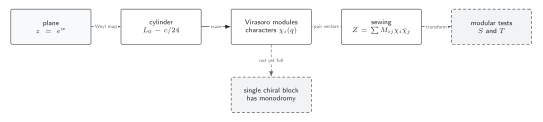
The schematic chain uses , , and . A single chiral character or block is not yet a full modular-invariant CFT.
The same chain, with its required checks, is:
| Step | Formula or object | Required check |
|---|---|---|
| Coordinate map | , | Image is the punctured plane and the contour orientation is preserved |
| Anomalous shift | in the declared transformation law | |
| Module trace | Null states have been quotiented and state multiplicities are nonnegative | |
| Full torus object | Left–right sectors are complete and is physically admissible | |
| Modular action | , | The chosen character basis closes under both transformations |
A normalization check from the vacuum
Section titled “A normalization check from the vacuum”The Virasoro algebra gives
because . This equals the coefficient of in . Thus the OPE normalization, the central term in the mode algebra, and the level-two vacuum norm agree. A factor-of-two mismatch in any one of these formulas diagnoses inconsistent conventions.
Common pitfalls
Section titled “Common pitfalls”Reversing the Schwarzian. The displayed formula transforms the -plane tensor into the -coordinate tensor. Solving it for reverses the sign and Jacobian placement; state which direction is used before substituting .
Ignoring the contour orientation. Clockwise contours change the sign of every mode integral. Fix counterclockwise orientation before deriving the commutator.
Calling a primary. The Schwarzian vanishes only for Möbius maps or when . At nonzero central charge, is quasiprimary under the global subgroup, not primary under arbitrary local maps.
Exercises
Section titled “Exercises”Use the Virasoro algebra to compute the norm of for .
Solution
Since for and ,
It is nonnegative for all when and is negative for every such when , immediately excluding reflection positivity in that vacuum module.
References
Section titled “References”- Di Francesco, Philippe, Pierre Mathieu, and David Sénéchal. Conformal Field Theory. Graduate Texts in Contemporary Physics. New York: Springer, 1997. DOI.
- Ginsparg, Paul. “Applied Conformal Field Theory.” In Fields, Strings and Critical Phenomena, Les Houches Session XLIX, edited by Édouard Brézin and Jean Zinn-Justin, 1–168. Amsterdam: North-Holland, 1990. arXiv.
Original QFT.org content:CC BY 4.0, unless an item supplies different terms. Third-party material retains its own terms.