

Bulk-Point and Flat-Space Limits: CFT-Side Criteria
Bulk-point and flat-space limits are singular probes of a family of CFT correlators. They are not ordinary substitutions into a Euclidean four-point function. A valid test fixes the Lorentzian continuation, external-state smearing, normalization, spectrum scaling, and order of limits, then asks whether a CFT distribution converges. Interpreting the limit as a bulk collision or S-matrix element requires the dictionary developed in Volume 15.
Required background. Large-Gap Constraints and CFT-Side Locality Tests supplies the gap and boundedness hypotheses. Mellin-Space CFT Correlators supplies the contour and Gamma measure. Helpful background. Celestial and Cosmological Correlator Interfaces compares other observable interfaces without identifying their axiom systems.
Lorentzian bulk-point-type kinematics
Section titled “Lorentzian bulk-point-type kinematics”Begin with a Euclidean correlator in a domain where the OPE converges, specify an ordering, and continue and along a path that records every crossed branch cut. A bulk-point-type configuration occurs, in the proposed geometric interpretation, when the boundary insertions can be joined by null rays to one interior event. Intrinsically, the CFT question is whether the continued correlator develops a distinguished singular distribution as approaches on that Lorentzian sheet.
The Euclidean locus is not itself singular for separated points. The path is essential: different windings around , , or select different operator orderings and discontinuities. A useful local parameter is
but a statement such as is incomplete until it declares:
- the causal ordering and continuation path;
- which cross-ratio combination is held fixed;
- whether the limit is pointwise or after smearing;
- the order in the large-N expansion;
- the range in which other lightcone or coincident-point singularities are absent;
- the normalization used to compare different members of the CFT family.
Perturbative correlators associated with local bulk diagrams can display such singularities Gary, Giddings, and Penedones 2009, §§3–5. Crucially, the exact nonperturbative correlator need not retain an infinite singularity. Maldacena, Simmons-Duffin, and Zhiboedov 2017, §§2–4 explain how the perturbative diagnostic is encoded in CFT data and why exact finite-coupling behavior can be smoother. Therefore the claim must name the perturbative order before assigning a singular exponent.
Smearing before interpreting
Section titled “Smearing before interpreting”Local operator insertions create states with broad energy support. To isolate a scattering-like configuration one introduces boundary wavepackets,
with support, frequency width, angular width, and normalization declared. A candidate transition functional is then a smeared correlator
Here labels the large scale in the proposed flat limit and is fixed by unit normalization of the packet states. The CFT-side criterion is convergence of for an explicitly stated class of test functions. Plane waves are a limiting idealization; taking their width to zero before can reintroduce image collisions or infrared contamination. Wavepacket constructions and their finite-curvature corrections are analyzed in Fitzpatrick and Kaplan 2011, §§2–4.
A Mellin scaling criterion
Section titled “A Mellin scaling criterion”For a family of correlators with scale , suppose external dimensions scale as
for massive-type external states, or follow a separately declared massless scaling. A Mellin flat-space prescription probes variables of order at fixed ratios. In a broad class of conventions it has the form
where the exponent , normalization , contour, and relation among the Mellin variables are fixed by the external dimensions and correlator convention. This display is a scaling template, not a universal normalization formula. A claimed limit must derive its own and from the preceding Mellin representation.
The CFT-side test is:
as a distribution on a stated domain of , after poles, wavepackets, and external normalizations have been controlled. The Mellin formula relating such asymptotics to flat-space amplitudes was proposed in Penedones 2011, §5 and established under holographic assumptions in Fitzpatrick and Kaplan 2012, §§2–3. On this page, the surviving object is called a CFT scaling distribution; Volume 15 decides when it is an S-matrix.
Noncommuting limits
Section titled “Noncommuting limits”At least four limits can appear:
where is a packet width. The order is part of the result. For example:
- taking first may expose a perturbative bulk-point-type singularity that is smoothed at every fixed ;
- taking Mellin variables large before the gap can invalidate the contact expansion;
- taking with fixed external describes a different regime from ;
- taking too early can turn a convergent distributional limit into a divergent pointwise one.
A safe finite-parameter study lists a sequence , keeps the dimensionless kinematic ratios and packet prescription fixed, and reports residuals
for several test packets. One scaling point cannot establish convergence.
Where the inference stops
Section titled “Where the inference stops”Inspect the final branch of the figure: a controlled scaling distribution reaches the CFT boundary, while “local event” and “S-matrix” remain across it.
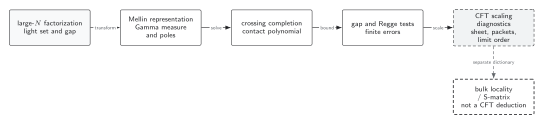
Bulk-point-type behavior and a flat-space-type scaling distribution require a declared sheet, packet normalization, gap and Regge regime, several scaling points, and an order of limits. These are CFT diagnostics; a bulk event, local dynamics, or S-matrix is not inferred without the separate holographic dictionary. The map is schematic.
| Stage | Input held fixed | Limit taken | Observable check | Strongest conclusion here |
|---|---|---|---|---|
| Lorentzian continuation | Euclidean normalization and ordering | path to chosen sheet | cuts and discontinuities match the causal ordering | specified Lorentzian correlator |
| bulk-point-type approach | sheet and nonsingular cross-ratio combination | pointwise exponent or smeared distribution with errors | perturbative CFT singularity diagnostic | |
| wavepacket extraction | packet family, norm, angular and frequency widths | support focused with controlled tails | norm and unwanted-image suppression | transition functional of CFT states |
| Mellin scaling | Gamma measure, contour, , external-dimension scaling | through at least four values | distributional convergence and residuals | flat-space-type CFT scaling distribution |
| interpretation | all previous assumptions plus an independent dictionary | prescribed bulk limit | Volume 15 consistency tests | outside this chapter |
A reproducible calculation should test constant and degree-two contact terms across a finite scaling sequence and include a noncommuting-limit failure.
Current evidence boundary
Section titled “Current evidence boundary”The research-sensitive interface was checked through 9 August 2026. The page retains the classic bulk-point and Mellin scaling criteria and makes no claim that they are sufficient for a holographic dual, that an exact correlator must contain a perturbative bulk-point pole, or that a pointwise large- value defines an S-matrix. Current refinements and theory-specific applications belong on the analytic and numerical conformal-bootstrap research map and in Volume 15.
Common pitfalls
Section titled “Common pitfalls”Setting in Euclidean space. The diagnostic lives on a particular Lorentzian sheet reached by a declared path. The Euclidean diagonal is not the same limit.
Reading a perturbative singularity as exact. Resummation and finite- effects can smooth it. Always state the order in the large-N expansion.
Calling a large Mellin value a flat-space amplitude. External dimensions, powers, the contour, normalization, and distributional convergence are essential.
Removing smearing before the large-scale limit. Plane-wave and flat-radius limits can fail to commute. Keep a normalized packet family until convergence has been demonstrated.
Exercises
Section titled “Exercises”Suppose . Construct a Richardson-improved estimator from and that cancels the term.
Solution
Because ,
The improvement is valid only if both values use the same dimensionless kinematics, packet convention, normalization, and order of the other limits.
References
Section titled “References”- Fitzpatrick, A. L., and Kaplan, J. “Analyticity and the Holographic S-Matrix.” Journal of High Energy Physics 2012, 127 (2012). arXiv. DOI.
- Fitzpatrick, A. L., and Kaplan, J. “Scattering States in AdS/CFT.” arXiv.
- Gary, M., Giddings, S. B., and Penedones, J. “Local Bulk S-Matrix Elements and CFT Singularities.” Physical Review D 80, 085005 (2009). arXiv. DOI.
- Maldacena, J., Simmons-Duffin, D., and Zhiboedov, A. “Looking for a Bulk Point.” Journal of High Energy Physics 2017, 013 (2017). arXiv. DOI.
- Penedones, J. “Writing CFT Correlation Functions as AdS Scattering Amplitudes.” Journal of High Energy Physics 2011, 025 (2011). arXiv. DOI.
Original QFT.org content:CC BY 4.0, unless an item supplies different terms. Third-party material retains its own terms.