

The State–Operator Correspondence
In radial quantization, a local operator inserted at the center of a sphere prepares a state on that sphere, and shrinking a sufficiently regular state toward the center recovers a local operator. This is the state–operator correspondence. Its cleanest form applies to the local vacuum sector of a CFT on , with the origin and point at infinity included through conformal compactification. It is not a claim that ordinary local operators create states in every topological, twisted, gauge-flux, boundary, or extended-operator sector.
Required background. Radial Time and Quantization on Spheres constructs states by path integrals on balls. Local and Composite Operator Insertions explains what counts as a renormalized local insertion. Helpful background. Primaries, Descendants, and Conformal Multiplets supplies the primary and descendant labels carried across the map.
From an operator to a state
Section titled “From an operator to a state”Let be a renormalized local operator at the origin, where includes its spin and internal indices. The path integral over a small ball with this insertion defines a boundary wavefunctional on the surrounding sphere. In operator notation,
The equation is a definition in radial quantization, not a formal multiplication of singular operator-valued distributions at the same point. The insertion has already been renormalized, and the vacuum is the state prepared by the empty ball.
For a primary at the origin, the conformal algebra gives
while rotations act in the same or representation as the operator indices. Translation descendants map directly to descendant states:
Thus the correspondence preserves scaling dimension, spin, internal charge, statistics, and the null relations imposed on the operator multiplet. The derivation from path-integral gluing and the conformal algebra is given in Simmons-Duffin 2017, §§6.1 and 6.3, pp. 26–29, Open PDF.
The map is linear but need not be injective before null operators are removed. If an operator has vanishing correlation functions with every allowed insertion, it creates a zero-norm or null state in the reconstructed space. The physical statement is therefore a correspondence between local operators modulo null relations and states modulo null vectors.
From a state back to an operator
Section titled “From a state back to an operator”The converse requires distinguishing annular transfer from an active change of scale. Let be a state in the local vacuum sector on the sphere of radius . With logarithmic radial time increasing outward, Euclidean transfer through the annulus from to is
The inverse annular transfer from inward to has the opposite sign, . This agrees with the cylinder coordinate and the Euclidean evolution operator on From Flat Space to the Cylinder.
Operator extraction instead uses an active rescaling of the state by the dimensionless factor , not inverse transfer through a fixed annulus. Define
If is diagonalizable with a spectrum bounded below, decompose the state into dilatation eigenstates. For an eigenstate of dimension ,
Once the state normalization on the reference sphere is fixed, the limiting insertion is defined weakly by
where every insertion in stays a fixed positive distance from the origin. The two lines are identical; the first displays the dimensionless scale ratio and the reference-radius normalization, while the second is the customary shorthand. This weak, correlation-function definition is appropriate for operator-valued distributions.
For a general state, one obtains a sum or integral of scaling components rather than a single operator of definite dimension. If the spectrum contains Jordan blocks, radial evolution also produces powers of ; if it is continuous, a spectral measure replaces the discrete expansion. These are modifications of the spectral representation, not permission to assume a discrete orthonormal basis. Rychkov 2017, §3.1.3, pp. 39–40, Open PDF gives the standard discrete-spectrum construction and makes the state quantum numbers explicit.
Bras and insertions at infinity
Section titled “Bras and insertions at infinity”The conjugate of a ket prepared inside a sphere is represented by a path integral over the exterior. Conformal inversion maps that exterior to another ball, which motivates an insertion at infinity. For a scalar primary of dimension ,
With the two-point normalization
the corresponding pairing is
For spinning operators, inversion acts on every index, and complex conjugation acts on internal representations as well. Consequently the scalar formula cannot simply be copied with indices suppressed. Conjugation and Reflection Positivity derives the radial adjoint and states the positivity assumptions.
Plane, cylinder, and quantum numbers
Section titled “Plane, cylinder, and quantum numbers”The same correspondence can be viewed on the cylinder . The logarithmic coordinate sends the origin to . A primary insertion at the origin prepares a cylinder energy eigenstate:
up to the separately specified vacuum-energy convention. A descendant at level has energy . This spectral statement is checked by the cylinder two-point function, whose large positive time separation decays with the lowest dimension that couples to the chosen operators.
The figure summarizes the three equivalent descriptions to compare: an insertion at the center of a ball, a state on its boundary sphere, and an energy eigenstate on the cylinder. The arrows are valid only in the stated local sector and after the appropriate Weyl and conjugation factors are included.
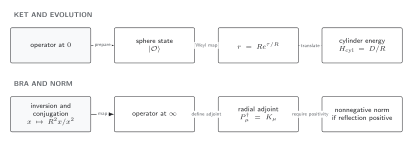
The state–operator map in the local vacuum sector. Radial evolution is generated by , cylinder evolution by , and the exterior path integral defines the bra. The diagram is schematic and does not assert positivity or completeness without their separate hypotheses.
The same content can be read without the figure:
| Description | Object | Generator | Essential qualification |
|---|---|---|---|
| Punctured plane | Local insertion | Dilatations | The insertion is renormalized and belongs to a specified sector |
| Sphere slice | State on | Radial transfer operator | Null states are quotiented; positivity is not automatic |
| Cylinder | Energy eigenstate at | Weyl factors and any vacuum-energy shift must be included | |
| Exterior region | Bra | Reversed radial evolution | Inversion, index reflection, and complex conjugation define the adjoint |
Where the correspondence stops
Section titled “Where the correspondence stops”The correspondence is strongest in a local CFT sector on a sphere. It needs modification or an explicit restriction in the following cases.
- A disorder operator, line, surface, or other extended insertion may create a state in a sector with nontrivial data linking the sphere; an ordinary point operator does not replace it.
- Gauge theories require gauge-invariant insertions or a carefully defined charged sector. A gauge-variant local field does not automatically define a physical Hilbert-space state.
- A boundary or defect changes the spatial slice and the preserved conformal group. Its local operators obey a defect-specific state–operator map.
- Noncompact theories can have delta-normalizable states and continuous spectra. Logarithmic theories can have nondiagonalizable . Both invalidate a naive discrete orthonormal expansion.
- On more general spatial manifolds, states need not correspond to point insertions. The sphere is special because shrinking it isolates one point.
The precise conclusion is a sector-qualified equivalence: local operators modulo null relations encode the local states obtainable by shrinking spherical boundaries, and their conformal quantum numbers become radial or cylinder energies and spins. Completeness of these states is the separate subject of Completeness and the Operator Basis.
Check your understanding
Section titled “Check your understanding”If is a scalar primary with , show that its state has unit norm in this normalization.
Answer
Use . Then . For spin, the inversion tensor and index pairing must also be included.
References
Section titled “References”- Rychkov, Slava. EPFL Lectures on Conformal Field Theory in Dimensions. SpringerBriefs in Physics. Cham: Springer, 2017. doi:10.1007/978-3-319-43626-5. Open PDF.
- Simmons-Duffin, David. “The Conformal Bootstrap.” In New Frontiers in Fields and Strings, 1–74. Singapore: World Scientific, 2017. doi:10.1142/9789813149441_0001. Open PDF.
Original QFT.org content:CC BY 4.0, unless an item supplies different terms. Third-party material retains its own terms.