

Thermal and Nonequilibrium QFT
Thermal and nonequilibrium quantum field theory asks how quantum fields behave in states with temperature, density, preparation history, driving, or environmental exchange—and which reduced description remains trustworthy at the scale of the question. This volume connects equilibrium ensembles and KMS structure to real-time contours, kinetic and stochastic reductions, hydrodynamics, thermalization, open dynamics, hot gauge plasmas, and QCD collision inference. Its organizing rule is simple: every conclusion names the state, observable, scale, approximation, validation test, and evidence supporting it.
A broad real- and imaginary-time synthesis with compatible domain warnings is given by Landsman and van Weert 1987, §§ 2–4, pp. 149–218.
Helpful background. Partition Functions and Thermodynamic Response supplies equilibrium generating functions. Closed-Time-Path Grammar supplies normalized in–in evolution. Beta Functions, Running Masses, and Field Anomalous Dimensions supplies running-coupling control. Power Counting and Predictive Order supplies scale separation and truncation.
Choose a description from the question
Section titled “Choose a description from the question”No single formalism is “the thermal theory.” Begin with the observable and its time and length scales.
| Reader’s question | Natural first description | Essential assumption | Early warning that another description is needed |
|---|---|---|---|
| equilibrium pressure or susceptibility | Gibbs/KMS state and Euclidean generating functional | equilibrium state and controlled thermodynamic limit | phase coexistence, sign problem, or infrared scale invalidates the expansion |
| static screening or phase structure | thermal EFT or dimensionally reduced theory | separation from nonzero Matsubara modes | critical or magnetostatic retained sector becomes strongly coupled |
| causal response after a perturbation | retarded correlator on a closed time path | prepared initial state and causal source protocol | memory, initial correlations, or nonanalytic kernels cannot be neglected |
| evolution of two-point functions | Kadanoff–Baym equations | specified self-energy closure and renormalized initial data | Ward identities, conservation, or memory convergence fail |
| dilute or quasiparticle transport | kinetic equation | narrow shells, gradient expansion, and controlled collision kernel | widths, coherence, or correlations are of leading order |
| longest-wavelength conserved dynamics | hydrodynamics | separation between conserved and nonhydrodynamic timescales | instability, acausality, loss of hyperbolicity, or extra slow modes |
| stochastic critical dynamics | Langevin, Fokker–Planck, or MSRJD theory | justified coarse graining and noise calculus | colored, multiplicative, or non-Markovian noise changes the universality class |
| subsystem or driven evolution | influence functional or quantum master equation | declared system–environment split and reduction | non-Markovianity, positivity failure, or conditional/full dynamics are conflated |
| hot non-Abelian plasma | scale-specific HTL, EQCD/MQCD, ultrasoft, or kinetic EFT | an actual hierarchy among , , and | adjacent scales overlap or the magnetic sector dominates |
| properties inferred from nuclear collisions | multistage forward model and uncertainty-aware inference | complete likelihood, covariance, priors, discrepancy, and validation | parameter degeneracy or stage dependence prevents identification |
The table gives entry points, not equivalences. Euclidean data can define exact analytic functions under strong hypotheses, but finite noisy Euclidean samples do not by themselves determine transport. A hydrodynamic fit can constrain a model while leaving microscopic thermalization underdetermined. A completely positive master equation can be a consistent ansatz without being a microscopic derivation.
Six connected routes through the volume
Section titled “Six connected routes through the volume”Equilibrium, density, and thermal calculation
Section titled “Equilibrium, density, and thermal calculation”| Chapter | What it establishes |
|---|---|
| Equilibrium States, Ensembles, and Thermodynamic Limits | ensembles, field configurations, response, correlations, fluctuations, phases, and limit order |
| KMS States, Imaginary Time, and Thermal Spectra | Gibbs/KMS equivalence in its domain, thermal boundary conditions, Matsubara sums, spectral representations, and continuation limits |
| Finite Density and Conserved Charges | chemical potentials, background holonomy, charged KMS relations, susceptibilities, superfluid onset, and access boundaries |
| Thermal Perturbation Theory and Renormalization | thermal scale counting, sum-integrals, state-independent counterterms, pressure, masses, cuts, widths, and infrared failure |
| Thermal EFT, Screening, and Resummation | matched modes, screening, ring and variational reorganizations, static reduction, dissipative matching, and double-counting tests |
| Thermal Phases, Metastability, and Nucleation | physical phase criteria, metastability, bounce and determinant factors, wall dynamics, and completion conditions |
Microscopic real time and controlled reductions
Section titled “Microscopic real time and controlled reductions”| Chapter | What it establishes |
|---|---|
| Real-Time Contours, Keldysh Bases, and Response | normalized contours, and bases, unitarity identities, response, KMS, and nonlinear sources |
| Nonequilibrium Green Functions and Kadanoff–Baym Evolution | two-time equations, self-energy closures, initial correlations, conservation, Wigner transforms, and numerical checks |
| Critical and Stochastic Dynamics | Langevin fields, probability evolution, response functionals, detailed balance, dynamic universality, quenches, and aging |
| Kinetic Theory and Transport Equations | distribution functions, shell and gradient limits, collisions, entropy production, closures, coherence, and breakdown |
Hydrodynamics, fluctuations, and transport
Section titled “Hydrodynamics, fluctuations, and transport”| Chapter | What it establishes |
|---|---|
| Hydrodynamic Variables, Frames, and Ideal Modes | conserved variables, local equilibrium, constitutive tensors, hydrostatics, frames, sound, shear, and charge modes |
| Relativistic Dissipation, Transients, Stability, and Causality | viscous constitutive data, conventional first order, transient theories, BDNK, stability, causality, hyperbolicity, and attractors |
| Fluctuating, Generalized, and Schwinger–Keldysh Hydrodynamics | fluctuation kernels, SK actions, long-time tails, anomalies, superfluids, higher-form sectors, integrability, spin, and Hydro+ |
| Response, Transport, and Inference | Kubo relations, contact and magnetization terms, order of limits, spectral peaks, sum rules, diffusion, viscosity, and inverse uncertainty |
Thermalization and open dynamics
Section titled “Thermalization and open dynamics”| Chapter | What it establishes |
|---|---|
| Thermalization, Integrability Breaking, and Quantum Chaos | dephasing, ETH and exceptions, prethermalization, nonthermal fixed points, operator spreading, OTOCs, chaos bounds, and spectral evidence |
| Open QFT and Driven Dynamics | influence functionals, master equations, Lindblad fields, memory, driven steady states, positivity, causal consistency, and renormalization |
Hot gauge theory and QCD evidence
Section titled “Hot gauge theory and QCD evidence”| Chapter | What it establishes |
|---|---|
| Hot Gauge Theory and Plasma EFTs | , , and sectors, dimensional reduction, HTLs, collective modes, ultrasoft color, kinetic theory, transport, and instabilities |
| QCD Matter and Multistage Collision Inference | versioned equation-of-state and phase evidence, pre-equilibrium, hydrodynamization, particlization, electromagnetic and hard probes, heavy flavor, quarkonium, and global inference |
Readers can move linearly, but several shorter routes are coherent:
- for a graduate thermal core: Chapters 1 → 2 → 4 → 5 → 11 → 14;
- for finite density: Chapters 1 → 2 → 3 → 14 → 18;
- for microscopic real time: closed-time-path foundations → Chapters 7 → 8 → 10 → 11;
- for stochastic and open fields: Chapters 1 → 9 → 13 → 16;
- for phase transitions: Chapters 1 → 4 → 5 → 6;
- for plasma and collision theory: Chapters 2 → 3 → 4 → 5 → 10 → 12 → 14 → 17 → 18.
Shared conventions
Section titled “Shared conventions”The site uses natural units and the Lorentzian metric
Its Fourier pair is
so . With
and the Fourier transform of the commutator, the corresponding Hermitian two-point convention gives . Any page using another community convention states the translation and checks an invariant response or sum rule.
The equilibrium density operator is proportional to
and a chemical potential is licensed only for a conserved charge within the declared state. Bosonic and fermionic thermal boundary conditions, contour branch order, normalization, Wigner coordinates, stochastic calculus, hydrodynamic frame, and transport limits are stated where first used because they vary across subfields. Conventions and normalizations is the site-wide reference.
How strong is the conclusion?
Section titled “How strong is the conclusion?”The same formula can support different claims depending on its derivation and input.
| Basis | What may be concluded | What still requires more evidence |
|---|---|---|
| exact identity | equality under stated definitions and existence assumptions | numerical value or regime relevance |
| theorem | conclusion under every listed hypothesis | extension beyond those hypotheses |
| controlled expansion or EFT | result through a stated order with a power-counted remainder | extrapolation when scales collide |
| reproducible computation | result for frozen equations, inputs, algorithms, and tolerances | continuum, model, or physical identification outside the tested domain |
| experimental or observational dataset | measured estimator with calibration, covariance, and selection stated | unique microscopic explanation |
| multistage inference | posterior or likelihood statement conditional on model, priors, emulator, covariance, and discrepancy | model-independent “measurement” of an unidentifiable parameter |
Mutable numerical values, method comparisons, and open disputes belong in the dated Thermal and Nonequilibrium Field Theory research field. An executable check should keep its equations, inputs, tolerances, expected failures, and preserved outputs together so the result can be inspected independently. Preparation gaps can be repaired through Learn quantum field theory. These resources extend the durable exposition; they do not silently raise the strength of a page’s conclusion.
Boundaries that matter throughout
Section titled “Boundaries that matter throughout”Euclidean access is not automatically real-time access. Exact continuation and finite noisy reconstruction are separate problems.
Hydrodynamization is not isotropization or thermalization. Each is defined by different observables and can occur on a different timescale.
A conserving truncation is not automatically gauge consistent. Ward identities and vertex consistency require independent tests.
A bounce exponent is not a nucleation rate. Fluctuation determinants, zero and negative modes, statistical and dynamical prefactors, and completion dynamics remain visible.
Conventional relativistic Navier–Stokes is not every first-order theory. Stability, causality, and hyperbolicity are formulation- and frame-dependent questions.
An OTOC is not proof of chaos. Regulator, operator, time window, finite-size scaling, and counterexamples must be checked against independent diagnostics.
A Lindblad ansatz is not a microscopic derivation. Complete positivity does not establish the weak-coupling, Markov, secular, or locality approximations used to obtain it.
A fit is not identification. Agreement with collision data does not make a parameter unique or remove forward-model dependence.
The schematic below organizes the relationships used on this page. Inspect it with this question in mind: Which description answers a thermal or nonequilibrium question at the required scale and evidence level?
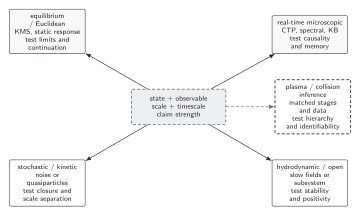
A declared state, observable, scale, and evidence requirement select among equilibrium, real-time, stochastic or kinetic, hydrodynamic or open, and plasma or collision-inference descriptions; each exit retains its own failure test. Solid connections show the primary relation; dashed outlines or arrows mark qualifications and failure boundaries. The diagram is schematic and not to scale.
The surrounding discussion supplies the relevant equations and checks in text form; the figure is a navigational summary.
Check your preparation
Section titled “Check your preparation”You are prepared for the core route if you can
- distinguish time-ordered, retarded, advanced, Wightman, and spectral correlators;
- derive a response by differentiating a normalized generating functional;
- explain why the thermodynamic and long-time limits may not commute;
- identify a conserved current and its susceptibility;
- perform power counting with more than one momentum scale; and
- read a covariance matrix or uncertainty band without inferring model uniqueness.
If one item is unfamiliar, follow its linked prerequisite from the first chapter that uses it. The chapter overviews state both required and helpful background and finish with concrete mastery checks.
References
Section titled “References”- Berges, Jürgen. “Introduction to Nonequilibrium Quantum Field Theory.” AIP Conference Proceedings 739 (2004): 3–62. doi:10.1063/1.1843591.
- Kamenev, Alex. Field Theory of Non-Equilibrium Systems. Cambridge: Cambridge University Press, 2011. doi:10.1017/CBO9781139003667.
- Kovtun, Pavel. “Lectures on Hydrodynamic Fluctuations in Relativistic Theories.” Journal of Physics A: Mathematical and Theoretical 45, no. 47 (2012): 473001. doi:10.1088/1751-8113/45/47/473001.
- Laine, Mikko, and Aleksi Vuorinen. Basics of Thermal Field Theory: A Tutorial on Perturbative Computations. Lecture Notes in Physics 925. Cham: Springer, 2016. doi:10.1007/978-3-319-31933-9.
- Landsman, N. P., and Ch. G. van Weert. “Real- and Imaginary-Time Field Theory at Finite Temperature and Density.” Physics Reports 145, nos. 3–4 (1987): 141–249. doi:10.1016/0370-1573(87)90121-9.
Original QFT.org content:CC BY 4.0, unless an item supplies different terms. Third-party material retains its own terms.